
Velvety Fruit-eating Bat
Enchisthenes hartii
Red List assessment
Least Concernon the IUCN Red List
- EXExtinct
- EWExtinct in the Wild
- CRCritically Endangered
- ENEndangered
- VUVulnerable
- NTNear Threatened
- LCLeast Concern
The Velvety Fruit-eating Bat is recorded in 13 countries across North America and South America. The IUCN Red List assesses the Velvety Fruit-eating Bat as Least Concern. No precise global population estimate is available.
- Family
- Phyllostomidae
- Order
- Chiroptera
- Genus
- Enchisthenes
- Countries recorded
- 13
- Continents
- North America and South America
- Red List category
- Least Concern
- Data updated
- August 9, 2026
What is the Velvety Fruit-eating Bat?
Enchisthenes hartii is a small, frugivorous bat and the sole member of the genus Enchisthenes within the family Phyllostomidae (New World leaf-nosed bats). It is named after ornithologist and naturalist Jonathan C. Hart and is recognized for its exceptionally soft, velvety dark fur that distinguishes it from its relatives. It inhabits tropical and subtropical forests from Mexico to northern South America, playing an important ecological role as a seed disperser. Its placement in a monotypic genus reflects distinct morphological and molecular characteristics that separate it from the closely related Artibeus species.
Where does the Velvety Fruit-eating Bat live?
Mexico, Central America (Guatemala, Belize, Honduras, El Salvador, Nicaragua, Costa Rica, Panama), and northern South America (Colombia, Venezuela, Ecuador, Peru, Bolivia, Trinidad)
Ranges from southern Mexico (Oaxaca, Chiapas, Veracruz) through all of Central America (Guatemala, Belize, Honduras, El Salvador, Nicaragua, Costa Rica, Panama) into northern South America, including Colombia, Venezuela, Trinidad, Ecuador, Peru, and Bolivia.
Altitude and depth
Found from near sea level up to approximately 2,000–2,500 m elevation, with a notable presence in foothill and lower montane forest zones.
Seasonal movements
No long-distance migrations are known. Activity and foraging behavior may shift seasonally in response to fruiting patterns of key plant species, but the species remains resident year-round throughout its range.
Habitat of the Velvety Fruit-eating Bat
Primarily inhabits humid tropical and subtropical forests, including lowland rainforests, montane cloud forests, and forest edges. It shows a preference for areas with abundant fruiting trees and can also exploit secondary forest and disturbed habitats adjacent to primary forest.
Adaptations to its environment
Its distinctively velvety, dense fur may provide thermoregulatory advantages in cooler montane environments. Like other phyllostomid bats, it possesses a well-developed noseleaf used for echolocation, and its robust jaw musculature is adapted for processing hard-skinned fruits. Its relatively large eyes aid navigation in low-light, dense forest understory.
Conservation status and numbers
Least Concern (LC) on the IUCN Red List. The species has a wide geographic range, tolerates some degree of habitat disturbance, and is not believed to be experiencing population declines severe enough to warrant a more threatened category.
Estimated population
No precise global population estimate is available. The species is considered locally uncommon to moderately common across its range, with population trend presumed stable overall.
What threatens the Velvety Fruit-eating Bat?
The primary threats are deforestation and habitat degradation due to agricultural expansion, logging, and urbanization, particularly in montane forest zones. Fragmentation of forest habitats can reduce connectivity between populations. Climate change may alter the distribution and phenology of fruiting trees that the bat depends on.
Diseases and parasites
Like most bats, it may harbor ectoparasites such as bat flies (Streblidae) and mites. As a phyllostomid bat, it is a potential host for various blood parasites (Haemosporidians). It may also carry coronaviruses and other viruses common to chiropteran hosts, though specific studies on this species are limited.
What is being done to protect it?
The species benefits from protection within numerous national parks and biological reserves throughout its range, such as La Amistad International Park (Costa Rica/Panama) and various protected areas in Mexico and Colombia. It is covered under general wildlife protection laws in most countries within its range.
Recommended actions
Priority actions include maintaining and expanding protected area networks in montane forest zones, reducing illegal deforestation, conducting more systematic population surveys to better understand abundance and distribution, and monitoring the effects of climate change on fruiting tree phenology critical to this species.
What the Velvety Fruit-eating Bat looks like
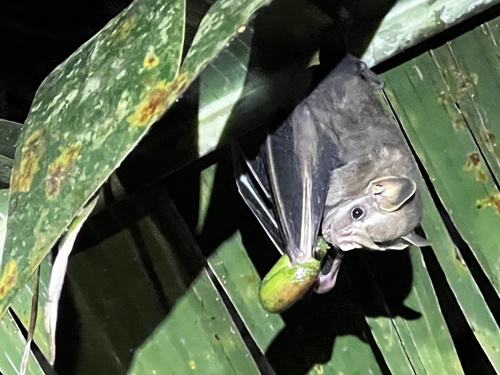
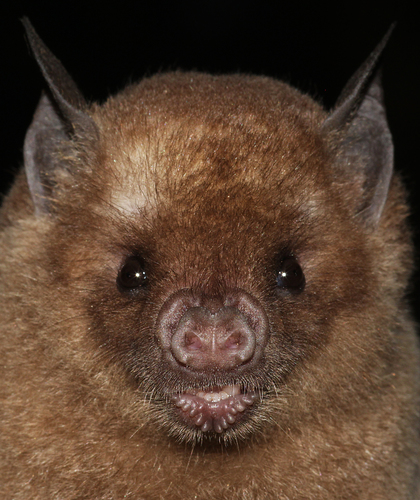
The fur is characteristically dark brown to blackish and notably soft and velvety in texture, giving the species its common name. It displays faint whitish facial stripes — a median dorsal stripe on the head and lateral facial stripes above and below the eye — though these are less pronounced than in many Artibeus relatives. The noseleaf is short and well-defined, and the ears are short and dark.
Size
Body length approximately 55–70 mm; forearm length approximately 38–45 mm; wingspan estimated at 28–35 cm. There is no externally visible tail.
Weight
Typically 12–20 grams; no marked sexual size dimorphism is reported, though females may be slightly heavier when pregnant.
Distinctive features
Distinguished from related Artibeus species by its exceptionally velvety, dark fur, its notably small size, and subtle molecular and morphological characters. The posterior palate is shorter than in most Artibeus, and the overall fur texture is a reliable field character. Genetic analysis clearly separates it from all Artibeus species.
Differences between males and females
Sexual dimorphism is minimal. Females may be slightly larger or heavier during reproductive periods, but there is no notable difference in fur color or external morphology between the sexes.
Behaviour and diet of the Velvety Fruit-eating Bat
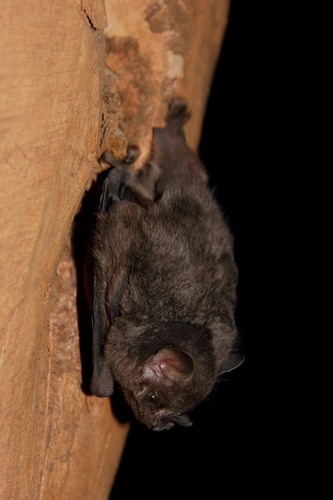
Generally roosts in small groups, often among foliage or in tree hollows. Like many phyllostomid bats, it may form small harem groups or roost in mixed-sex clusters, but large colonies are not typical of this species.
When it is active
Strictly nocturnal. Foraging activity begins shortly after dusk and continues through the night, with peak activity typically in the early nighttime hours when fruiting resources are exploited.
Diet
Primarily frugivorous, feeding on a wide variety of soft tropical fruits, particularly figs (Ficus spp.) and other small-seeded fruits. It likely supplements its diet with nectar, pollen, and occasional insects, as is common among phyllostomid bats.
How it feeds and hunts
Forages by flying through the forest understory and canopy to locate ripe fruits, using both echolocation and olfaction. Once a fruit is detected, the bat may carry it to a feeding roost to consume it, which aids in seed dispersal away from the parent plant.
Communication
Uses echolocation for navigation and obstacle avoidance; calls are relatively low-intensity and frequency-modulated, typical of forest-dwelling phyllostomids. Social communication involves high-frequency vocalizations within roost groups and possibly scent signals.
Interactions with other species
Predated upon by owls (e.g., Ciccaba virgata, Tyto alba), snakes, and small carnivorous mammals. It competes with other frugivorous bats, particularly Artibeus species, for fruiting resources. As a seed disperser for tropical fruits, it has important mutualistic relationships with a variety of plant species.
Role in its ecosystem
Plays a key ecological role as a seed disperser in tropical and montane forests. By consuming fruits and defecating seeds at distance from parent trees, it contributes to forest regeneration and plant diversity, particularly in fragmented landscapes where other dispersers may be absent.
Reproduction and lifecycle
Breeding biology is not thoroughly documented for this species. Like many tropical phyllostomid bats, it likely exhibits a bimodal polyestrous pattern, potentially producing one or two offspring per year. Gestation in related Artibeus species is approximately 3–4 months.
Raising the young
As is typical in bats, the mother provides sole parental care. The single pup is carried by the mother initially and then left at the roost while she forages. Weaning likely occurs after several weeks, with juveniles becoming volant (capable of flight) at approximately 4–6 weeks of age.
Maturity and lifespan
Sexual maturity is likely reached at approximately 6–12 months of age, as in related species. Lifespan in the wild is estimated at 5–10 years, though data specific to this species are lacking; related bats in captivity can live over 10 years.
Taxonomy and naming of the Velvety Fruit-eating Bat
Classification
Mammalia > Chiroptera > Phyllostomidae > Enchisthenes > Enchisthenes hartii
Scientific synonyms
Artibeus hartii Thomas, 1892 — formerly placed within the genus Artibeus before being separated into the monotypic genus Enchisthenes.
What research says
Recent studies
Recent molecular phylogenetic analyses of the tribe Stenodermatini have helped clarify the evolutionary position of Enchisthenes hartii and confirmed its separation from Artibeus. Studies on bat diversity in Central American montane forests have occasionally recorded this species and contributed occurrence data to biodiversity databases.
Genome and DNA
The exact chromosome number is not well documented for Enchisthenes hartii specifically. Molecular phylogenetic studies (e.g., using cytochrome b and nuclear markers) have confirmed its status as a distinct monotypic genus within the tribe Stenodermatini of Phyllostomidae.
Compared with similar species
Most closely related to species within the genus Artibeus (e.g., Artibeus jamaicensis, Artibeus lituratus), from which it was separated based on smaller body size, velvety fur texture, shorter posterior palate, and molecular divergence. It is smaller and darker than most Artibeus species and lacks the bold white facial stripes characteristic of many of them.
The Velvety Fruit-eating Bat and people
The Velvety Fruit-eating Bat is the sole species in its entire genus, making it a 'monotypic' genus — a remarkable evolutionary lineage with no living close relatives. Its fur has an unusually soft, velvety texture unlike most other bats, which inspired its common name. Like many frugivorous bats, it can carry seeds in its gut across hundreds of meters, effectively acting as a 'flying gardener' replanting the tropical forest.
Where and how to see it
Best observed at night in humid montane and lowland forests from Mexico to Bolivia. Mist-netting surveys near fruiting fig trees or fruiting forest edges are the most reliable method of encounter. Cloud forest zones in Costa Rica (e.g., Monteverde) and Panama offer good opportunities during the dry season when bat activity near fruiting trees is high.
Risks to humans
No notable risk to humans. Like all bats, it could theoretically carry rabies virus, so direct handling without proper protective equipment should be avoided. It poses no aggressive threat under natural conditions.
Countries where the Velvety Fruit-eating Bat is recorded
The 13 countries named in the range description of its IUCN Red List assessment.
Questions about the Velvety Fruit-eating Bat
Where does the Velvety Fruit-eating Bat live?
The Velvety Fruit-eating Bat is recorded in Belize, Bolivia, Colombia, Costa Rica and Ecuador, among 13 countries in total across North America and South America. These countries come from the range description of its IUCN Red List assessment, and they are what place the species on the interactive map.
Is the Velvety Fruit-eating Bat endangered?
The IUCN Red List assesses the Velvety Fruit-eating Bat as Least Concern. The species is widespread and abundant enough not to qualify for any threatened category. It does not mean the species is safe forever, only that nothing in the current data raises an alarm.
How many are left in the wild?
No precise global population estimate is available. This figure comes from the species assessment on the IUCN Red List; population estimates for wild mammals are ranges, not counts, and are revised at each assessment.
What habitat does the Velvety Fruit-eating Bat live in?
Primarily inhabits humid tropical and subtropical forests, including lowland rainforests, montane cloud forests, and forest edges.
What is the scientific name of the Velvety Fruit-eating Bat?
The Velvety Fruit-eating Bat is Enchisthenes hartii, in the family Phyllostomidae, order Chiroptera.
Other species in the family Phyllostomidae
Species that share its range
Sources
Conservation status, range description and population estimate come from the IUCN Red List assessment for Enchisthenes hartii. Countries are derived from that range description, not from a mapped country list. Last refreshed on .
The distribution map is drawn from the IUCN Red List spatial data compiled in 2008. IUCN (International Union for Conservation of Nature)