
Brown Fruit-eating Bat
Artibeus concolor
Red List assessment
Least Concernon the IUCN Red List
- EXExtinct
- EWExtinct in the Wild
- CRCritically Endangered
- ENEndangered
- VUVulnerable
- NTNear Threatened
- LCLeast Concern
The Brown Fruit-eating Bat is recorded in 9 countries across South America. The IUCN Red List assesses the Brown Fruit-eating Bat as Least Concern. No precise global population estimate is available.
- Family
- Phyllostomidae
- Order
- Chiroptera
- Genus
- Artibeus
- Countries recorded
- 9
- Continents
- South America
- Red List category
- Least Concern
- Data updated
- August 9, 2026
What is the Brown Fruit-eating Bat?
Artibeus concolor is a medium-to-large Neotropical leaf-nosed bat belonging to the family Phyllostomidae, native to lowland tropical forests of northern South America. It is primarily frugivorous, with a strong preference for figs (Ficus spp.) and other soft fruits, playing a vital ecological role as a seed disperser across Amazonian and adjacent forest ecosystems. Unlike many of its congeners, it lacks conspicuous white facial stripes, appearing uniformly brown, which distinguishes it visually within the genus. It is considered a fairly common species throughout its range and is classified as Least Concern by the IUCN.
Where does the Brown Fruit-eating Bat live?
Northern South America: Colombia, Venezuela, Trinidad, Guyana, Suriname, French Guiana, northern and central Brazil (especially Amazonia), Ecuador, Peru, and Bolivia
Found across northern and central South America: Colombia (east of the Andes), Venezuela, Trinidad, Guyana, Suriname, French Guiana, Brazil (mainly Amazonian states such as Amazonas, Pará, Roraima, Rondônia), Ecuador, Peru, and Bolivia. Its core range is centered on the Amazon Basin.
Altitude and depth
Typically found from sea level up to approximately 1,000 m elevation, most commonly in lowland Amazonian forests below 500 m.
Seasonal movements
No significant seasonal migration has been documented. Breeding and foraging activity may intensify during periods of peak fruit availability, which varies locally. Like most tropical bats, it remains active year-round without hibernation.
Habitat of the Brown Fruit-eating Bat
Primarily occupies lowland tropical rainforests, both primary and secondary growth, as well as gallery forests, forest edges, and occasionally disturbed habitats near human settlements. It shows a strong association with areas containing fruiting fig trees and other fruit-producing tropical trees.
Adaptations to its environment
Possesses a well-developed noseleaf (phyllostome) that enhances echolocation precision for navigating dense forest understory. Its robust dentition and strong jaw musculature are adapted for processing hard-skinned tropical fruits. Relatively low-intensity echolocation is supplemented by olfactory and visual cues to locate ripe fruit.
Conservation status and numbers
Least Concern (LC) on the IUCN Red List. The species has a wide distribution, is reasonably tolerant of secondary habitats, and does not appear to face significant population declines at a global scale. Local threats exist but are not considered sufficient to warrant a more threatened category.
Estimated population
No precise global population estimate is available. The species is considered relatively common within its range; population trend is presumed stable, though localized declines may occur in heavily deforested areas.
What threatens the Brown Fruit-eating Bat?
Deforestation and habitat fragmentation driven by agricultural expansion (soy, cattle ranching) and logging in the Amazon Basin represent the primary threats. Hunting pressure is minimal, but large-scale forest loss could reduce local population viability over time.
Diseases and parasites
Can serve as a reservoir or carrier of rabies virus, as is common among many bat species, though transmission to humans is rare. Frequently parasitized by ectoparasitic bat flies (family Streblidae) and mites. May carry internal parasites including nematodes and trypanosomes.
What is being done to protect it?
The species occurs within numerous protected areas across its range, including Amazonian national parks and biological reserves in Brazil, Peru, Colombia, and Venezuela. It benefits indirectly from broad Amazonian conservation efforts, including ARPA (Amazon Region Protected Areas) in Brazil.
Recommended actions
Continued monitoring of populations in deforestation hotspots along the Amazon arc is recommended. Maintaining forest connectivity through wildlife corridors would benefit this and many other frugivorous bat species. Research into population genetics across its range would clarify conservation priorities.
What the Brown Fruit-eating Bat looks like
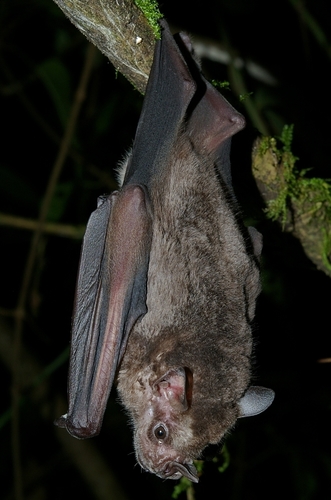
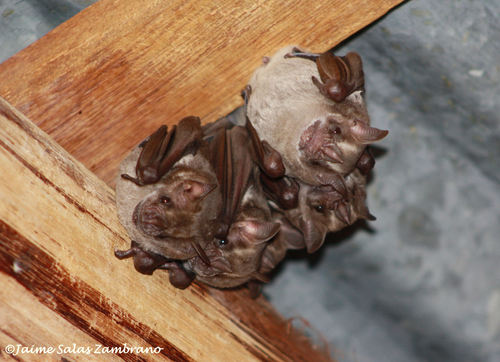
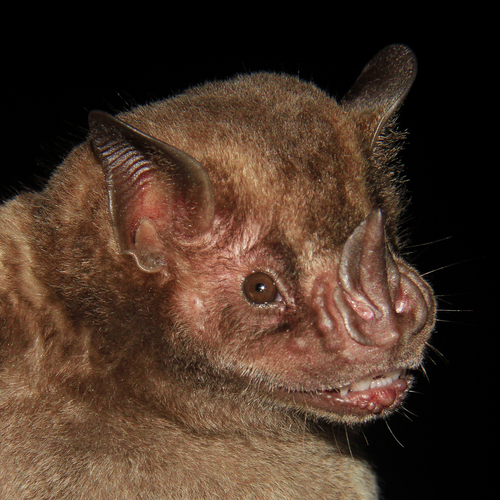
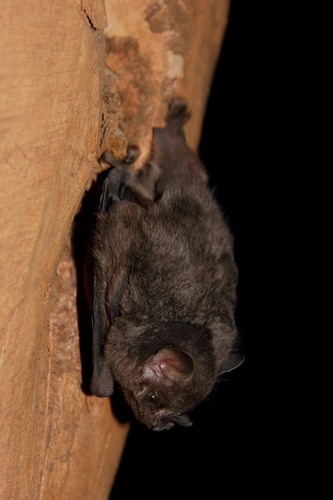
Dorsal fur is uniformly medium to dark brown, fading to paler grayish-brown on the ventral surface. The face features a well-developed, lanceolate noseleaf and large rounded ears. The wing membranes are dark brownish-black and leathery. The interfemoral (tail) membrane is narrow and the tail is absent or extremely vestigial.
Size
Forearm length approximately 57–64 mm; total body length roughly 75–90 mm. Wingspan estimated at 35–45 cm. No external tail is visible.
Weight
Approximately 40–65 g; sexual dimorphism in weight is modest, with females sometimes slightly heavier, especially when pregnant or lactating.
Distinctive features
The most important visual distinction from closely related species such as Artibeus jamaicensis and Artibeus lituratus is the complete absence of white facial stripes. Its uniformly brown coloration and relatively large body size help separate it from smaller stripe-faced Artibeus species such as A. watsoni.
Differences between males and females
Sexual dimorphism is limited. Females may be marginally larger or heavier than males, particularly during pregnancy and lactation, which is typical of the genus. No notable differences in pelage coloration between sexes.
Behaviour and diet of the Brown Fruit-eating Bat
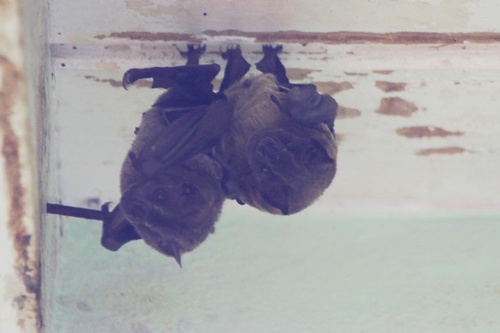
Typically roosts in small groups; males may form harem-based social groups with several females, a pattern common across Artibeus. Roosts are found in tree hollows, dense foliage, or under large leaves. Group sizes generally range from a few individuals to small colonies of 10–20.
When it is active
Strictly nocturnal. Foraging activity typically begins shortly after sunset and may continue through much of the night, with peaks coinciding with periods of high fruit availability in the forest canopy and sub-canopy.
Diet
Primarily frugivorous, with a strong preference for figs (Ficus spp.), which form a dietary staple. Also consumes other soft tropical fruits, pollen, and nectar opportunistically. Occasional ingestion of insects for protein supplementation may occur.
How it feeds and hunts
Locates ripe fruit using a combination of echolocation (low-intensity, high-frequency pulses), olfaction (detecting volatile compounds from ripe fruit), and visual cues. Plucks fruit in flight or while briefly hovering, then carries it to a feeding roost to consume.
Communication
Uses ultrasonic echolocation calls for spatial navigation and potentially for social signaling. Produces audible social vocalizations (squeaks and chirps) within roost groups to maintain social cohesion and mediate agonistic interactions. Scent glands may play a role in social and reproductive communication.
Interactions with other species
As a frugivore and seed disperser, it has mutualistic relationships with numerous tropical tree species, especially Ficus. Natural predators include arboreal snakes, owls (e.g., Ciccaba virgata), and felids near roosting sites. It competes with other frugivorous bats (e.g., Carollia, Sturnira) and birds for fruit resources. Bat flies (Streblidae) are common ectoparasites.
Role in its ecosystem
Plays a critical ecological role as a seed disperser for tropical trees, contributing to forest regeneration and canopy diversity. By consuming and transporting seeds of fig trees and other fleshy-fruited plants across large distances, it supports the structural integrity and diversity of Amazonian forest ecosystems.
Reproduction and lifecycle
Like other Artibeus, likely exhibits a bimodal polyestrous reproductive pattern, with two birth peaks per year aligned with periods of resource abundance. Gestation lasts approximately 3.5–4 months. Litter size is typically one pup.
Raising the young
Mothers provide extended parental care; pups are carried initially and then left at the roost while the mother forages. Weaning occurs at approximately 1.5–2 months of age. Paternal care is minimal or absent, as is typical in harem-based bat societies.
Maturity and lifespan
Sexual maturity is likely reached within the first year of life, consistent with other Artibeus species. Wild lifespan is estimated at 5–10 years; captive individuals of congeners have lived up to 10–12 years.
Taxonomy and naming of the Brown Fruit-eating Bat
Classification
Mammalia > Chiroptera > Phyllostomidae > Artibeus > Artibeus concolor (Peters, 1865)
Scientific synonyms
Sometimes referred to as Koopmania concolor in older taxonomy, reflecting earlier placement in the subgenus Koopmania. Artibeus concolor Peters, 1865 remains the accepted name.
What research says
Recent studies
Molecular phylogeographic studies of Amazonian bat communities have included A. concolor to assess diversification patterns related to Pleistocene refugia and Amazonian rivers as biogeographic barriers. Dietary niche studies have highlighted its role in fig-seed dispersal networks in western Amazonia.
Genome and DNA
The karyotype of Artibeus concolor has not been definitively published in wide circulation; related species in the genus typically have diploid chromosome counts of 2n = 30–32. Phylogenetic molecular studies have confirmed its placement within a clade of large-bodied Artibeus alongside A. jamaicensis and A. lituratus.
Compared with similar species
Artibeus concolor closely resembles A. jamaicensis and A. lituratus but is distinguished by the absence of facial stripes. Compared to A. lituratus (Great Fruit-eating Bat), A. concolor is typically smaller and more uniformly brown. Compared to A. obscurus (Dark Fruit-eating Bat), it is generally slightly larger with a less sooty coloration.
The Brown Fruit-eating Bat and people
The Brown Fruit-eating Bat can consume its own body weight in fruit in a single night of foraging, making it a remarkably efficient seed-dispersal machine. Despite feeding primarily on figs, it processes the fruit so quickly that seeds pass through its gut intact and viable, sometimes being deposited kilometers from the parent tree. The lack of white facial stripes in this species — unusual among large Artibeus — initially led early taxonomists to debate its relationship to the rest of the genus.
Where and how to see it
Best observed at dusk in lowland Amazonian forests near fruiting fig trees or forest edges in Brazil (especially around Manaus), Venezuela, and Peru. Mist-netting studies and bat-detector transects conducted by researchers in protected areas such as Reserva Ducke (INPA, Manaus) frequently record this species. Guided ecotourism bat surveys in Amazon lodges offer occasional sighting opportunities.
Risks to humans
Minimal risk under normal circumstances. As with all wild bats, handling without proper protective equipment should be avoided due to the theoretical risk of rabies transmission. No venom. Not aggressive toward humans.
Countries where the Brown Fruit-eating Bat is recorded
The 9 countries named in the range description of its IUCN Red List assessment.
Questions about the Brown Fruit-eating Bat
Where does the Brown Fruit-eating Bat live?
The Brown Fruit-eating Bat is recorded in Bolivia, Brazil, Colombia, Ecuador and French Guiana, among 9 countries in total across South America. These countries come from the range description of its IUCN Red List assessment, and they are what place the species on the interactive map.
Is the Brown Fruit-eating Bat endangered?
The IUCN Red List assesses the Brown Fruit-eating Bat as Least Concern. The species is widespread and abundant enough not to qualify for any threatened category. It does not mean the species is safe forever, only that nothing in the current data raises an alarm.
How many are left in the wild?
No precise global population estimate is available. This figure comes from the species assessment on the IUCN Red List; population estimates for wild mammals are ranges, not counts, and are revised at each assessment.
What habitat does the Brown Fruit-eating Bat live in?
Primarily occupies lowland tropical rainforests, both primary and secondary growth, as well as gallery forests, forest edges, and occasionally disturbed habitats near human settlements.
What is the scientific name of the Brown Fruit-eating Bat?
The Brown Fruit-eating Bat is Artibeus concolor, in the family Phyllostomidae, order Chiroptera.
Other species in the genus Artibeus
Other species in the family Phyllostomidae
Sources
Conservation status, range description and population estimate come from the IUCN Red List assessment for Artibeus concolor. Countries are derived from that range description, not from a mapped country list. Last refreshed on .
The distribution map is drawn from the IUCN Red List spatial data compiled in 2008. IUCN (International Union for Conservation of Nature)