
Andersen's Fruit-eating Bat
Dermanura anderseni
Red List assessment
Least Concernon the IUCN Red List
- EXExtinct
- EWExtinct in the Wild
- CRCritically Endangered
- ENEndangered
- VUVulnerable
- NTNear Threatened
- LCLeast Concern
The Andersen's Fruit-eating Bat is recorded in 5 countries across South America. The IUCN Red List assesses the Andersen's Fruit-eating Bat as Least Concern. No precise global population estimate is available.
- Family
- Phyllostomidae
- Order
- Chiroptera
- Genus
- Dermanura
- Countries recorded
- 5
- Continents
- South America
- Red List category
- Least Concern
- Data updated
- August 9, 2026
What is the Andersen's Fruit-eating Bat?
Andersen's Fruit-eating Bat is a small phyllostomid bat first described by Osgood in 1916 and named in honor of the Danish zoologist Knud Andersen. It inhabits tropical and subtropical moist forests in the foothills and montane zones of western South America, particularly in the Yungas and adjacent lowland regions. Like all members of the genus Dermanura, it is primarily frugivorous and plays a significant ecological role as a seed disperser in its forest ecosystem. It is considered a relatively little-studied species, with much of what is known about it inferred from closely related congeners.
Where does the Andersen's Fruit-eating Bat live?
Western South America, primarily Bolivia, Peru, Ecuador, and western Brazil (upper Amazon basin)
The species is known from Bolivia (La Paz and Cochabamba departments, particularly the Yungas slopes), Peru (eastern Andes foothills), Ecuador, and likely parts of western Brazil and Colombia. The known specimen coordinates fall within the Bolivian Yungas near Coroico.
Altitude and depth
Typically recorded between 200 and 1,500 m above sea level, though may occasionally range slightly higher in the Yungas transitional zones.
Seasonal movements
No documented long-distance seasonal migrations. Activity patterns may shift subtly with fruiting seasons of key food plants. Like many tropical bats, populations likely remain resident year-round within their forest home ranges.
Habitat of the Andersen's Fruit-eating Bat
Primary habitat includes tropical and subtropical moist lowland forests as well as foothill forests (Yungas-type vegetation). It favors areas with dense fruiting vegetation, including secondary forests and forest edges. It is rarely found in open or heavily degraded habitats.
Adaptations to its environment
Possesses a well-developed noseleaf (rostral lance), a hallmark of Phyllostomidae, which enhances echolocation in dense forest environments. Its dentition is adapted for processing soft fruits, with robust molars capable of crushing seeds. Reduced tail and uropatagium allow for agile maneuvering in cluttered forest understory.
Conservation status and numbers
Listed as Least Concern (LC) on the IUCN Red List. The species is presumed to have a sufficiently large and stable population, and its range encompasses multiple protected areas. No major quantified population decline has been documented across three generations.
Estimated population
No precise global population estimate is available. The species is considered uncommon to moderately common within its range; population trend is presumed stable, though data are limited.
What threatens the Andersen's Fruit-eating Bat?
The primary threats are deforestation and habitat degradation through agricultural expansion (particularly coca cultivation and cattle ranching) in the Yungas and Amazonian foothills. Climate change may also alter the phenology of fruiting trees upon which the species depends.
Diseases and parasites
Like other Neotropical bats, it is susceptible to streblid bat flies (Streblidae) and other ectoparasites. It may carry coronaviruses and other viruses typical of phyllostomid bats, though no specific pathogen study on this species has been published.
What is being done to protect it?
The species likely benefits from protection within existing national parks and reserves in Bolivia (e.g., Madidi National Park, Cotapata National Park) and Peru. No species-specific conservation program is known to target D. anderseni.
Recommended actions
Priority actions include systematic field surveys to clarify distribution and population size, long-term monitoring in protected areas, and preservation of intact Yungas forest corridors. Further taxonomic and ecological studies are needed to distinguish it more reliably from congeners.
What the Andersen's Fruit-eating Bat looks like
Dorsal fur is typically tricolored — dark brownish at the base, with a paler middle band and darker tips — giving an overall medium-brown appearance. The ventral surface is paler, grayish-white. A prominent white noseleaf is present, and the ears are relatively short and rounded. The uropatagium is narrow, reflecting the reduced tail typical of the genus.
Size
Small bat; forearm length approximately 37–43 mm; total body length roughly 55–70 mm; wingspan estimated at 25–30 cm.
Weight
Estimated body mass between 10 and 18 g, typical for small Dermanura species; no significant documented sexual size difference.
Distinctive features
Dermanura anderseni is distinguished from closely related species (e.g., D. gnoma, D. phaeotis) by subtle differences in skull morphology, forearm length, and fur coloration. Compared to D. gnoma, it tends to be slightly larger with a somewhat more robust rostrum; however, reliable identification often requires craniodental measurements.
Differences between males and females
Sexual dimorphism is minimal; females may be marginally larger than males (as is common across many bat species), but differences are not reliably distinguishable in the field.
Behaviour and diet of the Andersen's Fruit-eating Bat
Likely roosts in small groups in foliage or tree cavities, consistent with other Dermanura species. Some Dermanura form small harem groups with one dominant male and several females; this social structure is probable for D. anderseni but not confirmed by specific studies.
When it is active
Strictly nocturnal. Foraging activity begins shortly after sunset, with peak activity in the first few hours of the night when ripe fruits are most accessible.
Diet
Primarily frugivorous, feeding on a wide variety of soft tropical fruits. Figs (Ficus spp.) are likely a dietary staple, as with most Dermanura. It may also occasionally consume nectar, pollen, or insects as supplementary food sources.
How it feeds and hunts
Locates fruiting trees using a combination of echolocation (low-duty-cycle, frequency-modulated calls) and olfaction. It plucks fruits in flight or while briefly hovering, then typically carries them to a nearby feeding roost to consume them.
Communication
Echolocation calls are used for orientation and obstacle avoidance in dense forest; social vocalizations (including contact calls) are used within roost groups. Scent glands may play a role in intraspecific communication, particularly in establishing harem group dynamics.
Interactions with other species
Potential predators include owls (Strigiformes), small felids, and arboreal snakes. It likely competes with other frugivorous bats (e.g., Artibeus, Sturnira) for fruit resources. As a seed disperser, it has mutualistic relationships with numerous fruiting plant species whose seeds survive gut passage.
Role in its ecosystem
Andersen's Fruit-eating Bat is an important seed disperser in Neotropical forest ecosystems. By transporting seeds away from parent trees, it promotes forest regeneration and plant diversity. It may also contribute to pollination of certain night-blooming plants.
Reproduction and lifecycle
Like most Phyllostomidae in tropical South America, D. anderseni likely exhibits bimodal polyestry, with two reproductive peaks per year aligned with seasonal fruiting abundance. Gestation is estimated at approximately 3–4 months, with one pup per birth.
Raising the young
The mother provides sole parental care. Pups are initially carried by the mother during foraging and are left at the roost as they grow. Weaning likely occurs at 1.5–2 months of age, consistent with other small frugivorous phyllostomids.
Maturity and lifespan
Sexual maturity is likely reached at 6–12 months of age. Lifespan in the wild is estimated at 5–10 years; data from captivity are unavailable for this species specifically.
Taxonomy and naming of the Andersen's Fruit-eating Bat
Classification
Mammalia > Chiroptera > Phyllostomidae > Dermanura > Dermanura anderseni
Scientific synonyms
Artibeus anderseni Osgood, 1916 — formerly placed in the genus Artibeus before the genus Dermanura was formally separated.
What research says
Recent studies
The taxonomic separation of Dermanura from Artibeus, supported by molecular phylogenetic studies in the 2000s and 2010s (e.g., work by Redondo et al. and others), helped clarify the status of D. anderseni as a distinct species. Detailed ecological studies specific to this species remain scarce.
Genome and DNA
Chromosome number for the genus Dermanura is typically 2n = 30–31, consistent with other stenodermatine bats, though a confirmed karyotype for D. anderseni specifically has not been published to my knowledge.
Compared with similar species
Dermanura anderseni is most similar to D. gnoma (Gnome Fruit-eating Bat) and D. phaeotis (Pygmy Fruit-eating Bat), differing in forearm length and craniodental proportions. Compared to the larger Artibeus jamaicensis, it is substantially smaller and has a less robust skull.
The Andersen's Fruit-eating Bat and people
1) Like many frugivorous bats, D. anderseni can disperse seeds several kilometers from the parent plant, making it a 'flying gardener' essential to forest regeneration. 2) The genus Dermanura was once lumped with the large genus Artibeus, and separating them required detailed molecular analysis — showing that even well-studied bat groups still harbor hidden evolutionary diversity. 3) The specific epithet 'anderseni' honors Knud Andersen (1867–1916), a pioneering Danish chiropterologist who compiled a landmark catalog of bats — making this species a tribute to one of the founding figures of bat science.
Where and how to see it
The best chance of observing this species is at night in the Bolivian Yungas, such as near Coroico (La Paz Department) or in Madidi National Park, using mist nets set at forest edges near fruiting fig trees. Local bat researchers and bioacoustics surveys may also help detect the species. The dry season (May–September) often facilitates access to Yungas trails.
Risks to humans
No notable risk. Like all bats, it could theoretically transmit pathogens if mishandled, so direct handling without protective equipment is inadvisable for non-specialists.
Countries where the Andersen's Fruit-eating Bat is recorded
The 5 countries named in the range description of its IUCN Red List assessment.
Questions about the Andersen's Fruit-eating Bat
Where does the Andersen's Fruit-eating Bat live?
The Andersen's Fruit-eating Bat is recorded in Bolivia, Brazil, Colombia, Ecuador and Peru across South America. These countries come from the range description of its IUCN Red List assessment, and they are what place the species on the interactive map.
Is the Andersen's Fruit-eating Bat endangered?
The IUCN Red List assesses the Andersen's Fruit-eating Bat as Least Concern. The species is widespread and abundant enough not to qualify for any threatened category. It does not mean the species is safe forever, only that nothing in the current data raises an alarm.
How many are left in the wild?
No precise global population estimate is available. This figure comes from the species assessment on the IUCN Red List; population estimates for wild mammals are ranges, not counts, and are revised at each assessment.
What habitat does the Andersen's Fruit-eating Bat live in?
Primary habitat includes tropical and subtropical moist lowland forests as well as foothill forests (Yungas-type vegetation).
What is the scientific name of the Andersen's Fruit-eating Bat?
The Andersen's Fruit-eating Bat is Dermanura anderseni, in the family Phyllostomidae, order Chiroptera.
Other species in the genus Dermanura
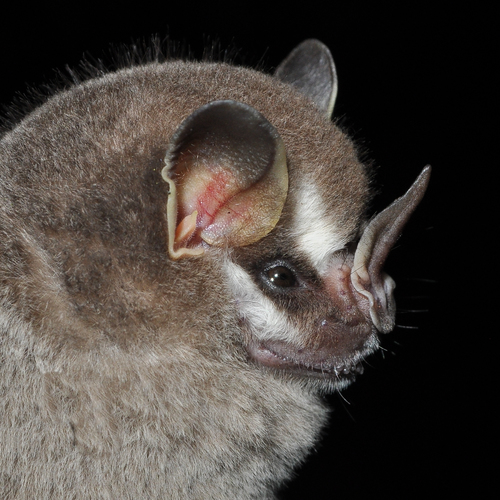
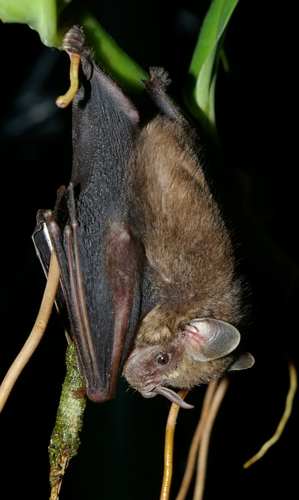
Other species in the family Phyllostomidae
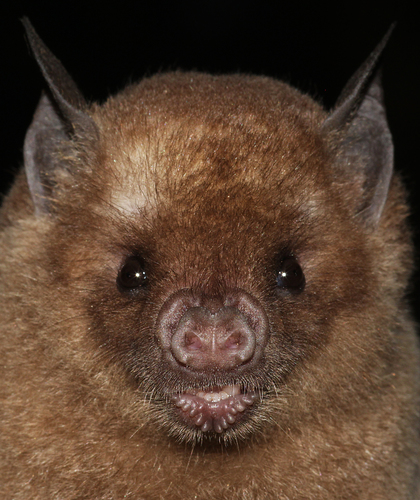
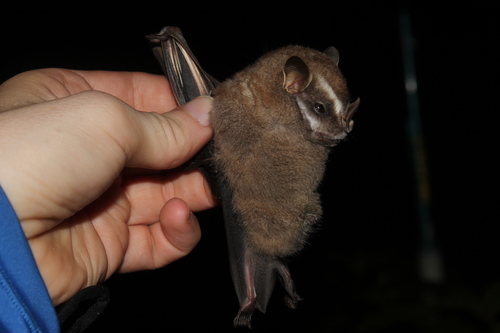
Sources
Conservation status, range description and population estimate come from the IUCN Red List assessment for Dermanura anderseni. Countries are derived from that range description, not from a mapped country list. Last refreshed on .
The distribution map is drawn from the IUCN Red List spatial data compiled in 2016. IUCN (International Union for Conservation of Nature)