
Brazilian Big-eyed Bat
Chiroderma doriae
Red List assessment
Least Concernon the IUCN Red List
- EXExtinct
- EWExtinct in the Wild
- CRCritically Endangered
- ENEndangered
- VUVulnerable
- NTNear Threatened
- LCLeast Concern
The Brazilian Big-eyed Bat is recorded in 3 countries across South America. The IUCN Red List assesses the Brazilian Big-eyed Bat as Least Concern. No precise global population estimate exists, but the species is considered locally common in suitable habitat; overall population trend is believed to be declining due to continued Atlantic Forest degradation.
- Family
- Phyllostomidae
- Order
- Chiroptera
- Genus
- Chiroderma
- Countries recorded
- 3
- Continents
- South America
- Red List category
- Least Concern
- Data updated
- August 9, 2026
What is the Brazilian Big-eyed Bat?
Chiroderma doriae is a medium-sized leaf-nosed bat endemic to the Atlantic Forest of Brazil, notable for its large eyes and distinctive facial stripes. It is a frugivorous species that plays an important ecological role in seed dispersal within its fragmented forest habitat. Despite habitat loss across its range, it remains classified as Least Concern due to its relatively wide distribution and tolerance of some habitat disturbance.
Where does the Brazilian Big-eyed Bat live?
Eastern Brazil, primarily in the Atlantic Forest biome, with records also in Paraguay and northeastern Argentina
Endemic to South America, with its core range in eastern and southeastern Brazil (states such as Bahia, Espírito Santo, Rio de Janeiro, São Paulo, and Minas Gerais). Marginal populations extend into eastern Paraguay and northeastern Argentina.
Altitude and depth
Typically found from sea level up to approximately 1000 meters elevation in Atlantic Forest habitats
Habitat of the Brazilian Big-eyed Bat
Primarily found in humid tropical and subtropical lowland and montane forests, especially within the Atlantic Forest biome. It also occurs in secondary growth forests and forest edges, showing some adaptability to disturbed habitats.
Adaptations to its environment
Possesses large eyes adapted for low-light foraging in dense forest understory, and a nose-leaf structure that aids in echolocation for navigation among vegetation. Its dentition is specialized for processing soft fruit pulp, allowing efficient exploitation of forest fruit resources.
Conservation status and numbers
Listed as Least Concern by the IUCN due to its relatively broad distribution across the Atlantic Forest and tolerance of some habitat modification, though populations are likely declining due to ongoing deforestation.
Estimated population
No precise global population estimate exists, but the species is considered locally common in suitable habitat; overall population trend is believed to be declining due to continued Atlantic Forest degradation.
What threatens the Brazilian Big-eyed Bat?
Habitat loss and fragmentation from deforestation for agriculture, urbanization, and logging are the primary threats. Pesticide use in agricultural areas may also affect food availability and bat health.
Diseases and parasites
Like other bats, may host ectoparasites such as bat flies (Streblidae) and endoparasites, though specific studies on this species' parasite load are limited.
What is being done to protect it?
The species benefits indirectly from protected areas within the Atlantic Forest Biosphere Reserve network, including several national parks and reserves in Brazil. It is not the target of species-specific conservation programs.
Recommended actions
Priority actions include preserving and restoring Atlantic Forest fragments, maintaining forest connectivity corridors, and conducting further population monitoring to better assess trends and habitat needs.
What the Brazilian Big-eyed Bat looks like
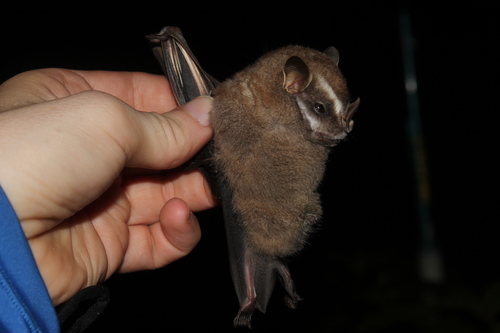
The fur is grayish-brown to brown on the dorsal side, often lighter on the underside, with a distinctive pale stripe running down the middle of the back. The face features prominent white or pale facial stripes and a well-developed nose-leaf typical of phyllostomid bats.
Size
Forearm length ranges from approximately 42-48 mm; total body length is typically around 55-65 mm.
Weight
Adults typically weigh between 15-20 grams, with no marked difference between sexes.
Distinctive features
Distinguished from other Chiroderma species by its larger size, distinct dorsal stripe, and specific dental characteristics used in taxonomic identification. Its notably large eyes relative to related bat genera also help distinguish it.
Behaviour and diet of the Brazilian Big-eyed Bat
Generally roosts in small groups, sometimes forming colonies of a few individuals to a couple dozen bats in tree cavities or dense foliage. Social structure within roosts is not well documented but appears to be non-hierarchical.
When it is active
Strictly nocturnal, emerging after dusk to forage for fruit and returning to roost sites before dawn.
Diet
Primarily frugivorous, feeding on a variety of forest fruits, with figs (Ficus spp.) being an important dietary component; may also consume nectar and pollen opportunistically.
How it feeds and hunts
Forages by flying through forest understory and canopy gaps, using echolocation combined with vision to locate ripe fruit; often plucks fruit in flight and carries it to a feeding perch to consume.
Communication
Communicates primarily through echolocation calls for navigation and possibly social calls between roost-mates; scent marking may also play a role in social and reproductive behavior.
Interactions with other species
Preyed upon by owls, hawks, and opportunistic mammalian predators; interacts with fruiting plants as a key seed disperser, forming a mutualistic relationship with several Atlantic Forest tree species.
Role in its ecosystem
Serves as an important seed disperser within the Atlantic Forest ecosystem, contributing to forest regeneration and plant community structure by spreading seeds of fig and other fruiting trees across the landscape.
Reproduction and lifecycle
Breeding likely occurs seasonally correlated with fruit abundance, though exact timing is not well documented; gestation is estimated at around 4-5 months based on related phyllostomid species, typically producing a single offspring per litter.
Raising the young
Females carry and nurse a single pup, which clings to the mother during early development; maternal care is the primary form of parental investment, as is typical for phyllostomid bats.
Maturity and lifespan
Sexual maturity is likely reached within the first year of life, consistent with similar-sized phyllostomid bats; lifespan in the wild is estimated at 5-10 years, though captive lifespan data is scarce.
Taxonomy and naming of the Brazilian Big-eyed Bat
Classification
Mammalia > Chiroptera > Phyllostomidae > Chiroderma > Chiroderma doriae
Scientific synonyms
Chiroderma dorianum (misspelling in some older literature)
What research says
Recent studies
Recent phylogenetic studies have helped clarify the taxonomic relationships within the genus Chiroderma, confirming C. doriae as a distinct species within the Atlantic Forest bat community, though detailed ecological studies remain limited.
Compared with similar species
Similar to other Chiroderma species like C. villosum and C. trinitatum, but distinguished by larger body size, more pronounced dorsal stripe, and restriction to the Atlantic Forest biome rather than Amazonian or Central American habitats.
The Brazilian Big-eyed Bat and people
Its large eyes are unusually prominent for a bat, giving rise to the common name 'big-eyed bat'; it plays a crucial hidden role in regenerating deforested areas of the Atlantic Forest by dispersing pioneer plant seeds.
Where and how to see it
Best observed at dusk near fruiting fig trees within Atlantic Forest reserves in southeastern Brazil, such as those in Rio de Janeiro or Espírito Santo states; mist-netting surveys by researchers offer the most reliable observation opportunities.
Risks to humans
No notable risk to humans; like all bats, it should not be handled directly due to general bat-associated disease precautions (e.g., rabies), though no specific incidents are documented for this species.
Countries where the Brazilian Big-eyed Bat is recorded
The 3 countries named in the range description of its IUCN Red List assessment.
Questions about the Brazilian Big-eyed Bat
Where does the Brazilian Big-eyed Bat live?
The Brazilian Big-eyed Bat is recorded in Argentina, Brazil and Paraguay across South America. These countries come from the range description of its IUCN Red List assessment, and they are what place the species on the interactive map.
Is the Brazilian Big-eyed Bat endangered?
The IUCN Red List assesses the Brazilian Big-eyed Bat as Least Concern. The species is widespread and abundant enough not to qualify for any threatened category. It does not mean the species is safe forever, only that nothing in the current data raises an alarm.
How many are left in the wild?
No precise global population estimate exists, but the species is considered locally common in suitable habitat; overall population trend is believed to be declining due to continued Atlantic Forest degradation. This figure comes from the species assessment on the IUCN Red List; population estimates for wild mammals are ranges, not counts, and are revised at each assessment.
What habitat does the Brazilian Big-eyed Bat live in?
Primarily found in humid tropical and subtropical lowland and montane forests, especially within the Atlantic Forest biome.
What is the scientific name of the Brazilian Big-eyed Bat?
The Brazilian Big-eyed Bat is Chiroderma doriae, in the family Phyllostomidae, order Chiroptera.
Other species in the genus Chiroderma
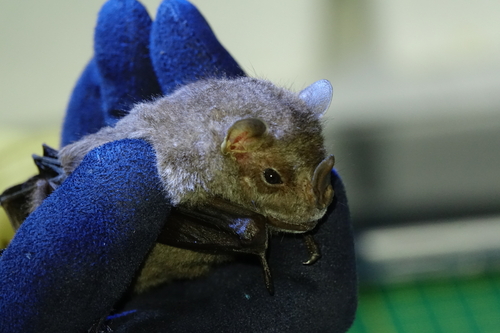
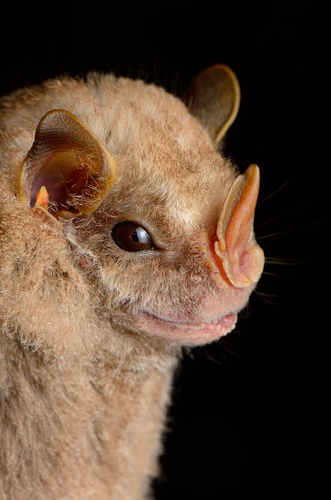
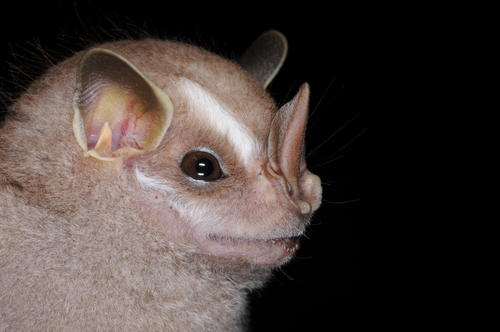
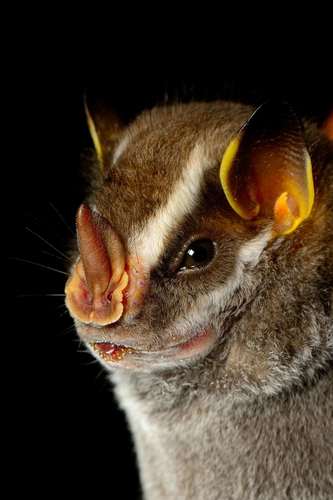
Other species in the family Phyllostomidae
Species that share its range
Sources
Conservation status, range description and population estimate come from the IUCN Red List assessment for Chiroderma doriae. Countries are derived from that range description, not from a mapped country list. Last refreshed on .
The distribution map is drawn from the IUCN Red List spatial data compiled in 2008. IUCN (International Union for Conservation of Nature)