
Altiplano Chinchilla Mouse
Chinchillula sahamae
Red List assessment
Least Concernon the IUCN Red List
- EXExtinct
- EWExtinct in the Wild
- CRCritically Endangered
- ENEndangered
- VUVulnerable
- NTNear Threatened
- LCLeast Concern
The Altiplano Chinchilla Mouse is recorded in 4 countries across South America. The IUCN Red List assesses the Altiplano Chinchilla Mouse as Least Concern. Population size unknown but presumed stable; the species is rarely encountered due to its cryptic habits and remote habitat.
- Family
- Cricetidae
- Order
- Rodentia
- Genus
- Chinchillula
- Countries recorded
- 4
- Continents
- South America
- Red List category
- Least Concern
- Data updated
- August 9, 2026
What is the Altiplano Chinchilla Mouse?
The Altiplano chinchilla mouse is a small, rare cricetid rodent endemic to the high-altitude Andean altiplano, notable for its thick, chinchilla-like soft fur adapted to extreme cold. It is the sole species in its genus, making it taxonomically distinctive among South American rodents. It inhabits rocky, sparsely vegetated terrain at very high elevations, where few other small mammals can survive.
Where does the Altiplano Chinchilla Mouse live?
High Andean altiplano of southern Peru, western Bolivia, northern Chile, and northwestern Argentina
Distributed across the high Andes of southern Peru, western Bolivia, northern Chile, and northwestern Argentina, centered on the Altiplano plateau region near Lake Titicaca and extending south toward the Atacama highlands.
Altitude and depth
3,500 to 5,000 meters above sea level
Seasonal movements
No long-distance migration; activity may be reduced during the coldest winter months and increased during the relatively warmer, wetter summer season.
Habitat of the Altiplano Chinchilla Mouse
Found in rocky outcrops, boulder fields, and sparse bunchgrass (tola and ichu grassland) habitats of the high Andean puna and altiplano. It favors areas with rock crevices for shelter and thermal protection.
Adaptations to its environment
Possesses extremely dense, soft fur similar to chinchillas for insulation against the frigid high-altitude climate. Its compact body shape reduces heat loss, and it shelters in rock crevices to escape temperature extremes and predators.
Conservation status and numbers
Listed as Least Concern by IUCN due to its relatively wide distribution across the high Andes and presumed stable population, despite being uncommon and difficult to survey.
Estimated population
Population size unknown but presumed stable; the species is rarely encountered due to its cryptic habits and remote habitat.
What threatens the Altiplano Chinchilla Mouse?
Potential threats include habitat degradation from overgrazing by livestock, mining activities in the altiplano, and climate change affecting high-altitude ecosystems.
What is being done to protect it?
No species-specific conservation programs are known; some populations occur within protected areas such as national reserves in the Andean altiplano region.
Recommended actions
Further population surveys and ecological studies are needed, along with monitoring of habitat impacts from mining and grazing in high Andean regions.
What the Altiplano Chinchilla Mouse looks like
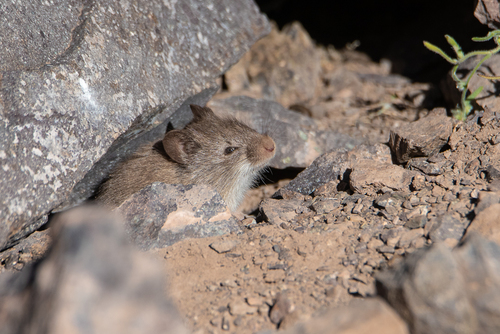
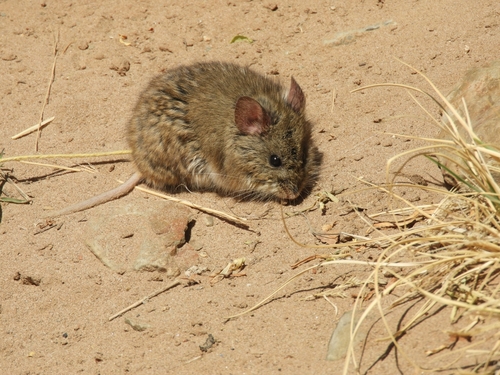
Covered in long, soft, dense grayish-brown to yellowish-gray fur with a paler underside, giving it a distinctly fluffy chinchilla-like appearance. It has large eyes, rounded ears, and a moderately long tail covered in fine fur.
Size
Body length approximately 11-14 cm, with a tail length of about 7-9 cm
Weight
Approximately 30-50 grams
Distinctive features
Distinguished from other Andean rodents by its unusually soft, thick pelage resembling that of true chinchillas, along with its specialized rock-dwelling habits at extreme altitudes.
Behaviour and diet of the Altiplano Chinchilla Mouse
Believed to be largely solitary or living in small family groups, though detailed social behavior remains poorly studied due to the species' elusive nature.
When it is active
Primarily nocturnal or crepuscular, sheltering in rock crevices during the day to avoid extreme temperature fluctuations and predators.
Diet
Herbivorous, feeding on available high-altitude vegetation including grasses, herbs, and possibly seeds found in its sparse puna habitat.
Communication
Likely uses vocalizations, scent marking, and tactile cues typical of small rodents, though specific communication behaviors have not been well documented.
Interactions with other species
Likely preyed upon by high-altitude raptors, foxes, and small carnivores of the Andean region; competes with other small rodents for limited vegetation and shelter sites.
Role in its ecosystem
Plays a role as a primary consumer in the fragile high-altitude puna ecosystem and serves as a prey source for Andean predators, contributing to local food web dynamics.
Reproduction and lifecycle
Breeding biology is poorly documented; presumed to breed during the warmer, wetter summer months with small litter sizes typical of high-altitude cricetid rodents.
Raising the young
Details are largely unknown, but as with related cricetids, females likely provide primary care to altricial young in a sheltered nest site.
Maturity and lifespan
Specific data unavailable; likely reaches sexual maturity within a few months as typical for small cricetid rodents, with a wild lifespan of probably 1-3 years.
Taxonomy and naming of the Altiplano Chinchilla Mouse
Classification
Mammalia > Rodentia > Cricetidae > Chinchillula > Chinchillula sahamae
What research says
Recent studies
Limited recent research exists; most studies focus on taxonomic placement and distribution records within Andean small mammal surveys.
Compared with similar species
Similar in appearance to true chinchillas (Chinchilla spp.) due to convergent fur adaptations for cold climates, but Chinchillula is a much smaller cricetid rodent unrelated taxonomically to the Chinchillidae family.
The Altiplano Chinchilla Mouse and people
Despite its common name and chinchilla-like fur, this species is not a true chinchilla but a distantly related cricetid rodent. It is one of the highest-altitude dwelling rodents in South America, surviving in some of the harshest, coldest terrestrial environments on the continent.
Where and how to see it
Best observed at dusk or dawn among rocky outcrops in the high Andean altiplano of Bolivia or southern Peru, particularly near Lake Titicaca's surrounding highlands; patience and knowledge of rock crevice habitats improve sighting chances.
Risks to humans
No notable risk
Countries where the Altiplano Chinchilla Mouse is recorded
The 4 countries named in the range description of its IUCN Red List assessment.
Questions about the Altiplano Chinchilla Mouse
Where does the Altiplano Chinchilla Mouse live?
The Altiplano Chinchilla Mouse is recorded in Argentina, Bolivia, Chile and Peru across South America. These countries come from the range description of its IUCN Red List assessment, and they are what place the species on the interactive map.
Is the Altiplano Chinchilla Mouse endangered?
The IUCN Red List assesses the Altiplano Chinchilla Mouse as Least Concern. The species is widespread and abundant enough not to qualify for any threatened category. It does not mean the species is safe forever, only that nothing in the current data raises an alarm.
How many are left in the wild?
Population size unknown but presumed stable; the species is rarely encountered due to its cryptic habits and remote habitat. This figure comes from the species assessment on the IUCN Red List; population estimates for wild mammals are ranges, not counts, and are revised at each assessment.
What habitat does the Altiplano Chinchilla Mouse live in?
Found in rocky outcrops, boulder fields, and sparse bunchgrass (tola and ichu grassland) habitats of the high Andean puna and altiplano.
What is the scientific name of the Altiplano Chinchilla Mouse?
The Altiplano Chinchilla Mouse is Chinchillula sahamae, in the family Cricetidae, order Rodentia.
Other species in the family Cricetidae
Species that share its range
Sources
Conservation status, range description and population estimate come from the IUCN Red List assessment for Chinchillula sahamae. Countries are derived from that range description, not from a mapped country list. Last refreshed on .
The distribution map is drawn from the IUCN Red List spatial data compiled in 2008. IUCN (International Union for Conservation of Nature)