
Antillean Fruit-eating Bat
Brachyphylla cavernarum
Red List assessment
Least Concernon the IUCN Red List
- EXExtinct
- EWExtinct in the Wild
- CRCritically Endangered
- ENEndangered
- VUVulnerable
- NTNear Threatened
- LCLeast Concern
The Antillean Fruit-eating Bat is recorded in 5 countries across North America. The IUCN Red List assesses the Antillean Fruit-eating Bat as Least Concern. Population size is not precisely quantified, but the species is considered locally abundant in suitable habitat with an overall stable population trend.
- Family
- Phyllostomidae
- Order
- Chiroptera
- Genus
- Brachyphylla
- Countries recorded
- 5
- Continents
- North America
- Red List category
- Least Concern
- Data updated
- August 9, 2026
What is the Antillean Fruit-eating Bat?
The Antillean fruit-eating bat is a large, robust phyllostomid bat endemic to the Caribbean islands, particularly Puerto Rico, the Virgin Islands, and parts of the Lesser Antilles. It is one of the largest bats in its range and plays a crucial ecological role as a seed disperser and pollinator for numerous native plants. Known for roosting in large colonies in caves, it is remarkable for its adaptability to both natural and human-modified habitats.
Where does the Antillean Fruit-eating Bat live?
Puerto Rico, the Virgin Islands, and the Lesser Antilles (including Saba, St. Kitts, Montserrat, Guadeloupe, Dominica, Martinique, St. Lucia, St. Vincent, Barbados, and Grenada)
Distributed across the northeastern Caribbean, including Puerto Rico, the U.S. and British Virgin Islands, and several islands of the Lesser Antilles such as Guadeloupe, Dominica, Martinique, St. Lucia, and Grenada.
Altitude and depth
Typically found from sea level up to around 600-800 meters elevation on volcanic islands.
Seasonal movements
No long-distance migration is known; however, some seasonal shifts in roosting sites and foraging activity may occur in response to fruiting and flowering cycles of food plants.
Habitat of the Antillean Fruit-eating Bat
Found in a variety of habitats including tropical dry and moist forests, mangroves, agricultural areas, and urban gardens. It roosts primarily in caves, but also uses hollow trees, rock crevices, and buildings.
Adaptations to its environment
Possesses strong jaws and broad molars adapted for crushing fruit and pollen-rich flowers, along with a keen sense of smell for locating ripe fruit. Its ability to roost in large cave colonies provides protection from predators and stable microclimates.
Conservation status and numbers
Listed as Least Concern (LC) by the IUCN due to its relatively wide distribution and large, stable populations across multiple islands, though some local populations face habitat pressure.
Estimated population
Population size is not precisely quantified, but the species is considered locally abundant in suitable habitat with an overall stable population trend.
What threatens the Antillean Fruit-eating Bat?
Main threats include cave disturbance and destruction, deforestation, agricultural expansion, and pesticide use that reduces food plant availability. Hurricanes and human persecution due to misconceptions about bats also pose localized risks.
Diseases and parasites
Known to host various ectoparasites such as bat flies (Streblidae) and mites, as well as potential exposure to bat-associated viruses like rabies, though documented cases are rare.
What is being done to protect it?
Some populations benefit from protection in national parks and cave reserves across Puerto Rico and Lesser Antillean islands. Public education campaigns in the Caribbean aim to reduce cave disturbance and improve public perception of bats.
Recommended actions
Recommended actions include protecting key roosting caves from disturbance, promoting sustainable agricultural practices near foraging areas, and continuing public education to prevent unnecessary killing of bats.
What the Antillean Fruit-eating Bat looks like
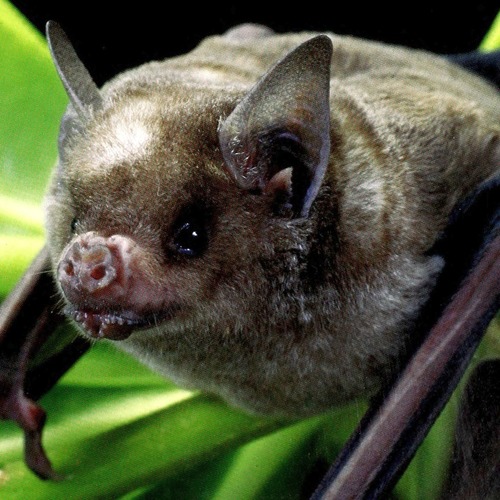
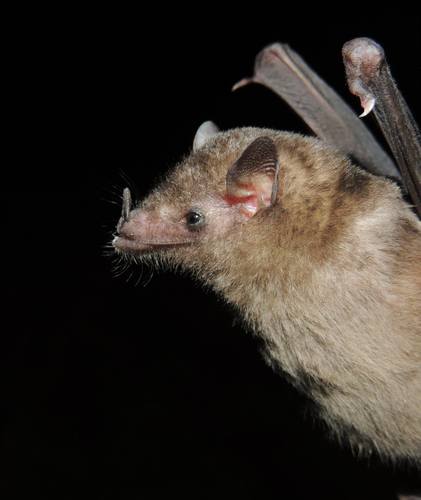
The fur is generally brown to grayish-brown, sometimes with a reddish tinge, and the bat has a short, broad snout typical of fruit-eating phyllostomids. It lacks a noseleaf structure typical of many other phyllostomids, having instead a simple, small nasal pad.
Size
Body length ranges from approximately 7 to 9 cm, with a wingspan of about 40 to 45 cm.
Weight
Adults typically weigh between 30 and 50 grams, with males and females similar in size.
Distinctive features
Distinguished from related species by its larger size, robust build, and the absence of a well-developed noseleaf, which is unusual within the family Phyllostomidae. Its short tail and broad wings also help differentiate it from smaller nectarivorous bats in the region.
Differences between males and females
Minimal sexual dimorphism is observed, with males and females being similar in size and coloration.
Behaviour and diet of the Antillean Fruit-eating Bat
Highly social, roosting in colonies that can number from a few dozen to several thousand individuals in caves. Social hierarchies within colonies are not well studied but likely involve some degree of spatial organization.
When it is active
Nocturnal, emerging after dusk to forage on fruit, nectar, and pollen, returning to roost sites before dawn.
Diet
Omnivorous, primarily feeding on ripe fruit, flower nectar, and pollen, with occasional consumption of insects. Important food plants include figs, guavas, and various flowering trees.
How it feeds and hunts
Forages by flying through forest canopy and open areas, using echolocation and olfaction to locate ripe fruit and flowers; often visits the same feeding trees repeatedly.
Communication
Communicates through echolocation calls for navigation and social vocalizations within roosts; scent may also play a role in individual and colony recognition.
Interactions with other species
Predators include birds of prey and occasionally snakes near roost entrances; it may compete with other frugivorous and nectarivorous bats for food resources but also coexists with them in shared habitats.
Role in its ecosystem
Plays a vital ecological role as a seed disperser and pollinator, helping maintain forest regeneration and plant diversity across Caribbean islands.
Reproduction and lifecycle
Breeding appears to occur seasonally, often linked to periods of fruit abundance, with females typically giving birth to a single pup after a gestation period of about 4-5 months.
Raising the young
Females care for the single offspring, nursing it in the roost until it is capable of flight and independent foraging, a period lasting several weeks to a couple of months.
Maturity and lifespan
Sexual maturity is typically reached within the first year of life; lifespan in the wild is estimated at around 10-15 years, potentially longer in protected cave environments.
Taxonomy and naming of the Antillean Fruit-eating Bat
Classification
Class Mammalia > Order Chiroptera > Family Phyllostomidae > Genus Brachyphylla > Species Brachyphylla cavernarum
Subspecies
Two subspecies are generally recognized: B. c. cavernarum (Lesser Antilles) and B. c. intermedia (Puerto Rico and Virgin Islands), though taxonomic boundaries remain debated.
Scientific synonyms
Brachyphylla cavernarum minor has been proposed historically but is not widely accepted as a valid distinct taxon.
What research says
Recent studies
Recent studies have focused on the species' role in seed dispersal networks and its genetic connectivity across Caribbean island populations, highlighting the importance of maintaining habitat corridors.
Genome and DNA
Limited genomic studies exist, but karyotype analyses suggest a diploid chromosome number typical of phyllostomid bats (2n=32), used in phylogenetic comparisons within the family.
Compared with similar species
Compared to the closely related Brachyphylla nana of Cuba and the Bahamas, B. cavernarum tends to be slightly larger and occupies a more southeastern Caribbean range, with some differences in cranial morphology.
The Antillean Fruit-eating Bat and people
This bat is one of the few New World fruit bats without a noseleaf, giving it a somewhat pig-like snout. It can form massive cave colonies numbering in the thousands, creating a spectacular sight at dusk emergence.
Where and how to see it
Best observed at dusk near known cave roosts in Puerto Rico or the Lesser Antilles, particularly during the fruiting season of local trees; guided cave tours in protected areas often offer safe viewing opportunities.
Risks to humans
No notable risk to humans, though as with all bats, minimal direct contact is recommended to avoid disease transmission such as rabies.
Human uses
No significant direct human use, though the species is valued indirectly for its ecological services in pollination and seed dispersal, which benefit local agriculture and forest ecosystems.
Myths and legends
In some Caribbean folklore, bats in general are associated with supernatural or spiritual symbolism, though no specific legends are documented for this species alone.
Countries where the Antillean Fruit-eating Bat is recorded
The 5 countries named in the range description of its IUCN Red List assessment.
Questions about the Antillean Fruit-eating Bat
Where does the Antillean Fruit-eating Bat live?
The Antillean Fruit-eating Bat is recorded in Barbados, Dominica, Grenada, Puerto Rico and St. Lucia across North America. These countries come from the range description of its IUCN Red List assessment, and they are what place the species on the interactive map.
Is the Antillean Fruit-eating Bat endangered?
The IUCN Red List assesses the Antillean Fruit-eating Bat as Least Concern. The species is widespread and abundant enough not to qualify for any threatened category. It does not mean the species is safe forever, only that nothing in the current data raises an alarm.
How many are left in the wild?
Population size is not precisely quantified, but the species is considered locally abundant in suitable habitat with an overall stable population trend. This figure comes from the species assessment on the IUCN Red List; population estimates for wild mammals are ranges, not counts, and are revised at each assessment.
What habitat does the Antillean Fruit-eating Bat live in?
Found in a variety of habitats including tropical dry and moist forests, mangroves, agricultural areas, and urban gardens.
What is the scientific name of the Antillean Fruit-eating Bat?
The Antillean Fruit-eating Bat is Brachyphylla cavernarum, in the family Phyllostomidae, order Chiroptera.
Other species in the genus Brachyphylla
Other species in the family Phyllostomidae
Species that share its range
Sources
Conservation status, range description and population estimate come from the IUCN Red List assessment for Brachyphylla cavernarum. Countries are derived from that range description, not from a mapped country list. Last refreshed on .
The distribution map is drawn from the IUCN Red List spatial data compiled in 2008. IUCN (International Union for Conservation of Nature)