
American Bison
Bison bison
Red List assessment
Near Threatenedon the IUCN Red List
- EXExtinct
- EWExtinct in the Wild
- CRCritically Endangered
- ENEndangered
- VUVulnerable
- NTNear Threatened
- LCLeast Concern
The American Bison is recorded in 3 countries across North America. The IUCN Red List assesses the American Bison as Near Threatened. Approximately 500,000 bison exist today, but the vast majority are managed as livestock on private ranches; only about 20,000-30,000 are considered wild or semi-wild in conservation herds, with populations generally stable or slowly increasing.
- Family
- Bovidae
- Order
- Artiodactyla
- Genus
- Bison
- Countries recorded
- 3
- Continents
- North America
- Red List category
- Near Threatened
- Data updated
- August 9, 2026
What is the American Bison?
The American Bison is the largest terrestrial mammal in North America, once numbering in the tens of millions across the Great Plains before being driven to near extinction in the 19th century. It is an iconic symbol of the American West, known for its massive shoulder hump, shaggy mane, and role as a keystone grassland species. Today it survives mainly in protected parks, reserves, and on private ranches through extensive conservation efforts.
Where does the American Bison live?
North America, primarily the United States and Canada, with a small population in northern Mexico
Historically ranged across most of North America from Alaska and northern Canada south to Mexico. Today, wild and semi-wild populations persist in protected areas such as Yellowstone National Park, Wood Buffalo National Park, and various wildlife refuges in the US and Canada, with additional herds on private ranches.
Altitude and depth
Typically found at elevations from sea level up to about 3,000 meters, including high-altitude grasslands in the Rocky Mountains.
Seasonal movements
Bison undergo seasonal movements between summer and winter ranges in search of forage, though they are not long-distance migrants like some ungulates. They grow a thick winter coat that is shed in patches during spring.
Habitat of the American Bison
Bison primarily inhabit temperate grasslands, prairies, and plains, though wood bison occupy boreal forest and forest-edge habitats. They favor open areas with abundant grasses and sedges, as well as access to water sources.
Adaptations to its environment
Bison have a massive head and muscular hump that allow them to swing their heads like a plow to clear snow and access buried vegetation in winter. Their thick, insulating fur and small ears reduce heat loss in cold climates, and their keen sense of smell compensates for relatively poor eyesight.
Conservation status and numbers
Near Threatened (NT) according to IUCN, reflecting recovery from near extinction but continued dependence on active management; wild, unfenced, and genetically pure populations remain limited.
Estimated population
Approximately 500,000 bison exist today, but the vast majority are managed as livestock on private ranches; only about 20,000-30,000 are considered wild or semi-wild in conservation herds, with populations generally stable or slowly increasing.
What threatens the American Bison?
Main threats include habitat fragmentation, hybridization with domestic cattle, limited genetic diversity, disease transmission (e.g., brucellosis), and restricted range due to agricultural and urban development.
Diseases and parasites
Bison can be affected by diseases such as brucellosis, bovine tuberculosis, and anthrax, as well as parasites including ticks and internal helminths.
What is being done to protect it?
Conservation efforts include reintroduction programs by the National Park Service, The Nature Conservancy, and Native American tribes, along with genetic management to reduce cattle-gene introgression and habitat restoration in places like Yellowstone and Banff National Park.
Recommended actions
Priority actions include expanding protected habitat connectivity, increasing genetically pure wild herds, reducing hybridization with cattle, and continuing collaborative management between governments, tribes, and conservation organizations.
What the American Bison looks like
Bison have a dark brown, shaggy coat that is especially thick around the head, neck, and forelegs, with a pronounced shoulder hump and a small, curved set of horns present in both sexes. Their large head, short tail, and massive front-heavy build give them a distinctive silhouette.
Size
Shoulder height ranges from 1.5 to 2 meters, with body length reaching 3 to 3.8 meters including the head.
Weight
Males (bulls) typically weigh 460-1,000 kg, while females (cows) weigh 360-540 kg.
Distinctive features
Distinguished from domestic cattle and other bovids by their prominent shoulder hump, disproportionately large head, and shaggy mane-like fur on the front half of the body.
Differences between males and females
Males are notably larger and more heavily built than females, with thicker horns and a more pronounced hump, though both sexes possess horns.
Behaviour and diet of the American Bison
Bison are highly social, forming herds that can range from small family groups of females and calves to large aggregations of hundreds during breeding season, with bulls often more solitary or in small bachelor groups outside the rut.
When it is active
Bison are primarily diurnal, grazing during the cooler parts of the day and resting or ruminating during midday heat.
Diet
Bison are herbivorous grazers, feeding primarily on grasses and sedges, supplementing their diet with forbs and browse when grasses are scarce, especially in winter.
Communication
Bison communicate through vocalizations such as grunts, bellows, and snorts, along with body postures, tail positioning, and scent marking via wallowing and glandular secretions.
Interactions with other species
Historically, wolves and grizzly bears were the primary natural predators of bison, particularly targeting calves and weakened individuals; today predation is limited mostly to wolves in areas like Yellowstone. Bison also interact with prairie dog colonies and other grassland species by shaping vegetation structure through grazing.
Role in its ecosystem
As a keystone species of North American grasslands, bison grazing patterns promote plant diversity, create habitat heterogeneity, and their wallows form microhabitats that benefit various plant and invertebrate species.
Reproduction and lifecycle
The breeding season (rut) occurs from July to September, with dominant bulls competing for access to females through displays and battles. Gestation lasts about 9.5 months, resulting in a single calf born in spring.
Raising the young
Calves are cared for primarily by their mothers, who nurse them for up to a year, though calves begin grazing within weeks of birth. Cows are highly protective and calves often stay close to the maternal herd for one to two years.
Maturity and lifespan
Bison typically reach sexual maturity around 2-3 years of age, with a lifespan of 15-20 years in the wild and up to 25 years in captivity.
Taxonomy and naming of the American Bison
Classification
Class Mammalia > Order Artiodactyla > Family Bovidae > Genus Bison > Species Bison bison
Subspecies
Two recognized subspecies: Bison bison bison (Plains bison), found historically across the Great Plains from Canada to Mexico, and Bison bison athabascae (Wood bison), native to boreal forests of northern Canada and Alaska.
Scientific synonyms
Bos bison (original Linnaean classification, 1758)
What research says
Recent studies
Recent genomic studies have focused on identifying and reducing cattle gene introgression in bison herds to preserve genetic purity, as well as research into disease resistance and population genetics for conservation herd management.
Genome and DNA
Bison have 60 chromosomes and can hybridize with domestic cattle (Bos taurus), a genetic concern for conservation since many bison herds carry some cattle DNA introgression.
Compared with similar species
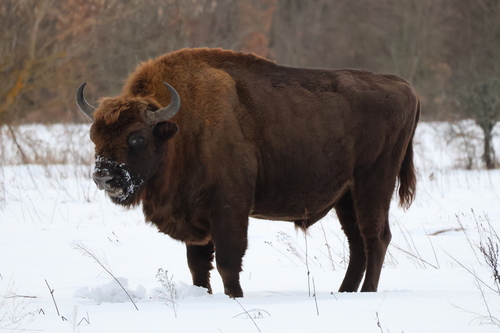
Compared to the European bison (Bison bonasus), the American bison has a larger head, more prominent hump, and shorter legs, while the wisent has a longer body and less pronounced hump, reflecting adaptation to forested versus open habitats.
The American Bison and people
Bison can run up to 55 km/h despite their massive size, and they are excellent swimmers capable of crossing large rivers. Despite near-extinction in the 1800s with fewer than 1,000 individuals remaining, they have become a global conservation success story.
Where and how to see it
Yellowstone National Park and Custer State Park in the US, as well as Wood Buffalo National Park in Canada, offer excellent opportunities to observe wild bison, especially during the summer rutting season when herds gather in open meadows.
Risks to humans
Bison can be dangerous if approached too closely, as they are capable of charging at high speed and causing serious injury; visitors are advised to maintain a safe distance of at least 25 meters.
Human uses
Bison have been historically vital to Native American cultures for meat, hides, and tools, and are now farmed commercially for lean meat production, as well as maintained in conservation herds for ecological restoration.
Myths and legends
Bison hold deep spiritual and cultural significance for many Native American tribes, symbolizing abundance, strength, and the interconnectedness of life, often featured in creation stories and ceremonial practices.
Countries where the American Bison is recorded
The 3 countries named in the range description of its IUCN Red List assessment.
Questions about the American Bison
Where does the American Bison live?
The American Bison is recorded in Canada, Mexico and United States across North America. These countries come from the range description of its IUCN Red List assessment, and they are what place the species on the interactive map.
Is the American Bison endangered?
The IUCN Red List assesses the American Bison as Near Threatened. The species does not qualify as threatened today, but it is close to the thresholds and likely to cross them soon. It is the category that most often changes at the next assessment.
How many are left in the wild?
Approximately 500,000 bison exist today, but the vast majority are managed as livestock on private ranches; only about 20,000-30,000 are considered wild or semi-wild in conservation herds, with populations generally stable or slowly increasing. This figure comes from the species assessment on the IUCN Red List; population estimates for wild mammals are ranges, not counts, and are revised at each assessment.
What habitat does the American Bison live in?
Bison primarily inhabit temperate grasslands, prairies, and plains, though wood bison occupy boreal forest and forest-edge habitats.
What is the scientific name of the American Bison?
The American Bison is Bison bison, in the family Bovidae, order Artiodactyla.
Other species in the genus Bison
Other species in the family Bovidae
Species that share its range
Sources
Conservation status, range description and population estimate come from the IUCN Red List assessment for Bison bison. Countries are derived from that range description, not from a mapped country list. Last refreshed on .
The distribution map is drawn from the IUCN Red List spatial data compiled in 2017. IUCN (International Union for Conservation of Nature)