
Aztec Fruit-eating Bat
Dermanura azteca
Red List assessment
Least Concernon the IUCN Red List
- EXExtinct
- EWExtinct in the Wild
- CRCritically Endangered
- ENEndangered
- VUVulnerable
- NTNear Threatened
- LCLeast Concern
The Aztec Fruit-eating Bat is recorded in 8 countries across North America. The IUCN Red List assesses the Aztec Fruit-eating Bat as Least Concern. No precise global population estimate is available.
- Family
- Phyllostomidae
- Order
- Chiroptera
- Genus
- Dermanura
- Countries recorded
- 8
- Continents
- North America
- Red List category
- Least Concern
- Data updated
- August 9, 2026
What is the Aztec Fruit-eating Bat?
The Aztec Fruit-eating Bat is a small neotropical leaf-nosed bat belonging to the family Phyllostomidae, closely related to the better-known Jamaican Fruit Bat (Artibeus jamaicensis) but considerably smaller. It inhabits tropical, subtropical, and montane forests from Mexico through Central America, often reaching elevations exceeding 2,000 m. Remarkable for its role as a seed disperser, it contributes significantly to forest regeneration across its range. It bears characteristic pale facial stripes and an erect noseleaf typical of phyllostomid bats.
Where does the Aztec Fruit-eating Bat live?
Mexico (from Tamaulipas, Sinaloa, and Jalisco southward), Guatemala, Belize, Honduras, El Salvador, Nicaragua, Costa Rica, and Panama
Occurs throughout eastern and western Mexico (notably Tamaulipas, San Luis Potosí, Veracruz, Oaxaca, Chiapas, Jalisco, Nayarit, Sinaloa, Guerrero), continuing through Guatemala, Belize, Honduras, El Salvador, Nicaragua, Costa Rica, and Panama. The species reaches its northern limit in the Sierra Madre Oriental and Occidental foothills of Mexico.
Altitude and depth
Recorded from near sea level up to approximately 2,500–3,000 m elevation, with highest densities often documented in montane and cloud forest zones between 800 and 2,000 m.
Seasonal movements
No long-distance migrations recorded; populations appear largely resident year-round. Activity levels and reproductive timing may track local fruit availability, shifting slightly between wet and dry seasons. No true hibernation occurs given the tropical climate of its range.
Habitat of the Aztec Fruit-eating Bat
Primarily tropical and subtropical moist broadleaf forests, including cloud forests and montane humid forests up to at least 2,500 m. Also found in forest edges, shade-coffee plantations, secondary growth, and disturbed habitats adjacent to intact forest. It shows a preference for areas with abundant fruiting trees.
Adaptations to its environment
Equipped with a well-developed noseleaf used in echolocation and olfaction to locate ripe fruit at night. The reduced uropatagium (tail membrane) and robust jaw musculature are adapted for processing tough fruit rinds. Its compact body and maneuverable flight allow navigation through dense forest understory. Robust olfactory capabilities help detect volatiles from ripe fruits.
Conservation status and numbers
Listed as Least Concern (LC) by the IUCN Red List. The species is relatively widespread and tolerant of some habitat disturbance, and no evidence of rapid population decline has been identified. It is considered common across much of its range.
Estimated population
No precise global population estimate is available. The species is considered relatively common throughout its range; the population trend is assumed to be stable, though localized declines may occur in heavily deforested regions.
What threatens the Aztec Fruit-eating Bat?
The primary threat is deforestation and conversion of tropical and cloud forests to agricultural land, cattle pasture, and urban areas, which reduces foraging habitat and roost sites. Pesticide use in plantation agriculture (particularly coffee) may affect prey availability. Climate change may alter elevational distributions and fruiting phenology of key food plants.
Diseases and parasites
Susceptible to rabies virus (though transmission to humans is rare for this species). Hosts ectoparasites including streblid bat flies (Trichobius spp., Speiseria spp.) and mites. Intestinal endoparasites (helminths, protozoans) have been documented in related phyllostomid bats.
What is being done to protect it?
Protected indirectly through its presence in numerous protected areas across its range, including biosphere reserves in Mexico (e.g., El Cielo, Sierra de Manantlán) and national parks in Central America. Mexican legislation (NOM-059-SEMARNAT) provides general protections for bats, and regional bat conservation networks (e.g., Red Latinoamericana para la Conservación de los Murciélagos, RELCOM) promote awareness.
Recommended actions
Priority actions include maintaining forest connectivity to preserve foraging corridors, monitoring population trends in heavily deforested areas, protecting roost sites within and outside protected areas, and promoting bat-friendly shade-grown coffee and cacao farming. Public education campaigns to reduce persecution of bats are also recommended.
What the Aztec Fruit-eating Bat looks like
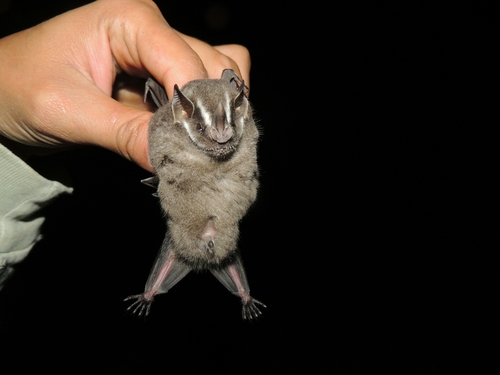
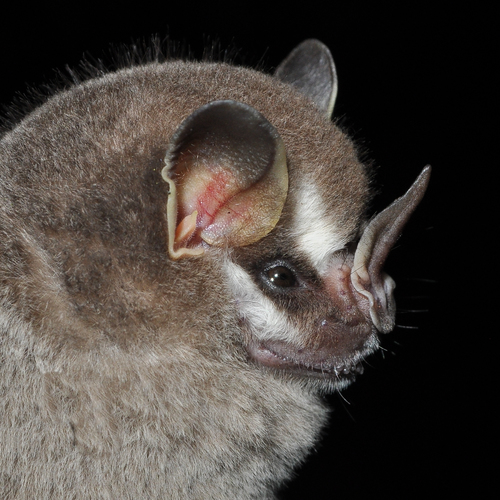
Dorsal fur is brownish-gray to dark brown; ventral fur is paler grayish-white. The face bears three white stripes: one median and two lateral, though these may be faint. The large, erect noseleaf is well-developed. Ears are medium-sized, pointed, and dark. The tail membrane (uropatagium) is reduced.
Size
Small bat: total body length approximately 55–75 mm; forearm length 35–43 mm; wingspan approximately 25–30 cm. No external tail or a very rudimentary one.
Weight
Approximately 11–19 g; adults typically weigh 12–17 g with little reported sexual size dimorphism, though pregnant or lactating females are notably heavier.
Distinctive features
Distinguished from the closely related Dermanura tolteca and D. phaeotis by a combination of forearm length, skull dimensions, and fur coloration. Compared to D. tolteca, D. azteca tends to be slightly larger and is found at higher elevations. The white facial stripes, though present, are less bold than those of larger Artibeus species.
Differences between males and females
Sexual dimorphism is minimal. Females may be slightly larger on average than males, a pattern common in bats. Reproductive females (pregnant or lactating) are conspicuously heavier. No notable color differences between sexes.
Behaviour and diet of the Aztec Fruit-eating Bat
Typically roosts in small groups of a few individuals to several dozen, often forming harem groups consisting of one dominant male, several females, and subordinate males. Some individuals roost solitarily beneath large leaves. Roost fidelity varies seasonally with fruit availability.
When it is active
Strictly nocturnal; foraging activity typically begins shortly after sunset and peaks in the early part of the night when fruit availability is highest. Activity may decrease during the middle of the night and resume before dawn.
Diet
Primarily frugivorous, with figs (Ficus spp.) forming a cornerstone of the diet. Also consumes other soft tropical fruits, as well as nectar, pollen, and insects, which provide supplemental protein and micronutrients. Diet composition shifts seasonally with fruit availability.
How it feeds and hunts
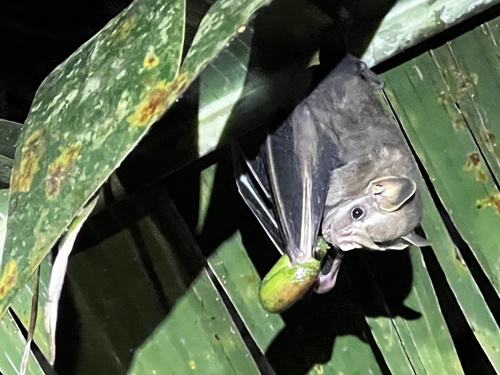
Locates ripe fruit primarily through olfaction and echolocation. Bats pluck fruit in flight and carry it to a feeding roost — a sheltered perch — where it is consumed. Soft parts are eaten and seeds are spat out or excreted, facilitating long-distance seed dispersal.
Communication
Uses echolocation (low-intensity, multiharmonic FM calls) for navigation and foraging, though olfaction is dominant for fruit location. Social vocalizations include squeaks and chirps used during roost interactions and mating. Scent glands may contribute to social and sexual communication.
Interactions with other species
Potential predators include owls (e.g., Ciccaba virgata), snakes, and small carnivores. Competes for fruit resources with other frugivorous bats (e.g., Artibeus jamaicensis, Carollia spp.) and birds. Serves as a host for ectoparasites including mites, streblid flies (Streblidae), and nycteribiid flies. Acts as a mutualist with fruiting trees through seed dispersal.
Role in its ecosystem
Key ecological role as a seed disperser, particularly for pioneer and fig species, facilitating tropical forest regeneration. Also contributes to pollination when feeding on nectar. As prey, it forms part of the food web supporting avian and reptilian predators in forest ecosystems.
Reproduction and lifecycle
Breeding can occur year-round in some areas, but appears to peak during the dry season in many parts of the range, with births timed to coincide with peak fruit abundance. Females typically give birth to a single pup after a gestation of approximately 3.5–4 months. Some populations may exhibit bimodal polyestry (two birth peaks per year).
Raising the young
Maternal care is primary; the mother nurses the pup and carries it during the early weeks of life. Pups are weaned at approximately 1–2 months of age. The father plays no direct role in pup rearing. Young bats begin flying and foraging independently shortly after weaning.
Maturity and lifespan
Sexual maturity is reached at approximately 6–9 months of age. Wild lifespan is estimated at 5–10 years, though data specific to this species are limited; captive individuals of related species have lived over 10 years.
Taxonomy and naming of the Aztec Fruit-eating Bat
Classification
Mammalia > Chiroptera > Phyllostomidae > Dermanura > Dermanura azteca
Subspecies
Some authorities recognize Dermanura azteca azteca (nominate, Mexico to Honduras) and Dermanura azteca minor (Costa Rica and Panama), though subspecific boundaries remain debated. The taxonomy is not universally settled.
Scientific synonyms
Artibeus aztecus Andersen, 1906 is the primary synonym; the species was long placed within the broad genus Artibeus before molecular and morphological evidence supported elevation of Dermanura to full genus status.
What research says
Recent studies
Recent phylogenomic studies have refined the placement of Dermanura within the tribe Stenodermatini and clarified its relationships with other small Artibeus-group bats. Ecological studies in Mexican cloud forests have highlighted this species' importance as a seed disperser for understory plants. Ongoing taxonomic revisions continue to assess subspecific boundaries.
Genome and DNA
Specific chromosome count for Dermanura azteca is not well-documented in the literature; related Artibeus-group bats typically have diploid chromosome numbers of 2n=30–31. Molecular phylogenetic studies (e.g., Redondo et al. 2008, Baker et al.) supported the elevation of Dermanura to genus level based on mitochondrial and nuclear DNA evidence.
Compared with similar species
Dermanura azteca is one of several small fruit-eating bats in the genus Dermanura (including D. tolteca, D. phaeotis, D. cinerea, D. watsoni). Compared to D. tolteca, it generally occupies higher elevations and has a slightly larger forearm. It is considerably smaller than sympatric Artibeus jamaicensis, which it may share foraging areas with, and tends to feed on smaller fruit items. Unlike Carollia spp., it is a specialist on fleshy fruits rather than Piper.
The Aztec Fruit-eating Bat and people
Despite its small size (weighing less than a AA battery), the Aztec Fruit-eating Bat can carry fruit items nearly as large as its own head back to its feeding roost. Like other phyllostomid bats, it can drink while hovering over water, dipping its lower jaw to scoop up liquid mid-flight. This species has been documented foraging in shade-coffee plantations, meaning your morning cup of coffee may owe something to its seed-dispersal activities.
Where and how to see it
Best observed at dusk and early evening in humid montane forests of eastern Mexico (e.g., cloud forests of the Sierra de Manantlán, El Cielo Biosphere Reserve, or Veracruz highlands) and in Central American national parks. Mist-netting surveys along forest trails near fruiting fig trees offer the best detection opportunities. Patience and a red-light headlamp (to preserve night vision) improve sighting chances at forest edges.
Risks to humans
No notable direct risk to humans; bites are possible if handled carelessly, but the species is non-aggressive. As with all bats, there is a theoretical risk of rabies exposure from bites, and standard precautions (avoiding handling without gloves, seeking medical advice after any bite) are recommended.
Human uses
Not directly harvested or farmed. Of significant indirect economic value through pollination and seed dispersal services benefiting timber trees, shade-coffee crops, and tropical fruit plants. Used as a study species in ecological and evolutionary research on bat foraging ecology, phylogenetics, and tropical forest dynamics.
Myths and legends
Bats in general hold important symbolism across Mesoamerican cultures; the Aztec and Maya associated bats with the underworld, death, and rebirth — the Maya god Camazotz was a bat deity linked to caves and night. While no specific mythology is attributed exclusively to Dermanura azteca, local communities throughout its Mexican range traditionally associate small cave- and foliage-roosting bats with omens and the supernatural, sometimes viewing them negatively despite their ecological importance.
Countries where the Aztec Fruit-eating Bat is recorded
The 8 countries named in the range description of its IUCN Red List assessment.
Questions about the Aztec Fruit-eating Bat
Where does the Aztec Fruit-eating Bat live?
The Aztec Fruit-eating Bat is recorded in Belize, Costa Rica, El Salvador, Guatemala and Honduras, among 8 countries in total across North America. These countries come from the range description of its IUCN Red List assessment, and they are what place the species on the interactive map.
Is the Aztec Fruit-eating Bat endangered?
The IUCN Red List assesses the Aztec Fruit-eating Bat as Least Concern. The species is widespread and abundant enough not to qualify for any threatened category. It does not mean the species is safe forever, only that nothing in the current data raises an alarm.
How many are left in the wild?
No precise global population estimate is available. This figure comes from the species assessment on the IUCN Red List; population estimates for wild mammals are ranges, not counts, and are revised at each assessment.
What habitat does the Aztec Fruit-eating Bat live in?
Primarily tropical and subtropical moist broadleaf forests, including cloud forests and montane humid forests up to at least 2,500 m.
What is the scientific name of the Aztec Fruit-eating Bat?
The Aztec Fruit-eating Bat is Dermanura azteca, in the family Phyllostomidae, order Chiroptera.
Other species in the genus Dermanura
Other species in the family Phyllostomidae
Sources
Conservation status, range description and population estimate come from the IUCN Red List assessment for Dermanura azteca. Countries are derived from that range description, not from a mapped country list. Last refreshed on .
The distribution map is drawn from the IUCN Red List spatial data compiled in 2016. IUCN (International Union for Conservation of Nature)