
Amazonian Manatee
Trichechus inunguis
Red List assessment
Vulnerableon the IUCN Red List
- EXExtinct
- EWExtinct in the Wild
- CRCritically Endangered
- ENEndangered
- VUVulnerable
- NTNear Threatened
- LCLeast Concern
The Amazonian Manatee is recorded in 4 countries across South America. The IUCN Red List assesses the Amazonian Manatee as Vulnerable. Estimated at fewer than 10,000 mature individuals, with a continuing declining trend across much of its range.
- Family
- Trichechidae
- Order
- Sirenia
- Genus
- Trichechus
- Countries recorded
- 4
- Continents
- South America
- Red List category
- Vulnerable
- Data updated
- August 9, 2026
What is the Amazonian Manatee?
The Amazonian manatee is the smallest species of manatee and the only sirenian species living exclusively in freshwater. It inhabits the Amazon River basin, where it grazes on aquatic vegetation. Unlike its marine relatives, it lacks nails on its flippers, hence the species name 'inunguis'. It is remarkable for its adaptation to the seasonal flood cycles of the Amazon, moving between flooded forests and river channels.
Where does the Amazonian Manatee live?
Brazil, Peru, Colombia, Ecuador
Found throughout the Amazon basin in Brazil, Peru, Colombia, and Ecuador, extending into the upper Amazon tributaries. Its range follows the extent of the Amazon River and its major tributaries, generally absent from fast-flowing or turbulent waters.
Altitude and depth
Lowland freshwater systems, typically below 300m elevation; water depth used ranges from 1 to 10 meters.
Seasonal movements
Exhibits seasonal movements tied to the Amazon's flood pulse, moving into flooded forests during high water season to feed and retreating to deeper river channels and lakes during low water season when food is scarcer.
Habitat of the Amazonian Manatee
Exclusively freshwater habitats including slow-moving rivers, oxbow lakes, flooded forests (varzea), and blackwater lagoons within the Amazon basin. It prefers areas with abundant floating and submerged vegetation and calm waters.
Adaptations to its environment
Possesses a low metabolic rate and can survive months with reduced food intake during low water season by relying on fat reserves. Its lack of nails and reduced bone density are adaptations for a purely aquatic freshwater lifestyle, and its skin folds allow expansion during feeding on abundant vegetation.
Conservation status and numbers
Classified as Vulnerable (VU) by IUCN due to ongoing population decline estimated at over 30% over three generations, driven primarily by historic and ongoing hunting pressure combined with habitat degradation.
Estimated population
Estimated at fewer than 10,000 mature individuals, with a continuing declining trend across much of its range.
What threatens the Amazonian Manatee?
Illegal hunting for meat and oil, incidental entanglement in fishing gear, habitat degradation from deforestation and dam construction, and pollution from agricultural runoff and mining activities.
Diseases and parasites
Susceptible to skin parasites, barnacles-like organisms in some populations, and various internal parasites; disease is not a major known threat but can affect stressed or captive individuals.
What is being done to protect it?
Protected under Brazilian and other national wildlife laws prohibiting hunting; rehabilitation and reintroduction programs exist, notably run by INPA in Manaus, Brazil. Several protected areas and reserves within the Amazon basin provide partial habitat protection.
Recommended actions
Strengthen enforcement against illegal hunting, expand protected freshwater habitats, promote community-based conservation and awareness programs, and support rehabilitation and release initiatives for orphaned calves.
What the Amazonian Manatee looks like
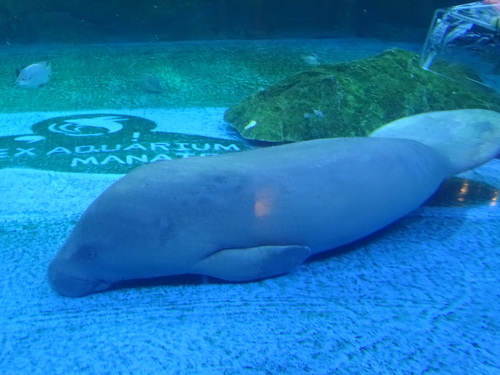
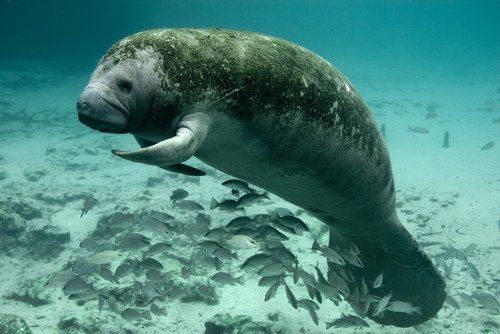
Smooth, wrinkled grey to black skin often with a distinctive pale pink or white patch on the belly, a rounded paddle-like tail, and no nails on the flippers (unlike other manatee species). The body is fusiform and streamlined, adapted for slow aquatic movement.
Size
Body length typically ranges from 2.5 to 3 meters.
Weight
Adults weigh between 350 and 500 kg, with some individuals reaching up to 480 kg.
Distinctive features
Distinguished from West Indian and West African manatees by its smaller size, lack of nails on flippers, exclusively freshwater habitat, and often a pale ventral patch.
Differences between males and females
Minimal sexual dimorphism; females are sometimes slightly larger than males, but external differences are subtle.
Behaviour and diet of the Amazonian Manatee
Generally solitary or found in small, loose groups, though mother-calf pairs are the most stable social unit. Larger aggregations may occur temporarily at abundant feeding sites.
When it is active
Primarily active during daylight hours (diurnal), spending much of the day feeding and resting near the water surface or bottom.
Diet
Strict herbivore feeding on a wide variety of aquatic and floating vegetation including water hyacinth, grasses, and floating macrophytes, consuming up to 8% of its body weight daily.
Communication
Communicates through low-frequency vocalizations such as squeaks and chirps, especially between mothers and calves, along with tactile interactions.
Interactions with other species
Has few natural predators as an adult, though jaguars and caimans may prey on young calves; interacts ecologically with fish and turtles that may follow manatees to feed on stirred-up vegetation and parasites removed from their skin.
Role in its ecosystem
Plays an important ecological role as a grazer that helps control aquatic vegetation growth, maintaining waterway health and influencing nutrient cycling within the Amazon floodplain ecosystem.
Reproduction and lifecycle
Breeding can occur year-round but often peaks during the flood season; gestation lasts about 12-14 months, typically resulting in a single calf.
Raising the young
Calves are cared for exclusively by the mother, nursing for up to two years while also learning to forage on vegetation; the bond between mother and calf is strong and prolonged.
Maturity and lifespan
Sexual maturity is reached around 4-5 years of age; lifespan can reach 30 years or more in the wild, with similar longevity in captivity under good care.
Taxonomy and naming of the Amazonian Manatee
Classification
Mammalia > Sirenia > Trichechidae > Trichechus > Trichechus inunguis
Scientific synonyms
Manatus inunguis, Trichechus inunguis inunguis
What research says
Recent studies
Recent studies using satellite tagging and genetic analysis have revealed detailed information on seasonal movement patterns and population connectivity across different Amazon tributaries.
Genome and DNA
Diploid chromosome number is 2n=56, similar to other Trichechus species; genetic studies have helped clarify population structure across the Amazon basin.
Compared with similar species
Compared to the West Indian manatee (Trichechus manatus), the Amazonian manatee is smaller, lacks nails on its flippers, and is restricted to freshwater rather than coastal marine and estuarine habitats.
The Amazonian Manatee and people
The Amazonian manatee is the only manatee species that never enters saltwater. It can survive for months during the dry season with minimal feeding by relying on stored body fat, and calves are known to vocalize distinct squeaks to stay in contact with their mothers.
Where and how to see it
Best observed in protected reserves such as the Mamirauá Sustainable Development Reserve in Brazil, especially during the flood season when manatees move into flooded forests; early morning boat tours with experienced guides increase chances of sightings.
Risks to humans
No notable risk to humans; manatees are gentle and non-aggressive herbivores.
Human uses
Historically hunted for meat, oil, and hide by local communities, though this is now illegal in most range countries; currently the species has ecotourism value in some protected reserves.
Myths and legends
In Amazonian folklore, manatees are sometimes associated with river spirits or mermaid-like legends, and indigenous communities have traditional stories linking them to fertility and water spirits.
Countries where the Amazonian Manatee is recorded
The 4 countries named in the range description of its IUCN Red List assessment.
Questions about the Amazonian Manatee
Where does the Amazonian Manatee live?
The Amazonian Manatee is recorded in Brazil, Colombia, Ecuador and Peru across South America. These countries come from the range description of its IUCN Red List assessment, and they are what place the species on the interactive map.
Is the Amazonian Manatee endangered?
Yes. The IUCN Red List assesses the Amazonian Manatee as Vulnerable, one of the three threatened categories. The species faces a high risk of extinction in the wild. It is the first of the three threatened categories: numbers are falling, the range is shrinking, or the population is small enough that a single bad event could do lasting damage.
How many are left in the wild?
Estimated at fewer than 10,000 mature individuals, with a continuing declining trend across much of its range. This figure comes from the species assessment on the IUCN Red List; population estimates for wild mammals are ranges, not counts, and are revised at each assessment.
What habitat does the Amazonian Manatee live in?
Exclusively freshwater habitats including slow-moving rivers, oxbow lakes, flooded forests (varzea), and blackwater lagoons within the Amazon basin.
What is the scientific name of the Amazonian Manatee?
The Amazonian Manatee is Trichechus inunguis, in the family Trichechidae, order Sirenia.
Other species in the genus Trichechus
Species that share its range
Sources
Conservation status, range description and population estimate come from the IUCN Red List assessment for Trichechus inunguis. Countries are derived from that range description, not from a mapped country list. Last refreshed on .
The distribution map is drawn from the IUCN Red List spatial data compiled in 2016. IUCN (International Union for Conservation of Nature)