
Broad-toothed Tailless Bat
Anoura latidens
Red List assessment
Least Concernon the IUCN Red List
- EXExtinct
- EWExtinct in the Wild
- CRCritically Endangered
- ENEndangered
- VUVulnerable
- NTNear Threatened
- LCLeast Concern
The Broad-toothed Tailless Bat is recorded in 3 countries across South America. The IUCN Red List assesses the Broad-toothed Tailless Bat as Least Concern. No quantitative global population estimate is available.
- Family
- Phyllostomidae
- Order
- Chiroptera
- Genus
- Anoura
- Countries recorded
- 3
- Continents
- South America
- Red List category
- Least Concern
- Data updated
- August 9, 2026
What is the Broad-toothed Tailless Bat?
Anoura latidens is a small, nectar-feeding bat of the family Phyllostomidae, first described by Handley in 1984. It inhabits montane forests in the Andean region of Colombia and is notable for its broader tooth morphology compared to congeners, reflected in its Latin name (lati = broad, dens = tooth). Like all members of the genus Anoura, it essentially lacks an externally visible tail, giving the group their common 'tailless bat' designation. It is considered an important pollinator of Andean highland flowers.
Where does the Broad-toothed Tailless Bat live?
Primarily the Andes of Colombia; possibly extending marginally into adjacent Ecuador and Venezuela
Known primarily from the Central and Western Andes of Colombia, with records concentrated around departments such as Antioquia, Quindío, Risaralda, Valle del Cauca, and Cundinamarca. Its full range may extend slightly into neighboring Ecuador or Venezuela, but confirmed records outside Colombia are sparse.
Altitude and depth
Typically found between approximately 1,000 and 3,000 meters above sea level in Andean montane zones, consistent with cloud forest and upper tropical forest belts.
Seasonal movements
No documented seasonal migration. Activity levels may vary with the local flowering phenology of nectar plants, but year-round residency is presumed within its Andean range.
Habitat of the Broad-toothed Tailless Bat
Predominantly montane and cloud forests of the Andes, including humid tropical and subtropical forest edges. It is associated with forested landscapes that support a diversity of nectar-producing plants and is generally found in areas with high floral resource availability.
Adaptations to its environment
Possesses a highly elongated, protrusible tongue and a slender, tubular muzzle adapted for extracting nectar from deep flowers. Its reduced or absent tail and well-developed uropatagium provide maneuverability during hovering flight. Echolocation calls are adapted for navigation in dense forest understorey.
Conservation status and numbers
Least Concern (LC) on the IUCN Red List. The species is assessed as LC because it is not believed to meet the thresholds for more threatened categories; however, data on population size and trends remain limited, and continued monitoring is advisable given ongoing Andean deforestation.
Estimated population
No quantitative global population estimate is available. Population trend is presumed stable but insufficiently documented; its relatively restricted Andean range makes it potentially vulnerable to localized habitat loss.
What threatens the Broad-toothed Tailless Bat?
Deforestation and habitat fragmentation resulting from agricultural expansion (particularly cattle ranching and coffee/coca cultivation), logging, and human settlement in the Colombian Andes represent the primary threats. Climate change altering flowering phenology could also affect nectar availability.
Diseases and parasites
No specific disease or parasite data are available for A. latidens. Like other phyllostomid bats, it may harbor ectoparasites such as streblid bat flies and endoparasites including helminths. Its potential role as a reservoir for bat-associated viruses has not been studied.
What is being done to protect it?
The species occurs within several protected areas in the Colombian Andes, including national parks and regional natural reserves. Colombia's national biodiversity legislation provides general protection for bat species. No species-specific conservation programs are known to exist.
Recommended actions
Long-term population monitoring and roost surveys in the Colombian Andes; assessment of range extent in Ecuador and Venezuela; protection and restoration of cloud forest habitat; raising awareness among local communities about the ecological role of nectar bats as pollinators.
What the Broad-toothed Tailless Bat looks like
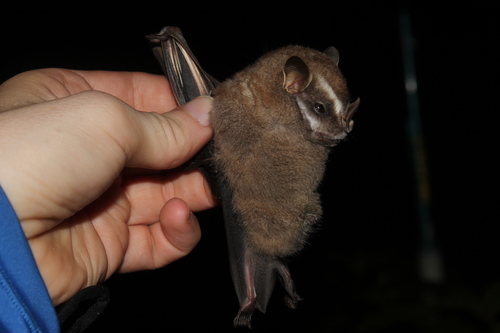
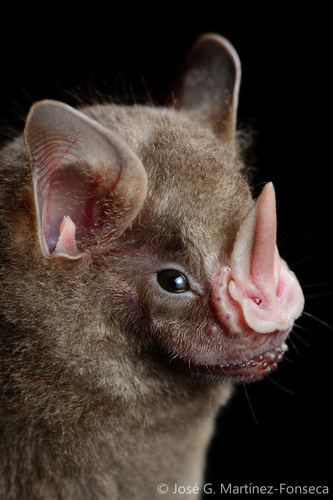
Fur is typically dark brownish to greyish-brown on the dorsum and slightly paler on the venter. The muzzle is notably elongated and narrow, with a small, lance-shaped noseleaf. Ears are moderate-sized and rounded. Wing membranes are dark brown to blackish.
Size
Body length approximately 60–75 mm; forearm length roughly 38–44 mm; wingspan estimated at 25–30 cm. No tail or only rudimentary tail visible externally.
Weight
Estimated body weight approximately 9–15 g, consistent with other Anoura species of similar size. Sexual dimorphism in mass is not well documented.
Distinctive features
Distinguished from closely related species such as Anoura geoffroyi and Anoura caudifer by its comparatively broader upper incisors and other dental proportions. Its dental breadth ratio is the primary taxonomic character separating it from congeners in the field and museum collections.
Differences between males and females
Sexual dimorphism has not been specifically described for this species. As in most Anoura, females may be marginally larger than males, which is a common pattern among phyllostomid bats, but this has not been quantitatively confirmed for A. latidens.
Behaviour and diet of the Broad-toothed Tailless Bat
Presumed to roost in small to moderate-sized colonies in caves, rock crevices, or hollow trees, as is typical for the genus. Specific social structure and colony size data for A. latidens are not documented.
When it is active
Strictly nocturnal. Foraging activity peaks during the first half of the night when nectar resources are most abundant. Roosts during the day in sheltered sites.
Diet
Primarily nectarivorous, feeding on the nectar of various Andean flowers, particularly those with elongated, tubular corollas adapted for bat pollination (chiropterophily). Also consumes pollen (an important protein source) and likely supplements diet with small insects.
How it feeds and hunts
Employs a hovering flight technique to access flowers, inserting its elongated tongue to lap nectar. Uses low-intensity, frequency-modulated echolocation calls to navigate and may detect flowers through olfactory cues. Insects are likely gleaned from foliage or caught in flight.
Communication
Uses ultrasonic echolocation for navigation and obstacle avoidance during flight. Social vocalizations within the roost likely include contact calls. Olfactory communication via scent glands may play a role in roost mate recognition.
Interactions with other species
Acts as an important pollinator for numerous Andean plant species, including those in families Bromeliaceae, Ericaceae, and Gesneriaceae. Natural predators likely include owls and other nocturnal raptors. May compete with other glossophagine bats (e.g., Anoura geoffroyi) for floral resources where ranges overlap.
Role in its ecosystem
A key nocturnal pollinator in Andean ecosystems, contributing to the reproductive success of specialized chiropterophilous plants. As a pollen vector, it links spatially separated plant populations and supports biodiversity in cloud forest systems.
Reproduction and lifecycle
Reproductive details are poorly documented for this species specifically. Related Anoura species typically show seasonal or bimodal reproductive patterns tied to local resource peaks; gestation lasts approximately 3–4 months and litter size is one pup per birth event.
Raising the young
As in other phyllostomid bats, the mother is presumed to be the sole caregiver. Pups are born altricial, nursed in the roost, and become volant within approximately 4–6 weeks. Maternal roosting clusters provide thermoregulatory benefits to young.
Maturity and lifespan
Sexual maturity is probably reached within the first year, consistent with other small phyllostomid bats. Lifespan in the wild is estimated at 5–10 years based on related species; no captive longevity data exist for this species.
Taxonomy and naming of the Broad-toothed Tailless Bat
Classification
Mammalia > Chiroptera > Phyllostomidae (subfamily Glossophaginae) > Anoura > Anoura latidens
What research says
Recent studies
Phylogenomic studies of the subfamily Glossophaginae have helped clarify the relationships among Anoura species, confirming A. latidens as a distinct lineage. Its dental morphology has been used in comparative studies of bat ecomorphology within the genus.
Genome and DNA
No published chromosome count or genomic data specific to Anoura latidens are available. Related glossophagine bats typically have diploid numbers of 2n=28–32, but this has not been confirmed for this species.
Compared with similar species
Anoura latidens is most similar to Anoura geoffroyi, from which it differs by broader upper incisors and subtler cranial proportions. Anoura fistulata (Ecuador) is notable for having the longest tongue relative to body size of any mammal, a specialization absent in A. latidens. Anoura caudifer retains a slightly more visible tail than A. latidens.
The Broad-toothed Tailless Bat and people
The name 'latidens' literally means 'broad-toothed' in Latin, making dental morphology the founding identification mark of this species. Like a hummingbird, this bat can hover in place while drinking nectar, beating its wings up to 15 times per second. Despite having essentially no visible tail, A. latidens belongs to the family of 'leaf-nosed bats,' distinguished by the characteristic noseleaf used to shape echolocation calls.
Where and how to see it
Best observed in the montane cloud forests of the Colombian Andes (e.g., Quindío, Risaralda) at dusk near flowering plants known to attract nectarivorous bats, such as large-flowered bromeliads and Marcgravia vines. Mist-netting surveys conducted by licensed researchers at forest edges and cave entrances represent the most reliable method of detection.
Risks to humans
No notable risk to humans. Like all bats, it should not be handled without proper equipment due to the general theoretical risk of bat-associated zoonoses; however, no specific disease risk has been documented for this species.
Countries where the Broad-toothed Tailless Bat is recorded
The 3 countries named in the range description of its IUCN Red List assessment.
Questions about the Broad-toothed Tailless Bat
Where does the Broad-toothed Tailless Bat live?
The Broad-toothed Tailless Bat is recorded in Colombia, Ecuador and Venezuela across South America. These countries come from the range description of its IUCN Red List assessment, and they are what place the species on the interactive map.
Is the Broad-toothed Tailless Bat endangered?
The IUCN Red List assesses the Broad-toothed Tailless Bat as Least Concern. The species is widespread and abundant enough not to qualify for any threatened category. It does not mean the species is safe forever, only that nothing in the current data raises an alarm.
How many are left in the wild?
No quantitative global population estimate is available. This figure comes from the species assessment on the IUCN Red List; population estimates for wild mammals are ranges, not counts, and are revised at each assessment.
What habitat does the Broad-toothed Tailless Bat live in?
Predominantly montane and cloud forests of the Andes, including humid tropical and subtropical forest edges.
What is the scientific name of the Broad-toothed Tailless Bat?
The Broad-toothed Tailless Bat is Anoura latidens, in the family Phyllostomidae, order Chiroptera.
Other species in the genus Anoura

Other species in the family Phyllostomidae
Sources
Conservation status, range description and population estimate come from the IUCN Red List assessment for Anoura latidens. Countries are derived from that range description, not from a mapped country list. Last refreshed on .
The distribution map is drawn from the IUCN Red List spatial data compiled in 2008. IUCN (International Union for Conservation of Nature)