
Stoliczka's Mountain Vole
Alticola stoliczkanus
Red List assessment
Least Concernon the IUCN Red List
- EXExtinct
- EWExtinct in the Wild
- CRCritically Endangered
- ENEndangered
- VUVulnerable
- NTNear Threatened
- LCLeast Concern
The Stoliczka's Mountain Vole is recorded in 4 countries across Asia. The IUCN Red List assesses the Stoliczka's Mountain Vole as Least Concern. No precise global population estimate is available.
- Family
- Cricetidae
- Order
- Rodentia
- Genus
- Alticola
- Countries recorded
- 4
- Continents
- Asia
- Red List category
- Least Concern
- Data updated
- August 9, 2026
What is the Stoliczka's Mountain Vole?
Stoliczka's Mountain Vole is a small, robust arvicoline rodent endemic to the high-altitude rocky terrain of the Himalayan-Tibetan region. It was named in honor of Czech-Austrian naturalist Ferdinand Stoliczka (1838–1874), who contributed greatly to the natural history of Asia. The species is well adapted to extreme cold and low-oxygen environments of the alpine zone. It is one of several Alticola species occupying rocky scree and talus slopes in Central Asia, where few other small mammals can survive.
Where does the Stoliczka's Mountain Vole live?
Central Asia: Tibetan Plateau, Qinghai, Xinjiang, Gansu and Sichuan provinces of China; Ladakh and Himachal Pradesh (India); northern Pakistan; Nepal
Distributed across the Tibetan Plateau and surrounding mountain ranges, including Qinghai, Xinjiang, Gansu, and Sichuan in China; the Karakoram and western Himalayas in northern Pakistan and Ladakh (India); Himachal Pradesh (India); and parts of Nepal. Its range largely follows elevations above 3,000 m across Central Asia.
Altitude and depth
Typically found between 3,000 and 5,500 m above sea level, with records from some of the highest rodent habitats on Earth. It can occasionally be recorded near the margins of permanent snow lines.
Seasonal movements
Does not undergo true hibernation despite harsh winters; remains active year-round, likely relying on cached food and subnivean tunnels under snow cover. Activity patterns may shift seasonally, with greater surface activity during warmer months when vegetation is available.
Habitat of the Stoliczka's Mountain Vole
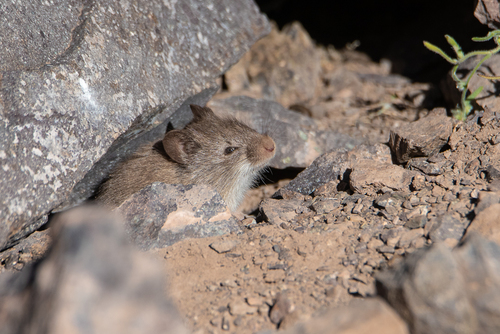
Primarily inhabits rocky alpine meadows, talus slopes, boulder fields, and scree at high elevations. It is closely associated with areas offering rock crevices and burrows under stones that provide shelter and protection from predators and harsh weather. Sparse vegetation including grasses, sedges, and cushion plants typify its habitat.
Adaptations to its environment
Its dense, soft fur provides excellent insulation against extreme cold at high altitudes. Compact body size relative to closely related lowland species reduces heat loss. Rocky crevice-dwelling behavior offers protection from wind and predators. Its digestive system is adapted to process coarse, nutrient-poor alpine vegetation.
Conservation status and numbers
Listed as Least Concern (LC) on the IUCN Red List. The species has a wide distribution across the Tibetan Plateau and surrounding ranges, and is presumed to have a relatively large, stable population with no evidence of rapid decline. No major range-wide threats have been identified to warrant a higher threat category.
Estimated population
No precise global population estimate is available. The species is considered locally common within suitable rocky alpine habitats across its wide range. Population trend is presumed stable based on the lack of documented major threats.
What threatens the Stoliczka's Mountain Vole?
Long-term threats include habitat degradation from overgrazing by domestic yaks, sheep, and goats in alpine meadows. Climate change poses an emerging threat through glacial retreat, permafrost thaw, and altitudinal shifts in vegetation zones. Localized persecution may occur as rodents are sometimes viewed as competitors with livestock for pasture.
Diseases and parasites
Likely hosts various ectoparasites (fleas, mites, ticks) and endoparasites (nematodes, cestodes) typical of arvicoline rodents. As a rodent in Central Asia, it could theoretically harbor zoonotic agents, but no specific disease associations have been documented for this species.
What is being done to protect it?
Much of the species' range falls within protected areas across China and India, including the Sanjiangyuan National Nature Reserve (Qinghai), Changtang Wildlife Reserve (Ladakh, India), and various Tibetan Plateau reserves. No species-specific conservation programs exist, as the species is not considered at risk.
Recommended actions
Long-term population monitoring is needed given the sensitivity of alpine ecosystems to climate change. Grazing pressure in critical alpine habitats should be regulated. Additional taxonomic and phylogeographic studies are needed to better delineate subspecies and evaluate population connectivity across fragmented mountain ranges.
What the Stoliczka's Mountain Vole looks like
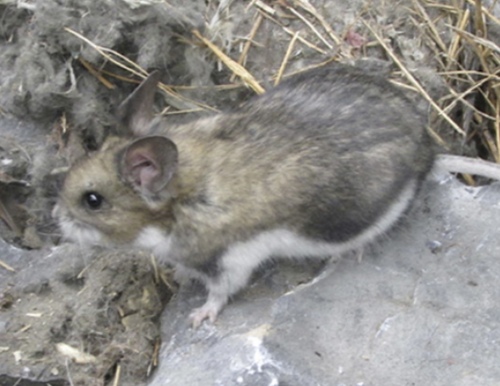
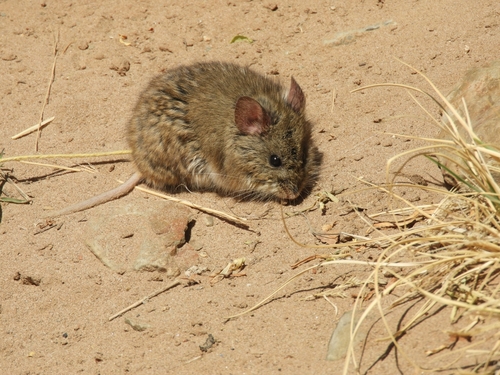
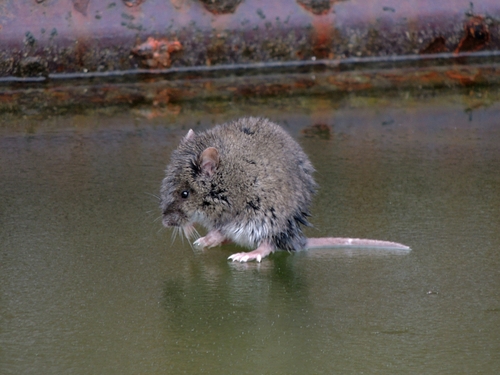
Dorsal fur is soft and dense, generally pale grayish-brown to ochreous-buff, sometimes with a slightly yellowish tinge. Ventral surface is whitish to pale gray. The ears are relatively small and partially hidden in the fur. The tail is short and bicolored (darker above, paler below). Feet are whitish.
Size
Body length approximately 95–130 mm; tail length 25–45 mm (relatively short, as typical for alpine Alticola). Hindfoot length approximately 16–20 mm. No significant size variation between sexes.
Weight
Typically 25–55 g. No pronounced sexual size dimorphism has been documented.
Distinctive features
Distinguished from other Alticola species by its relatively pale dorsal coloration, short tail, and specific dental morphology of the molars (rooted molars with characteristic enamel loop patterns). It is paler than the closely related A. roylei and has a shorter tail than A. albicauda.
Differences between males and females
Sexual dimorphism is minimal or absent in this species. Males and females are similar in size and coloration.
Behaviour and diet of the Stoliczka's Mountain Vole
Likely solitary or loosely social outside the breeding season, as is typical for arvicoline rodents in harsh alpine environments. Individuals maintain small home ranges centered on rock crevices. Social interactions may increase during the breeding season.
When it is active
Primarily diurnal to crepuscular, with peak surface activity in the morning and late afternoon. Activity is curtailed during harsh weather conditions. Remains active year-round under snow using subnivean runway systems.
Diet
Strictly herbivorous. Diet consists of grasses, sedges, forbs, roots, bulbs, and other available plant material in alpine meadows. Like many arvicoline rodents, it likely caches plant material in burrows or rock crevices as winter food stores.
How it feeds and hunts
Not applicable; strictly herbivorous. Forages by clipping vegetation close to shelter entrances, often carrying material back to caches within rock crevices or burrow systems.
Communication
Likely uses high-pitched vocalizations and ultrasonic calls for intraspecific communication, particularly during mating. Scent marking via specialized glands is presumed to play a role in territory delineation, as in related vole species.
Interactions with other species
Predators include raptors such as the Upland Buzzard (Buteo hemilasius), Saker Falcon (Falco cherrug), and owls, as well as mammalian carnivores such as the Tibetan Fox (Vulpes ferrilata), Least Weasel (Mustela nivalis), and Pallas's Cat (Otocolobus manul). It likely competes for space and food with other sympatric small rodents including Ochotona pika species.
Role in its ecosystem
As a herbivorous small mammal, Stoliczka's Mountain Vole plays a role as a primary consumer in alpine ecosystems, transferring energy from plants to predators. It may contribute to soil aeration through burrowing activity and can influence local vegetation dynamics through grazing.
Reproduction and lifecycle
Breeding season likely spans late spring through summer (May–August), when alpine vegetation is most abundant. Litter size is estimated at 3–6 pups based on related species. Gestation period is approximately 18–21 days. Multiple litters per year are possible during favorable seasons.
Raising the young
As with most arvicoline rodents, the female provides primary parental care. Young are born altricial (naked and blind) and develop rapidly. Weaning occurs at approximately 2–3 weeks of age, after which juveniles disperse to find their own territories.
Maturity and lifespan
Sexual maturity is likely reached at 4–6 weeks of age, typical of arvicoline rodents. Wild lifespan is estimated at 1–2 years; captive longevity data are unavailable for this species.
Taxonomy and naming of the Stoliczka's Mountain Vole
Classification
Mammalia > Rodentia > Cricetidae (subfamily Arvicolinae) > Alticola > Alticola stoliczkanus
Subspecies
Several subspecies have been proposed, including A. s. stoliczkanus (Blanford, 1875) — nominate form from Ladakh and western Tibet; A. s. stracheyi (Thomas, 1906) — from the upper Sutlej region; A. s. subluteus (Thomas, 1914) — from Qinghai and eastern Tibet. Subspecific boundaries are not firmly established.
Scientific synonyms
Arvicola stoliczkanus Blanford, 1875 (original combination); Microtus stoliczkanus; Alticola stracheyi Thomas, 1906 (now considered a synonym or subspecies).
What research says
Recent studies
Recent phylogeographic studies on the genus Alticola have examined population structure across the Tibetan Plateau. Some studies have suggested cryptic diversity within A. stoliczkanus, implying that current subspecific taxonomy may underestimate the true diversity of this complex. Molecular clock analyses indicate that Alticola colonized alpine environments during Pleistocene glacial cycles.
Genome and DNA
Detailed karyotypic data are limited; related Alticola species have diploid chromosome numbers around 2n = 34–38. No comprehensive genome sequencing study specific to A. stoliczkanus has been published to date.
Compared with similar species
Closely related to Royle's Mountain Vole (Alticola roylei), which shares much of its western Himalayan range but tends to be darker in coloration. The White-tailed Mountain Vole (Alticola albicauda) is distinguished by its conspicuously white tail. Compared to common lowland voles (Microtus spp.), Alticola species are more closely tied to rocky substrates and have a more specialized alpine niche.
The Stoliczka's Mountain Vole and people
Stoliczka's Mountain Vole lives in one of the harshest environments occupied by any small rodent on Earth, surviving at altitudes above 5,000 m where oxygen levels are nearly half those at sea level. Despite never hibernating, it remains active through brutal Tibetan winters by using networks of tunnels beneath the insulating snow layer. It was named after Ferdinand Stoliczka, a naturalist who died tragically during the 1874 Forsyth Expedition to Yarkand, making this vole a small but lasting scientific memorial.
Where and how to see it
Best observed during summer months (June–August) in rocky alpine terrain on the Tibetan Plateau and Qinghai highlands, where it can be spotted foraging near boulder fields in the early morning. The Sanjiangyuan region of Qinghai and the Changtang Plateau in Ladakh are good locations. Patience and stillness near rocky outcrops are essential, as the animals quickly retreat under rocks when disturbed.
Risks to humans
No notable risk to humans. Like all wild rodents, it could theoretically carry ectoparasites and pathogens, but no documented human health risks are associated with this species specifically.
Human uses
No known direct human uses. The species is not traded, farmed, or used in traditional medicine. It has been collected as museum specimens for taxonomic study.
Myths and legends
No known myths or legends are specifically associated with this species. Small rodents in Tibetan culture are generally not prominent in folklore, though local nomadic herders are well aware of voles as grazers competing with livestock on high pastures.
Countries where the Stoliczka's Mountain Vole is recorded
The 4 countries named in the range description of its IUCN Red List assessment.
Questions about the Stoliczka's Mountain Vole
Where does the Stoliczka's Mountain Vole live?
The Stoliczka's Mountain Vole is recorded in China, India, Nepal and Pakistan across Asia. These countries come from the range description of its IUCN Red List assessment, and they are what place the species on the interactive map.
Is the Stoliczka's Mountain Vole endangered?
The IUCN Red List assesses the Stoliczka's Mountain Vole as Least Concern. The species is widespread and abundant enough not to qualify for any threatened category. It does not mean the species is safe forever, only that nothing in the current data raises an alarm.
How many are left in the wild?
No precise global population estimate is available. This figure comes from the species assessment on the IUCN Red List; population estimates for wild mammals are ranges, not counts, and are revised at each assessment.
What habitat does the Stoliczka's Mountain Vole live in?
Primarily inhabits rocky alpine meadows, talus slopes, boulder fields, and scree at high elevations.
What is the scientific name of the Stoliczka's Mountain Vole?
The Stoliczka's Mountain Vole is Alticola stoliczkanus, in the family Cricetidae, order Rodentia.
Other species in the genus Alticola

Other species in the family Cricetidae
Sources
Conservation status, range description and population estimate come from the IUCN Red List assessment for Alticola stoliczkanus. Countries are derived from that range description, not from a mapped country list. Last refreshed on .
The distribution map is drawn from the IUCN Red List spatial data compiled in 2008. IUCN (International Union for Conservation of Nature)