
Mongolian Silver Vole
Alticola semicanus
Red List assessment
Least Concernon the IUCN Red List
- EXExtinct
- EWExtinct in the Wild
- CRCritically Endangered
- ENEndangered
- VUVulnerable
- NTNear Threatened
- LCLeast Concern
The Mongolian Silver Vole is recorded in 3 countries across Asia and Europe. The IUCN Red List assesses the Mongolian Silver Vole as Least Concern. No precise global population estimate is available.
- Family
- Cricetidae
- Order
- Rodentia
- Genus
- Alticola
- Countries recorded
- 3
- Continents
- Asia and Europe
- Red List category
- Least Concern
- Data updated
- August 9, 2026
What is the Mongolian Silver Vole?
The Mongolian Silver Vole (Alticola semicanus) is a small arvicoline rodent endemic to the rocky steppes and montane zones of Central Asia, primarily Mongolia and adjacent regions of southern Siberia and northern China. It is named for its distinctive silvery-gray dorsal fur, which provides effective camouflage among the pale rocks and boulders of its habitat. Like other members of the genus Alticola, it is tightly associated with rocky substrates — talus slopes, scree fields, and boulder-strewn grasslands — where it shelters in crevices and beneath stones. It is listed as Least Concern by the IUCN, reflecting a stable population across a reasonably broad range.
Where does the Mongolian Silver Vole live?
Mongolia (central, northern, and western regions), southern Russia (Tuva Republic, Buryatia), and northern China (Inner Mongolia, possibly Xinjiang)
The range is centered on Mongolia, covering the central and northern highlands including the Khangai and Khentii mountain systems, and extending into the Mongolian Altai. The species also occurs in the Tuva Republic and possibly Buryatia in southern Russia, and in northern Inner Mongolia and adjacent areas of China. Its distribution corresponds broadly to the Mongolian steppe-mountain belt.
Altitude and depth
Typically found between approximately 800 and 3,000 m above sea level, occupying both foothill rocky steppes and subalpine montane zones. It is most common at mid-elevations where rocky outcrops intersect with grass-forb steppe communities.
Seasonal movements
Does not undergo true hibernation. Activity may be reduced during the most severe winter months, with the species relying on cached food stores and subnivean (under-snow) runways. No seasonal migrations are documented; individuals remain resident in their rocky home range year-round.
Habitat of the Mongolian Silver Vole
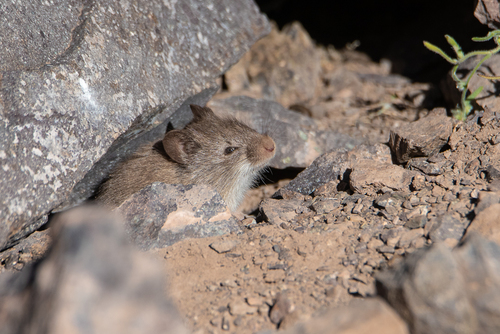
Rocky steppes, talus slopes, scree and boulder fields, and stone-covered montane grasslands in semi-arid continental environments. This species shows a strong preference for areas with exposed rock providing shelter and escape cover. It may also occupy shrubby valleys and dry riverbeds with a rocky substrate.
Adaptations to its environment
The silvery-gray pelage offers excellent crypsis against pale rock and stone surfaces. Its compact, robust body form minimizes heat loss in the extreme continental climate of Mongolia, where winter temperatures regularly fall below -30°C. Strong, curved claws aid in navigating rocky substrates, and food-caching behavior (storing dried grasses and forbs) ensures survival through harsh winters.
Conservation status and numbers
Listed as Least Concern (LC) on the IUCN Red List. The species occupies a sufficiently wide range across Mongolia and adjacent countries, with no evidence of rapid population decline or major range contraction. Its preferred rocky habitat is relatively resilient to most large-scale land-use changes affecting Mongolian grassland species.
Estimated population
No precise global population estimate is available. The species is considered locally common within suitable rocky habitat across its range, with no documented evidence of significant population decline. Population trend is assumed stable.
What threatens the Mongolian Silver Vole?
The primary potential threats include overgrazing by domestic livestock, which can degrade steppe vegetation and alter the plant community on which this vole depends. Mining and infrastructure expansion in Mongolia pose localized habitat disruption risks. Climate change may shift the distribution of suitable rocky steppe habitat and alter precipitation regimes, indirectly affecting food availability.
Diseases and parasites
Like other Central Asian rodents, this species is likely a host for ectoparasites including fleas, ticks, and mites. It may harbor endoparasites such as nematodes and cestodes. Central Asian rodents are known reservoirs for various zoonotic pathogens (including plague, Yersinia pestis), though specific documented associations for A. semicanus are not published.
What is being done to protect it?
The species benefits indirectly from Mongolian protected areas such as Khovsgol National Park, the Gobi Gurvan Saikhan National Park, and several Strictly Protected Areas that encompass rocky montane steppe habitat. No species-specific conservation programs are known to exist.
Recommended actions
Systematic population monitoring across its Mongolian range is recommended to detect any future decline. Assessments of the cumulative impacts of mining, overgrazing, and climate change on rocky steppe ecosystems would help identify emerging risks. Inclusion in broader Central Asian small mammal biodiversity programs would improve the knowledge base.
What the Mongolian Silver Vole looks like
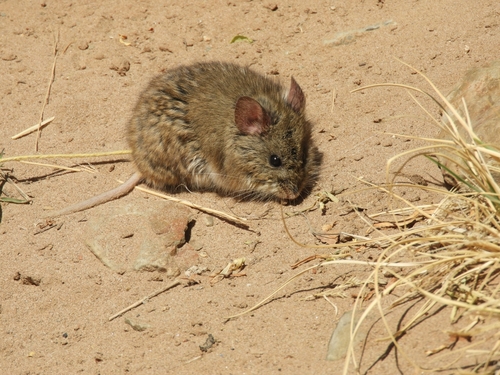
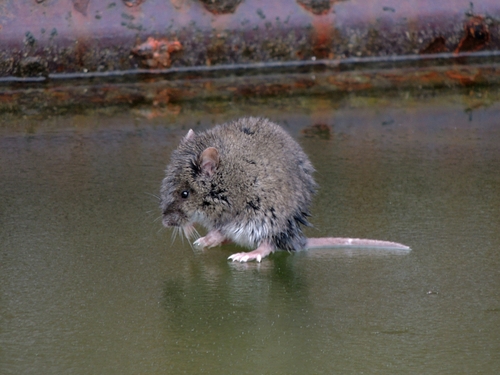
Dorsal fur is silvery-gray, sometimes with a faint ochraceous or buffy wash along the flanks; the ventral surface is pale whitish or creamy. The tail is bicolored (darker above, paler below) and noticeably short. The ears are moderately large and rounded, and the eyes are small and dark.
Size
Body length approximately 90–135 mm; tail length approximately 25–45 mm (relatively short, about 25–35% of body length); hind foot length approximately 16–20 mm.
Weight
Approximately 20–55 g; no marked sexual dimorphism in body mass.
Distinctive features
Distinguished from the closely related Silver Mountain Vole (A. argentatus) by its geographic range in lower-altitude Mongolian rocky steppes, its subtly different fur tone, and specific cranial and dental characters. The combination of silvery-gray dorsum, very short tail, and stocky body form separates it from most sympatric rodents. Definitive identification typically requires skull and dental measurements.
Differences between males and females
Minimal; males and females are similar in size and coloration. Any size difference is slight and not diagnostically useful in the field, as in most arvicoline rodents.
Behaviour and diet of the Mongolian Silver Vole
Likely semi-solitary or organized in small family units occupying defined rocky territories. Individuals shelter in rock crevices, beneath boulders, and in short burrows. Social tolerance may increase during the breeding season, and overlapping home ranges between males and females are probable.
When it is active
Primarily diurnal and crepuscular; most active in the morning and late afternoon when temperatures are moderate. Activity may shift to cooler periods during midsummer heat and may be reduced during the coldest winter months.
Diet
Strictly herbivorous. Diet consists of grasses, sedges, forbs, seeds, and other available plant material from the surrounding rocky steppe. Like other Alticola voles, it is believed to cache dried vegetation (forming small 'haystacks') near its sheltering rocks to provision itself through winter.
Communication
Produces high-pitched squeaks and alarm calls when threatened. Scent marking with urine and glandular secretions likely mediates territorial boundaries and reproductive signaling, as in related vole species. Vibrational or tactile signals may be used in confined rocky shelters.
Interactions with other species
Natural predators include raptors (upland buzzard Buteo hemilasius, rough-legged hawk, Saker falcon), small mustelids (stoat Mustela erminea, Siberian weasel M. sibirica), and pit vipers of the Mongolian steppe. It likely competes with pikas (Ochotona spp.) and other sympatric voles for rocky shelter and food resources. It is an important prey species for multiple predator guilds in the steppe ecosystem.
Role in its ecosystem
Functions as a primary consumer in the rocky steppe food web, converting plant biomass into animal biomass accessible to a wide range of predators. Food-caching behavior may locally influence vegetation dynamics near rocky shelters. Burrowing and movement beneath rocks contributes modestly to soil aeration and litter fragmentation.
Reproduction and lifecycle
Breeding season likely extends from April or May through August or September, with 2–4 litters possible per season under favorable conditions. Gestation is estimated at approximately 19–21 days, typical of arvicolines. Litter size is estimated at 3–7 young.
Raising the young
The female is the primary caregiver, nursing young in a nest of dry grass and plant fiber placed within a rock crevice or burrow. Young are altricial at birth, becoming mobile within approximately 2 weeks, and are weaned at around 3 weeks of age.
Maturity and lifespan
Sexual maturity is likely reached at approximately 5–8 weeks of age, consistent with other small arvicolines. Wild lifespan is estimated at 1–2 years given high predation pressure; captive individuals of related species may live up to 3 years.
Taxonomy and naming of the Mongolian Silver Vole
Classification
Mammalia > Rodentia > Cricetidae (subfamily Arvicolinae) > Alticola > Alticola semicanus
Scientific synonyms
Described by G.S. Miller in 1899 as Alticola semicanus; occasionally treated in older literature as affiliated with Alticola argentatus. No widely accepted junior synonyms are established.
What research says
Recent studies
Recent molecular phylogenetic analyses of the genus Alticola, particularly those reassessing Central Asian small mammal diversity, have supported the distinctiveness of A. semicanus from A. argentatus. Broad faunal surveys in Mongolia conducted since the 2000s have refined knowledge of its distributional range and habitat associations.
Genome and DNA
The karyotype of A. semicanus has not been extensively published. Related Alticola species typically have diploid chromosome numbers around 2n = 54. Molecular phylogenetic studies using mitochondrial and nuclear markers have helped confirm A. semicanus as a valid species within the Alticola clade.
Compared with similar species
Most closely related to the Silver Mountain Vole (A. argentatus) and Stoliczka's Mountain Vole (A. stoliczkanus), all sharing rocky habitat preferences and a similar compact body plan. A. semicanus is distinguished from A. argentatus by its more northerly and lower-elevation Mongolian distribution and subtle morphological differences. It shares its rocky steppe habitat with Brandt's vole (Lasiopodomys brandtii) in grassier areas, though the latter lacks the strong affinity for rocky terrain.
The Mongolian Silver Vole and people
The Latin name 'semicanus' means 'half-gray,' a fitting description for a vole whose silvery coat makes it nearly invisible against the pale stones of the Mongolian steppe. Despite living through winters where temperatures can plunge to -40°C, the Mongolian Silver Vole does not hibernate, instead surviving on carefully cached haystacks of dried grass stored next to its rocky den. This tiny rodent inhabits some of the most extreme continental climate zones on Earth — the same Mongolian landscapes once crossed by Genghis Khan's mounted armies.
Where and how to see it
Best observed in central and northern Mongolia during summer (June–August), when animals are most active during cooler morning and late afternoon hours. Rocky hillsides, talus slopes, and boulder fields in the Khangai Mountains, Khövsgöl region, and the foothills of the Mongolian Altai are excellent search areas. Sitting quietly near a suitable rocky outcrop and scanning with binoculars is the most effective observation technique, as the species is alert and retreats rapidly into rock crevices when disturbed.
Risks to humans
No notable direct risk to humans. As a wild rodent in a region where plague (Yersinia pestis) is enzootic, individuals should avoid handling wild-caught animals and be alert to flea bites when in the field. Standard precautions apply for anyone working with live-trapped rodents in Central Asia.
Countries where the Mongolian Silver Vole is recorded
The 3 countries named in the range description of its IUCN Red List assessment.
Questions about the Mongolian Silver Vole
Where does the Mongolian Silver Vole live?
The Mongolian Silver Vole is recorded in China, Mongolia and Russia across Asia and Europe. These countries come from the range description of its IUCN Red List assessment, and they are what place the species on the interactive map.
Is the Mongolian Silver Vole endangered?
The IUCN Red List assesses the Mongolian Silver Vole as Least Concern. The species is widespread and abundant enough not to qualify for any threatened category. It does not mean the species is safe forever, only that nothing in the current data raises an alarm.
How many are left in the wild?
No precise global population estimate is available. This figure comes from the species assessment on the IUCN Red List; population estimates for wild mammals are ranges, not counts, and are revised at each assessment.
What habitat does the Mongolian Silver Vole live in?
Rocky steppes, talus slopes, scree and boulder fields, and stone-covered montane grasslands in semi-arid continental environments.
What is the scientific name of the Mongolian Silver Vole?
The Mongolian Silver Vole is Alticola semicanus, in the family Cricetidae, order Rodentia.
Other species in the genus Alticola

Other species in the family Cricetidae
Sources
Conservation status, range description and population estimate come from the IUCN Red List assessment for Alticola semicanus. Countries are derived from that range description, not from a mapped country list. Last refreshed on .
The distribution map is drawn from the IUCN Red List spatial data compiled in 2008. IUCN (International Union for Conservation of Nature)