
Andean Long-clawed Mouse
Chelemys macronyx
Red List assessment
Least Concernon the IUCN Red List
- EXExtinct
- EWExtinct in the Wild
- CRCritically Endangered
- ENEndangered
- VUVulnerable
- NTNear Threatened
- LCLeast Concern
The Andean Long-clawed Mouse is recorded in 2 countries across South America. The IUCN Red List assesses the Andean Long-clawed Mouse as Least Concern. No precise population estimate exists; the species is considered to have a stable population based on its relatively broad range and lack of severe localized threats.
- Family
- Cricetidae
- Order
- Rodentia
- Genus
- Chelemys
- Countries recorded
- 2
- Continents
- South America
- Red List category
- Least Concern
- Data updated
- August 9, 2026
What is the Andean Long-clawed Mouse?
The Andean Long-clawed Mouse is a small burrowing rodent endemic to the temperate forests and Andean scrublands of southern Chile and Argentina. It is notable for its long, powerful claws adapted for digging, which give the species its common name. This species is part of a specialized group of South American rodents adapted to fossorial life. It plays a role in soil aeration and is an indicator species for healthy Andean ecosystems.
Where does the Andean Long-clawed Mouse live?
Southern Chile and Argentina, particularly in the Andean regions of Patagonia
Distributed along the Andes in southern Chile (from Bío Bío to Aysén regions) and adjacent Argentine Patagonia, primarily in the temperate forest biome of the southern Andes.
Altitude and depth
Typically found between 200-1500 meters above sea level in Andean foothill and mountain habitats.
Seasonal movements
No long-distance migration; activity may decrease slightly during harsh winter months but the species does not undergo true hibernation.
Habitat of the Andean Long-clawed Mouse
Found in temperate Nothofagus forests, Andean scrubland, and grassy meadows with loose, well-drained soil suitable for burrowing. Often associated with volcanic soils and areas with dense understory vegetation.
Adaptations to its environment
Possesses elongated, robust foreclaws specialized for digging burrows and searching for subterranean invertebrates. Its compact body and dense fur provide insulation against the cool, wet climate of the southern Andes.
Conservation status and numbers
Listed as Least Concern (LC) by the IUCN due to a relatively wide distribution and presumed stable population, though data on population trends remain limited.
Estimated population
No precise population estimate exists; the species is considered to have a stable population based on its relatively broad range and lack of severe localized threats.
What threatens the Andean Long-clawed Mouse?
Habitat loss due to deforestation, agricultural expansion, and logging in Andean forest regions poses the primary threat. Climate change affecting soil moisture and vegetation cover may also impact burrowing habitat suitability.
What is being done to protect it?
Some populations occur within protected areas and national parks in Chile and Argentina that preserve Nothofagus forest habitat, indirectly benefiting this species. No species-specific conservation programs are currently known.
Recommended actions
Recommended actions include further population and distribution surveys, monitoring habitat degradation in unprotected areas, and incorporating this species into broader Andean forest conservation planning.
What the Andean Long-clawed Mouse looks like
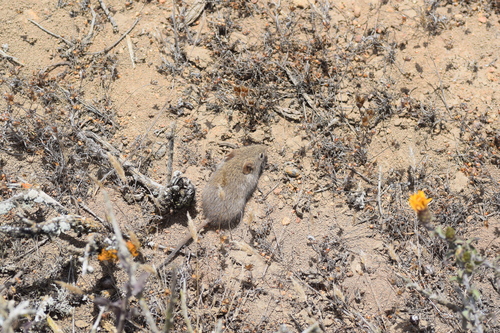
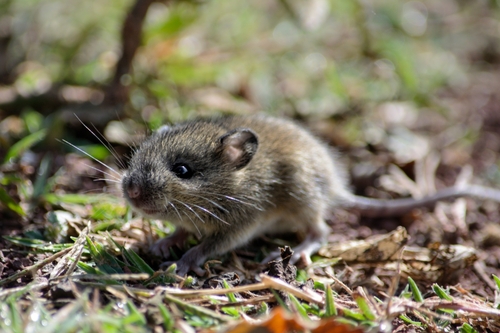
The fur is typically dark grayish-brown on the dorsal side with lighter, grayish underparts. It has small eyes and ears, a pointed snout, and notably long, curved claws on the forefeet adapted for digging.
Size
Body length approximately 9-12 cm, with a tail around 5-7 cm, giving a total length of roughly 14-19 cm.
Weight
Estimated body weight ranges from 20-40 grams.
Distinctive features
Distinguished from related species by its unusually long foreclaws relative to body size and its specific fossorial morphology, including a robust forelimb structure adapted for digging in Andean soils.
Behaviour and diet of the Andean Long-clawed Mouse
Generally solitary, with individuals maintaining separate burrow systems; social interactions are minimal outside of breeding encounters.
When it is active
Primarily nocturnal to crepuscular, though some diurnal activity may occur in remote, undisturbed habitats away from predators.
Diet
Omnivorous diet consisting mainly of soil invertebrates such as earthworms and insect larvae, supplemented with roots, seeds, and other plant material.
How it feeds and hunts
Uses its specialized claws to dig through soil and leaf litter, locating and extracting invertebrate prey from underground burrows and root systems.
Communication
Likely relies on scent marking via burrow systems and possibly soft vocalizations, consistent with other small fossorial rodents, though detailed studies are lacking.
Interactions with other species
Predated upon by owls, foxes, and other small carnivores native to the Andean forest ecosystem; may compete with other small rodents for similar burrowing habitat and food resources.
Role in its ecosystem
Functions as a soil engineer through its burrowing activity, contributing to soil aeration and nutrient cycling, while also serving as a prey source within the Andean forest food web.
Reproduction and lifecycle
Breeding likely occurs in spring and summer months, with litters typically small, though exact gestation length and litter size are not well documented for this species.
Raising the young
Presumed that females provide primary care for offspring within burrow nests, similar to related cricetid rodents, though specific behaviors have not been extensively studied.
Maturity and lifespan
Sexual maturity is likely reached within the first year of life, with a lifespan in the wild estimated at 2-3 years, typical for small cricetid rodents.
Taxonomy and naming of the Andean Long-clawed Mouse
Classification
Mammalia > Rodentia > Cricetidae > Chelemys > Chelemys macronyx
Scientific synonyms
Notiomys macronyx
What research says
Recent studies
Limited recent taxonomic and phylogenetic studies have examined its relationships within the genus Chelemys, helping clarify its distinction from closely related fossorial rodents in the region.
Compared with similar species
Similar in ecological niche to other South American fossorial cricetids like Notiomys and Geoxus, but distinguished by its longer claws and specific Andean forest habitat preference.
The Andean Long-clawed Mouse and people
Its remarkably long claws make it one of the most specialized diggers among South American rodents. Despite its burrowing lifestyle, it can also forage above ground at night. It belongs to a small and poorly studied genus with only a couple of recognized species.
Where and how to see it
Best observed at dusk or night in undisturbed Nothofagus forest areas of southern Chile's Andean foothills, though sightings are rare due to its secretive, burrowing lifestyle.
Risks to humans
No notable risk to humans.
Countries where the Andean Long-clawed Mouse is recorded
The 2 countries named in the range description of its IUCN Red List assessment.
Questions about the Andean Long-clawed Mouse
Where does the Andean Long-clawed Mouse live?
The Andean Long-clawed Mouse is recorded in Argentina and Chile across South America. These countries come from the range description of its IUCN Red List assessment, and they are what place the species on the interactive map.
Is the Andean Long-clawed Mouse endangered?
The IUCN Red List assesses the Andean Long-clawed Mouse as Least Concern. The species is widespread and abundant enough not to qualify for any threatened category. It does not mean the species is safe forever, only that nothing in the current data raises an alarm.
How many are left in the wild?
No precise population estimate exists; the species is considered to have a stable population based on its relatively broad range and lack of severe localized threats. This figure comes from the species assessment on the IUCN Red List; population estimates for wild mammals are ranges, not counts, and are revised at each assessment.
What habitat does the Andean Long-clawed Mouse live in?
Found in temperate Nothofagus forests, Andean scrubland, and grassy meadows with loose, well-drained soil suitable for burrowing.
What is the scientific name of the Andean Long-clawed Mouse?
The Andean Long-clawed Mouse is Chelemys macronyx, in the family Cricetidae, order Rodentia.
Other species in the genus Chelemys
Other species in the family Cricetidae
Species that share its range

Sources
Conservation status, range description and population estimate come from the IUCN Red List assessment for Chelemys macronyx. Countries are derived from that range description, not from a mapped country list. Last refreshed on .
The distribution map is drawn from the IUCN Red List spatial data compiled in 2008. IUCN (International Union for Conservation of Nature)