
Large-eared Vole
Alticola macrotis
Red List assessment
Least Concernon the IUCN Red List
- EXExtinct
- EWExtinct in the Wild
- CRCritically Endangered
- ENEndangered
- VUVulnerable
- NTNear Threatened
- LCLeast Concern
The Large-eared Vole is recorded in 4 countries across Asia and Europe. The IUCN Red List assesses the Large-eared Vole as Least Concern. No precise global estimate exists.
- Family
- Cricetidae
- Order
- Rodentia
- Genus
- Alticola
- Countries recorded
- 4
- Continents
- Asia and Europe
- Red List category
- Least Concern
- Data updated
- August 9, 2026
What is the Large-eared Vole?
The Large-eared Vole is a small, stout rodent of the genus Alticola, adapted to life among rocky outcrops and talus slopes at high elevations in Central Asian mountain ranges. It is named for its conspicuously large, rounded pinnae, which set it apart from many other vole species. Endemic to the alpine and subalpine zones of the Altai–Sayan mountain system and adjacent areas, it occupies one of the most physically demanding environments inhabited by any arvicoline rodent. Despite its harsh habitat, it maintains stable populations and is not currently considered at risk.
Where does the Large-eared Vole live?
Russia (Altai, Sayan, Tuva regions), Mongolia, northwestern China (Xinjiang, Inner Mongolia), possibly Kazakhstan
The species ranges across the Altai Mountains of southern Russia (Altai Republic, Tuva, Khakassia), the Sayan ranges, northern and western Mongolia, and extends into the Mongolian Altai and parts of Xinjiang and possibly Gansu in northwestern China. It is endemic to the Altai–Sayan biogeographic region.
Altitude and depth
Typically found between 1,500 m and 3,500 m above sea level; most records cluster between 2,000 m and 3,000 m in the alpine and subalpine belt.
Seasonal movements
Non-migratory and year-round resident in its rocky habitat. Does not hibernate, remaining active throughout winter under the snowpack and within rock crevices. Activity may be somewhat reduced during the harshest winter months, relying on cached food stores.
Habitat of the Large-eared Vole
Rocky montane terrain including talus slopes, boulder fields, scree, cliff faces, and alpine meadows interspersed with rocky outcrops. It favors areas with crevices and cavities in rocks that provide shelter from predators and weather. It occasionally ventures into adjacent shrubby or grassy alpine meadows to forage.
Adaptations to its environment
The enlarged ears may enhance hearing for predator detection in open rocky terrain. Dense, soft pelage provides insulation against extreme cold and rapid temperature fluctuations at altitude. Short limbs and a compact body minimize heat loss. The ability to store food in rock crevices allows survival through long alpine winters.
Conservation status and numbers
Least Concern (LC) on the IUCN Red List. The species has a relatively wide distribution within its specialist habitat, shows no evidence of rapid population decline, and its rocky montane habitats are largely intact and not subject to intensive human exploitation.
Estimated population
No precise global estimate exists. The population is thought to be stable given stable habitat conditions and LC status. Local densities can vary considerably depending on the availability of suitable rocky terrain.
What threatens the Large-eared Vole?
Climate change poses a potential long-term threat through upward compression and eventual loss of high-altitude rocky habitat. Overgrazing by livestock in some alpine areas may reduce vegetation quality and alter habitat structure near foraging zones. Mining and quarrying activities in montane areas may locally destroy habitat.
Diseases and parasites
Like other arvicoline rodents, it is likely host to various ectoparasites (fleas, mites, ticks) and endoparasites (nematodes, cestodes). As a rodent in Central Asia, it could theoretically harbor zoonotic pathogens, but no specific disease associations have been well documented for this species.
What is being done to protect it?
Parts of its range fall within protected areas such as the Altaisky Zapovednik and Sayano-Shushensky Biosphere Reserve in Russia and several protected areas in Mongolia. No species-specific conservation programs exist due to its LC status.
Recommended actions
Long-term monitoring of population trends in the context of climate change is advisable. Protection of alpine rocky habitats from mining expansion and uncontrolled grazing would benefit the species. Further taxonomic and phylogeographic studies are needed to resolve subspecific diversity.
What the Large-eared Vole looks like
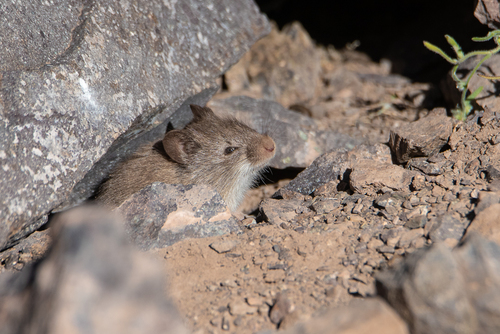
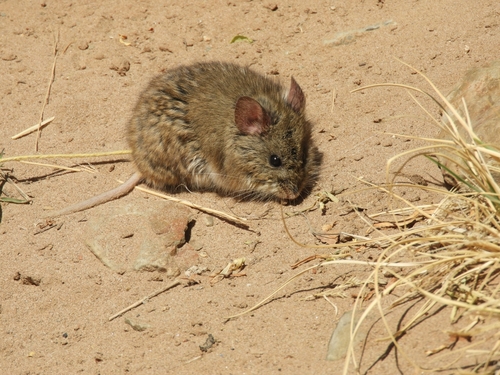
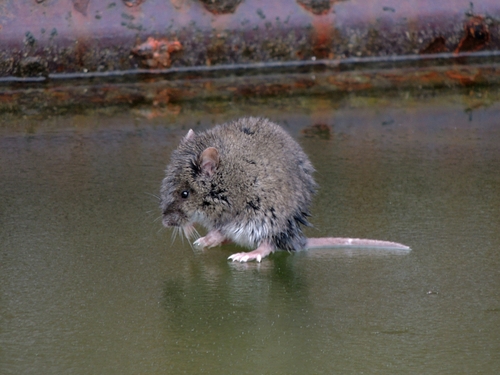
The dorsal pelage is typically soft and dense, ranging from pale grayish-brown to ochraceous buff, often with a slightly paler or whitish venter. The large, rounded ears are lightly furred and pale. The tail is bicolored, darker above and paler below, and relatively short. The eyes are small and dark.
Size
Head-body length approximately 90–130 mm; tail length 20–40 mm (relatively short for an Alticola); hindfoot 15–20 mm.
Weight
Typically 20–45 g; adults in late summer prior to winter may reach the higher end of this range due to fat accumulation.
Distinctive features
The most visually striking feature is its disproportionately large ears compared to other Alticola species and most other voles of the region. It is generally larger and paler than Alticola strelzowi and can be distinguished from Alticola argentatus by its ear size and subtle cranial features.
Differences between males and females
Sexual dimorphism is minimal; males and females are similar in size and coloration, as is typical for arvicoline rodents.
Behaviour and diet of the Large-eared Vole
Likely semi-social, similar to other Alticola species; individuals may share rock crevice systems, particularly in winter. Not strongly territorial, though adults may defend immediate foraging and shelter areas. Detailed social structure has not been thoroughly studied.
When it is active
Primarily active during daylight hours (diurnal) and at dawn and dusk (crepuscular), with activity patterns likely shifting seasonally. Under snow cover in winter, activity is channeled through subnivean runways and rock crevices.
Diet
Strictly herbivorous; feeds on grasses, sedges, forbs, mosses, and lichens typical of alpine rocky habitats. In winter, it relies on plant material cached in rock crevices during the warmer months, including dried grasses and seeds.
How it feeds and hunts
Not applicable; herbivore. Forages by cropping vegetation near rocky outcrops, making short excursions from cover. May pull plant stems into crevices for storage.
Communication
Likely uses high-pitched vocalizations for alarm and contact calls, as seen in related Alticola species. Scent marking via flank glands and urine may delineate individual ranges within shared rock systems. Specific communication behavior has not been extensively studied.
Interactions with other species
Predators include raptors (golden eagles, rough-legged buzzards), small mustelids (weasels, stoats), and foxes. Competes with other small rodents in alpine zones such as pikas (Ochotona spp.) for food and shelter sites. No known commensal or symbiotic relationships have been documented.
Role in its ecosystem
Serves as an important prey item for alpine predators, contributing to local food web dynamics. As a herbivore, it plays a role in nutrient cycling through grazing and food caching. May contribute to seed dispersal incidentally through caching behavior.
Reproduction and lifecycle
Breeding season likely extends from late spring through early autumn (May–September), constrained by the short alpine growing season. Gestation is approximately 19–21 days, typical for arvicolines. Litter size is estimated at 3–8 pups, and multiple litters per season are likely.
Raising the young
Altricial young are born in a nest constructed within rock crevices or under boulders, lined with dry grass and moss. The female is the primary caregiver; pups are weaned at approximately 3 weeks. Young become independent relatively quickly, within 4–6 weeks.
Maturity and lifespan
Sexual maturity is likely reached at 4–6 weeks of age, consistent with other voles. Lifespan in the wild is probably 1–2 years; captive longevity data are not available for this species.
Taxonomy and naming of the Large-eared Vole
Classification
Mammalia > Rodentia > Cricetidae > Arvicolinae > Alticola > Alticola macrotis
Subspecies
Alticola macrotis macrotis (Radde, 1862) is the nominate subspecies; additional infraspecific divisions have been proposed but remain poorly resolved and are not universally accepted.
Scientific synonyms
Microtus macrotis Radde, 1862; Arvicola macrotis; historically sometimes treated as conspecific with Alticola argentatus.
What research says
Recent studies
Recent molecular phylogenetic studies on the genus Alticola have helped clarify species boundaries and relationships within this complex group. Some analyses suggest that Alticola macrotis may represent a species complex with cryptic diversity across its range, but formal taxonomic revisions are pending.
Genome and DNA
Chromosome number has been reported as 2n = 54 in some Alticola species; specific karyotypic data for A. macrotis may vary and detailed molecular studies remain limited. Phylogenomic analyses place it within the Central Asian Alticola clade.
Compared with similar species
Closely related to Alticola argentatus (Silver Mountain Vole), which shares similar rocky alpine habitat but tends to be paler and has relatively smaller ears. Alticola strelzowi is smaller and darker. Among non-Alticola voles, it superficially resembles pikas in habitat preference but is much smaller and behaviorally distinct.
The Large-eared Vole and people
The 'large ears' that give this vole its common name are among the most prominent pinnae of any vole species worldwide, likely acting as sophisticated acoustic sensors in the wind-swept, predator-rich alpine landscape. Like certain other alpine rodents, this species can remain active year-round at altitudes where temperatures regularly plunge well below −30°C, surviving thanks to thick insulating fur and food caches wedged deep in rock crevices. Although it shares rocky habitats with pikas, the Large-eared Vole has independently evolved a similar 'haymaking' behavior — cutting and drying plant material before storing it — a striking example of convergent ecological adaptation.
Where and how to see it
Best observed in the Altai Republic of Russia or in the Mongolian Altai during late spring to early autumn (June–August) when animals are most active above the snowline. Look for movement among boulders and scree slopes between 2,000 and 3,000 m elevation in the early morning or late afternoon. Patience and stillness near talus slopes with visible runways or droppings are key; the species is cautious and retreats quickly into crevices when alarmed.
Risks to humans
No notable risk to humans. As with any wild rodent in Central Asia, theoretical risk of ectoparasite transmission (ticks, fleas) exists if handled, but the species is not known to be a significant reservoir of human-pathogenic agents.
Human uses
No known significant human uses. Not a target of commercial trapping or traditional medicine. Occasionally collected as museum specimens for scientific study.
Myths and legends
No specific myths, legends, or cultural symbolism are known to be associated with this species in the traditional cultures of its range. Small rodents in Mongolian and Siberian folklore are occasionally regarded as indicators of ecosystem health, but no specific lore tied to A. macrotis has been recorded.
Countries where the Large-eared Vole is recorded
The 4 countries named in the range description of its IUCN Red List assessment.
Questions about the Large-eared Vole
Where does the Large-eared Vole live?
The Large-eared Vole is recorded in China, Kazakhstan, Mongolia and Russia across Asia and Europe. These countries come from the range description of its IUCN Red List assessment, and they are what place the species on the interactive map.
Is the Large-eared Vole endangered?
The IUCN Red List assesses the Large-eared Vole as Least Concern. The species is widespread and abundant enough not to qualify for any threatened category. It does not mean the species is safe forever, only that nothing in the current data raises an alarm.
How many are left in the wild?
No precise global estimate exists. This figure comes from the species assessment on the IUCN Red List; population estimates for wild mammals are ranges, not counts, and are revised at each assessment.
What habitat does the Large-eared Vole live in?
Rocky montane terrain including talus slopes, boulder fields, scree, cliff faces, and alpine meadows interspersed with rocky outcrops.
What is the scientific name of the Large-eared Vole?
The Large-eared Vole is Alticola macrotis, in the family Cricetidae, order Rodentia.
Other species in the genus Alticola

Other species in the family Cricetidae
Sources
Conservation status, range description and population estimate come from the IUCN Red List assessment for Alticola macrotis. Countries are derived from that range description, not from a mapped country list. Last refreshed on .
The distribution map is drawn from the IUCN Red List spatial data compiled in 2008. IUCN (International Union for Conservation of Nature)