
Central Kashmir Vole
Alticola montosa
Red List assessment
Vulnerableon the IUCN Red List
- EXExtinct
- EWExtinct in the Wild
- CRCritically Endangered
- ENEndangered
- VUVulnerable
- NTNear Threatened
- LCLeast Concern
The Central Kashmir Vole is recorded in 2 countries across Asia. The IUCN Red List assesses the Central Kashmir Vole as Vulnerable. No precise global population estimate exists.
- Family
- Cricetidae
- Order
- Rodentia
- Genus
- Alticola
- Countries recorded
- 2
- Continents
- Asia
- Red List category
- Vulnerable
- Data updated
- August 9, 2026
What is the Central Kashmir Vole?
The Central Kashmir Vole is a small, high-altitude rodent belonging to the genus Alticola, a group of mountain voles adapted to rocky alpine environments across Central and South Asia. It is endemic to a restricted area of the central Kashmir Himalayas, making it one of the more geographically limited members of its genus. Its remarkable adaptation to extreme elevations and rugged scree terrain distinguishes it from lowland voles. It is listed as Vulnerable by the IUCN primarily due to its very small known range and ongoing habitat pressures.
Where does the Central Kashmir Vole live?
Endemic to the high mountain regions of central Kashmir, Jammu & Kashmir state, India. Possibly extending into adjacent areas of Pakistan-administered Kashmir.
Restricted to the high mountains of central Kashmir, within the Indian union territory of Jammu & Kashmir. Known from a very limited number of localities in the western Himalayan range, with the precise extent of its range remaining incompletely documented.
Altitude and depth
Typically found between approximately 3,000 and 4,800 meters above sea level, with the core population likely concentrated in the 3,500–4,500 m range.
Seasonal movements
Does not migrate but likely reduces above-ground activity during the harshest winter months. Like other high-altitude voles, it may cache food and remain active beneath snow cover in subnivean spaces rather than entering true hibernation.
Habitat of the Central Kashmir Vole
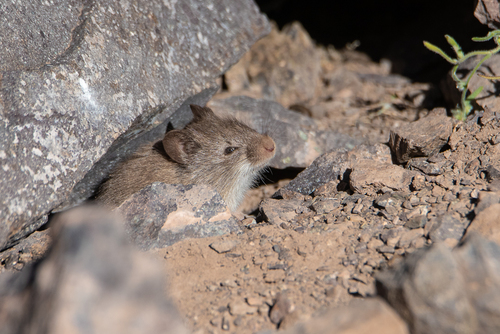
Alpine rocky slopes, scree fields, boulder-strewn grasslands, and subalpine meadows above the treeline. It favors habitats with interspersed rocks providing shelter from predators and harsh weather, combined with patches of low vegetation for foraging.
Adaptations to its environment
Dense, soft underfur provides excellent insulation against alpine cold. Compact body shape minimizes heat loss. Broad, clawed feet facilitate movement over rocky terrain. Its cryptic brownish-gray coloration provides camouflage against rock and dry grass backgrounds. Behavioral flexibility allows it to forage under snow in winter.
Conservation status and numbers
Vulnerable (VU) on the IUCN Red List, assessed due to its highly restricted endemic range (estimated extent of occurrence well below 20,000 km²), low number of known subpopulations, and inferred continuing decline in habitat quality driven by livestock overgrazing and climate-related changes to alpine vegetation.
Estimated population
No precise global population estimate exists. The population is considered small and likely declining, consistent with its Vulnerable status and restricted range.
What threatens the Central Kashmir Vole?
Overgrazing by domestic livestock (sheep, goats, cattle) degrades the alpine meadow vegetation on which it depends. Climate change is shrinking suitable high-altitude habitat as snowlines and vegetation zones shift upward. Habitat disturbance from expanding pastoral activities and occasional collection for local use may also pose risks.
Diseases and parasites
Specific parasites and diseases have not been documented for this species. Like other rodents, it is likely host to various ectoparasites (fleas, mites, ticks) and endoparasites (helminths, coccidia), some of which may act as vectors for zoonotic diseases.
What is being done to protect it?
Portions of its range may fall within protected areas such as Dachigam National Park or nearby wildlife sanctuaries in Jammu & Kashmir, though protection specifically targeting this species is not documented. Indian wildlife legislation (Wildlife Protection Act, 1972) provides general legal protection to wild mammals.
Recommended actions
Comprehensive field surveys to map its full distribution and estimate population size. Long-term monitoring of population trends and habitat quality. Regulation of livestock grazing pressure in key alpine habitats. Inclusion in regional biodiversity assessments and targeted conservation planning for high-altitude Himalayan small mammals.
What the Central Kashmir Vole looks like
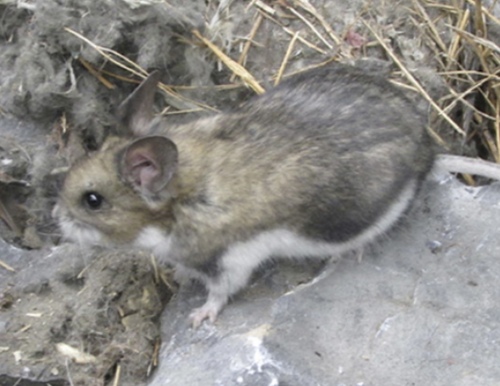
Soft, dense fur that is grayish-brown to tawny-brown on the dorsal surface, transitioning to paler whitish or grayish tones on the underparts. The tail is short, bicolored (darker above, paler below), and sparsely haired. Eyes are moderately large, ears relatively short and rounded, and the snout is blunt.
Size
Body length approximately 90–115 mm; tail length approximately 25–40 mm (relatively short compared to body). Total length roughly 115–155 mm.
Weight
Estimated 25–50 grams; no significant documented sexual size dimorphism, consistent with other Alticola species.
Distinctive features
Distinguished from the sympatric or nearby Alticola roylei (Royle's Mountain Vole) by subtle differences in skull morphology, pelage coloration, and geographic range. The relatively shorter tail and specific cranial measurements are key distinguishing features used by taxonomists.
Differences between males and females
Sexual dimorphism appears minimal, as is typical in Alticola voles; males and females are similar in size and coloration.
Behaviour and diet of the Central Kashmir Vole
Likely semi-colonial or loosely social, potentially maintaining overlapping home ranges with conspecifics around shared rocky refuges, as seen in related mountain voles. Not strongly territorial, but may defend immediate burrow or crevice sites.
When it is active
Polyphasic (active in multiple short bouts throughout the 24-hour cycle), which is typical for small rodents in alpine environments. May be more active during daylight hours in summer to exploit longer days and warmth.
Diet
Strictly herbivorous. Diet consists of grasses, sedges, alpine herbs, forbs, mosses, roots, and seeds. It may store food in caches within rock crevices to sustain itself during winter months when vegetation is snow-covered.
Communication
Likely uses ultrasonic vocalizations for intraspecific communication, as documented in related vole species. Scent marking via urine and glandular secretions is probable for territorial delineation. Alarm calls may alert conspecifics to predator presence.
Interactions with other species
Predated upon by raptors (e.g., Golden Eagle, Upland Buzzard, Himalayan Griffon), mustelids (e.g., weasels, stoats), foxes, and possibly Snow Leopard and Red Fox as incidental prey. Competes with other small rodents and pikas (Ochotona spp.) for food resources and shelter sites.
Role in its ecosystem
Plays an important role as a prey base for alpine predators and as a grazer/seed consumer influencing alpine plant communities. Its burrowing and caching behavior may contribute to minor soil turnover and seed dispersal in rocky alpine zones.
Reproduction and lifecycle
Breeding season likely concentrated in the warmer months (May–September) at high altitude. Gestation period estimated at approximately 20–25 days, consistent with related arvicolines. Litter size probably ranges from 3 to 6 young. Multiple litters per season are possible during favorable conditions.
Raising the young
The female provides primary parental care, nursing and warming the young in a nest constructed within a rock crevice or burrow. Young are altricial at birth but develop rapidly and are weaned within 2–3 weeks.
Maturity and lifespan
Sexual maturity is likely reached at 4–8 weeks of age, as typical in arvicolines. Lifespan in the wild is probably 1–2 years; captive lifespan data are unavailable for this species.
Taxonomy and naming of the Central Kashmir Vole
Classification
Mammalia > Rodentia > Cricetidae (subfamily Arvicolinae) > Alticola > Alticola montosa
Scientific synonyms
Originally described by Oldfield Thomas in 1907 as Alticola montosa. Some earlier taxonomic works placed it provisionally within the broader Alticola roylei complex, but it is now treated as a distinct species.
What research says
Recent studies
Published research specifically focused on Alticola montosa is scarce. It appears in regional faunal surveys of Himalayan small mammals and IUCN assessment documents, but targeted ecological or genetic studies are lacking as of the early 2020s.
Genome and DNA
Chromosome number has not been definitively published for A. montosa. Closely related Alticola species show variable karyotypes (2n ranging from 34 to 54 across the genus), reflecting the notable chromosomal diversity within Arvicolinae.
Compared with similar species
Most similar to Alticola roylei (Royle's Mountain Vole) and Alticola stoliczkanus (Stoliczka's Mountain Vole), all of which inhabit rocky high-altitude terrain across the Himalayas and Karakoram. A. montosa is distinguished by its more restricted central Kashmiri range and specific craniometric characters. All Alticola species share the characteristic dense insulative fur and short tail adapted to cold mountain environments.
The Central Kashmir Vole and people
Like some other subnivean small mammals, the Central Kashmir Vole likely exploits the insulating layer between snow and ground in winter, maintaining a microclimate that can be 20–30°C warmer than the outside air. Despite living in one of the most geographically contested regions on Earth (Kashmir), this tiny vole was scientifically described over a century ago and remains understudied. The genus Alticola contains some of the highest-altitude-dwelling rodents in the world, with certain species recorded above 5,000 meters.
Where and how to see it
Best sought in the high-altitude rocky meadows and scree slopes of central Kashmir during summer months (June–September) when snow cover is minimal. Look for runways through vegetation between boulders and listen for short alarm chips. Areas around Sonamarg and the upper Lidder Valley in Jammu & Kashmir may offer suitable habitat. Early morning activity bouts can be productive.
Risks to humans
No notable risk to humans. As with all wild rodents, handling should be avoided due to the potential for ectoparasite transmission or minor bites if cornered.
Countries where the Central Kashmir Vole is recorded
The 2 countries named in the range description of its IUCN Red List assessment.
Questions about the Central Kashmir Vole
Where does the Central Kashmir Vole live?
The Central Kashmir Vole is recorded in India and Pakistan across Asia. These countries come from the range description of its IUCN Red List assessment, and they are what place the species on the interactive map.
Is the Central Kashmir Vole endangered?
Yes. The IUCN Red List assesses the Central Kashmir Vole as Vulnerable, one of the three threatened categories. The species faces a high risk of extinction in the wild. It is the first of the three threatened categories: numbers are falling, the range is shrinking, or the population is small enough that a single bad event could do lasting damage.
How many are left in the wild?
No precise global population estimate exists. This figure comes from the species assessment on the IUCN Red List; population estimates for wild mammals are ranges, not counts, and are revised at each assessment.
What habitat does the Central Kashmir Vole live in?
Alpine rocky slopes, scree fields, boulder-strewn grasslands, and subalpine meadows above the treeline.
What is the scientific name of the Central Kashmir Vole?
The Central Kashmir Vole is Alticola montosa, in the family Cricetidae, order Rodentia.
Other species in the genus Alticola

Other species in the family Cricetidae
Sources
Conservation status, range description and population estimate come from the IUCN Red List assessment for Alticola montosa. Countries are derived from that range description, not from a mapped country list. Last refreshed on .
The distribution map is drawn from the IUCN Red List spatial data compiled in 2008. IUCN (International Union for Conservation of Nature)