
Gobi Altai Mountain Vole
Alticola barakshin
Red List assessment
Least Concernon the IUCN Red List
- EXExtinct
- EWExtinct in the Wild
- CRCritically Endangered
- ENEndangered
- VUVulnerable
- NTNear Threatened
- LCLeast Concern
The Gobi Altai Mountain Vole is recorded in 2 countries across Asia. The IUCN Red List assesses the Gobi Altai Mountain Vole as Least Concern. No precise global population estimate is available.
- Family
- Cricetidae
- Order
- Rodentia
- Genus
- Alticola
- Countries recorded
- 2
- Continents
- Asia
- Red List category
- Least Concern
- Data updated
- August 9, 2026
What is the Gobi Altai Mountain Vole?
The Gobi Altai Mountain Vole is a small arvicoline rodent endemic to the rocky mountain ranges of the Gobi-Altai region in southwestern Mongolia. It inhabits steep, talus-covered slopes and boulder fields at high elevations, where it shelters among rocks. Like other members of the genus Alticola, it is remarkably well-adapted to harsh, cold, semi-arid montane environments. It is a relatively poorly known species, and much of its ecology is inferred from congeners.
Where does the Gobi Altai Mountain Vole live?
Mongolia (Gobi-Altai mountain range), with possible range extension into adjacent northwestern China (Xinjiang)
Endemic to the Gobi-Altai mountain range of southwestern Mongolia; the range may marginally extend into adjacent portions of the Xinjiang Uyghur Autonomous Region of northwestern China. Its distribution is patchy, following the rocky ridgelines and massifs of this mountain system.
Altitude and depth
Typically found between approximately 1,800 and 3,500 m above sea level, occupying the alpine and subalpine rocky zones of the Gobi-Altai massif.
Seasonal movements
Does not hibernate but likely reduces activity during severe winter conditions. May cache food for winter use beneath rocks, as is common in Alticola species. No documented long-distance seasonal migrations.
Habitat of the Gobi Altai Mountain Vole
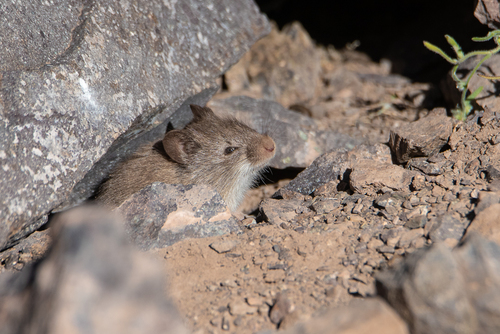
Rocky talus slopes, boulder fields, cliff faces, and scree zones in arid to semi-arid montane environments. Vegetation is sparse, dominated by alpine steppe grasses, sedges, and drought-tolerant shrubs. It avoids dense vegetated areas and strongly prefers rocky substrates for shelter and nesting.
Adaptations to its environment
Dense, soft fur provides insulation against extreme cold and temperature fluctuations. Compact body shape minimizes heat loss. Rocky crevice use provides thermal buffering and predator protection. Efficient kidneys allow water conservation in arid conditions, and the diet of dry plant material is adapted to scarce moisture availability.
Conservation status and numbers
Least Concern (LC) on the IUCN Red List. The species has a restricted but stable range within the Gobi-Altai; population numbers are not considered to be declining at a rate warranting a more threatened category. Monitoring data remain limited.
Estimated population
No precise global population estimate is available. The population is considered stable, though locally limited by the patchy distribution of suitable rocky habitat across the Gobi-Altai range.
What threatens the Gobi Altai Mountain Vole?
Overgrazing by livestock (particularly goats and camels) which can degrade the sparse alpine vegetation; climate change causing upward shifts in suitable rocky habitat zones; potential habitat disturbance from mining activities in the Gobi-Altai region. Predation pressure is natural rather than anthropogenic.
Diseases and parasites
No species-specific parasitological or disease studies are available. Like other Central Asian voles, it may host ectoparasites (fleas, mites, ticks) and endoparasites (helminths, coccidia), and could potentially serve as a reservoir for tick-borne pathogens or hantaviruses.
What is being done to protect it?
Part of the range falls within protected areas in Mongolia, including the Gobi-Gurvan-Saikhan National Park. Mongolia's Wildlife Law provides general protection to small mammals. No species-specific conservation programs are known to be in place.
Recommended actions
Conduct dedicated field surveys to better define the species' range and population size. Monitor potential impacts of climate change on high-altitude rocky habitats. Regulate livestock grazing intensity near talus zones. Assess the presence and impact of mining concessions within the known range.
What the Gobi Altai Mountain Vole looks like
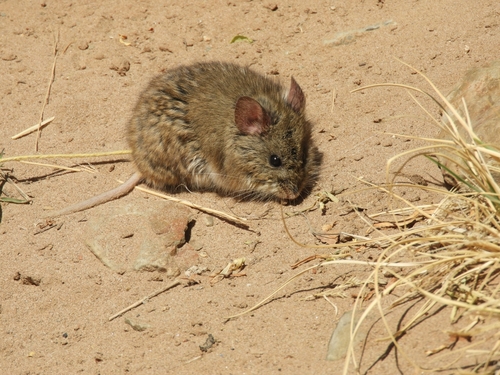
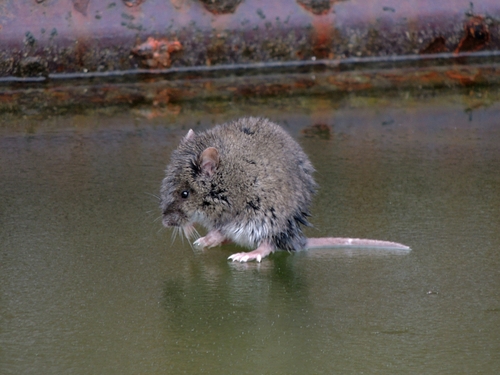
Dorsal fur is typically grayish-brown to ochraceous-grey, providing camouflage among rocks. Ventral fur is pale whitish or creamy. The tail is bicolored (darker above, paler below) and relatively short. Eyes are small and rounded; ears are moderately large and rounded, often partially hidden in fur.
Size
Body length approximately 90–130 mm; tail length approximately 25–45 mm (relatively short, typical of the genus). No significant data on shoulder height given the quadrupedal, low-profile posture.
Weight
Estimated 20–45 g based on comparable Alticola species; sexual size dimorphism is minimal.
Distinctive features
Distinguished from the closely related Silver Mountain Vole (A. argentatus) by its slightly darker, less silvery dorsal coloration and its restricted range in the Gobi-Altai. Differentiated from A. semicanus by cranial morphology and geographic range. Molecular and morphometric characters are required for definitive identification.
Differences between males and females
Minimal sexual dimorphism reported; males and females are similar in size and coloration, as is typical across the Alticola genus.
Behaviour and diet of the Gobi Altai Mountain Vole
Likely semi-social to solitary outside of the breeding season, with individuals maintaining small territories centered on rock crevices. Some communal nesting may occur in winter among family members to conserve heat, as seen in related species.
When it is active
Primarily diurnal to crepuscular, with peak foraging activity during morning and late afternoon. Activity patterns may shift seasonally in response to temperature extremes and predator pressure.
Diet
Strictly herbivorous; diet consists of grasses, sedges, forbs, mosses, lichens, and dry plant stems available in the alpine steppe. May gnaw on bark or roots during winter. Like congeners, it likely hoards dried plant material in rock crevices for winter consumption.
How it feeds and hunts
Not applicable; strictly herbivorous. Forages by cropping vegetation close to the ground near rocky refugia, rarely venturing far from shelter.
Communication
Uses ultrasonic vocalizations for mother-offspring communication and possibly for social signaling. Scent marking with urine and glandular secretions is likely used to establish territory boundaries, as in related voles. Foot-drumming on rocks may serve as an alarm signal.
Interactions with other species
Natural predators include raptors (Upland Buzzard, Saker Falcon, Short-eared Owl), mustelids (Siberian Weasel, Stoat), Red Fox, and potentially steppe snakes. It competes with other small mammals such as pikas (Ochotona species) for rocky habitat and food resources in the same zone.
Role in its ecosystem
Serves as an important prey base for montane predators in the Gobi-Altai ecosystem. As a herbivore, it contributes to nutrient cycling through consumption of plant material and deposition of feces in rocky substrate. May play a minor role in seed dispersal through food caching.
Reproduction and lifecycle
Breeding season likely extends from late spring through early autumn (approximately May–September), with 2–3 litters per year. Gestation is estimated at 17–21 days (typical of Alticola). Litter size is likely 3–7 pups per litter.
Raising the young
Altricial young are born hairless and blind in a nest lined with soft plant material within a rock crevice. The female provides primary parental care including nursing and nest maintenance. Young are weaned at approximately 3 weeks of age.
Maturity and lifespan
Sexual maturity is likely reached at 4–6 weeks of age, as typical of small arvicolines. Lifespan in the wild is estimated at 1–2 years; potentially up to 3 years in captivity under optimal conditions.
Taxonomy and naming of the Gobi Altai Mountain Vole
Classification
Mammalia > Rodentia > Cricetidae (subfamily Arvicolinae) > Alticola > Alticola barakshin
Scientific synonyms
Described by Bannikov in 1947; occasionally treated historically as a subspecies or close relative of Alticola argentatus (Silver Mountain Vole), but currently recognized as a distinct species.
What research says
Recent studies
No major recent studies focused exclusively on this species have been published. It appears in broader molecular phylogenetic analyses of the Alticola genus. Its taxonomic status has been clarified through morphological and genetic comparison with A. argentatus and related taxa.
Genome and DNA
Chromosome number has not been definitively published for this species. Congeners in Alticola show karyotypes ranging from 2n=34 to 2n=56. Molecular phylogenetic studies of the genus Alticola have helped confirm its species status.
Compared with similar species
Most closely related to other members of the argentatus-group within Alticola, particularly A. argentatus (Silver Mountain Vole) of the Pamir and Tian Shan ranges and A. semicanus (Mongolian Silver Vole). A. barakshin is distinguished primarily by geographic range, subtle pelage differences, and cranial measurements.
The Gobi Altai Mountain Vole and people
The species name 'barakshin' refers to the Barakshin locality in the Gobi-Altai of Mongolia, making it one of relatively few mammals named after a specific Mongolian toponym. Despite living in one of the harshest mountain environments on Earth, this vole does not hibernate and remains active year-round, relying on stored food and rock crevices to survive brutal winters. The Alticola genus as a whole is sometimes called 'high-mountain voles,' and several species have been recorded living above 5,000 m in the Himalayas — making them among the highest-altitude mammals on the planet.
Where and how to see it
Best observed in the Gobi-Altai mountain range of southwestern Mongolia, particularly around rocky talus slopes and boulder fields between 2,000 and 3,000 m elevation during summer months (June–August). Early morning hours near rock outcrops offer the best chance of sightings. The Gobi-Gurvan-Saikhan National Park area provides accessible high-altitude habitat.
Risks to humans
No notable risk. This small vole poses no direct threat to humans. As with all wild rodents, handling without protection is inadvisable due to potential ectoparasites or hantavirus risk, though no specific documented cases involve this species.
Countries where the Gobi Altai Mountain Vole is recorded
The 2 countries named in the range description of its IUCN Red List assessment.
Questions about the Gobi Altai Mountain Vole
Where does the Gobi Altai Mountain Vole live?
The Gobi Altai Mountain Vole is recorded in China and Mongolia across Asia. These countries come from the range description of its IUCN Red List assessment, and they are what place the species on the interactive map.
Is the Gobi Altai Mountain Vole endangered?
The IUCN Red List assesses the Gobi Altai Mountain Vole as Least Concern. The species is widespread and abundant enough not to qualify for any threatened category. It does not mean the species is safe forever, only that nothing in the current data raises an alarm.
How many are left in the wild?
No precise global population estimate is available. This figure comes from the species assessment on the IUCN Red List; population estimates for wild mammals are ranges, not counts, and are revised at each assessment.
What habitat does the Gobi Altai Mountain Vole live in?
Rocky talus slopes, boulder fields, cliff faces, and scree zones in arid to semi-arid montane environments.
What is the scientific name of the Gobi Altai Mountain Vole?
The Gobi Altai Mountain Vole is Alticola barakshin, in the family Cricetidae, order Rodentia.
Other species in the genus Alticola

Other species in the family Cricetidae
Sources
Conservation status, range description and population estimate come from the IUCN Red List assessment for Alticola barakshin. Countries are derived from that range description, not from a mapped country list. Last refreshed on .
The distribution map is drawn from the IUCN Red List spatial data compiled in 2008. IUCN (International Union for Conservation of Nature)