
Sambar
Rusa unicolor
Red List assessment
Vulnerableon the IUCN Red List
- EXExtinct
- EWExtinct in the Wild
- CRCritically Endangered
- ENEndangered
- VUVulnerable
- NTNear Threatened
- LCLeast Concern
The Sambar is recorded in 15 countries across Asia, North America and Oceania. The IUCN Red List assesses the Sambar as Vulnerable. Global population is unknown precisely but believed to be declining; some regional strongholds like protected areas in India maintain stable numbers while Southeast Asian populations have crashed dramatically in many areas.
- Family
- Cervidae
- Order
- Artiodactyla
- Genus
- Rusa
- Countries recorded
- 15
- Continents
- Asia, North America and Oceania
- Red List category
- Vulnerable
- Data updated
- August 9, 2026
What is the Sambar?
The sambar is one of the largest deer species in Asia, known for its robust build and shaggy dark coat. It inhabits a wide range of forested habitats across South and Southeast Asia and plays a crucial ecological role as prey for large predators like tigers. Its adaptability to diverse habitats and elevations makes it one of the most widespread deer species in Asia, though populations face significant hunting pressure.
Where does the Sambar live?
South and Southeast Asia, including India, Sri Lanka, Nepal, Myanmar, Thailand, Malaysia, Indonesia, and southern China
Found across the Indian subcontinent, Sri Lanka, Nepal, Bhutan, Myanmar, Thailand, Laos, Cambodia, Vietnam, Peninsular Malaysia, Sumatra, Borneo, Java, and southern China (Hainan). Introduced populations exist in Australia, New Zealand, and the United States (Texas, Florida).
Altitude and depth
0-3000m, with populations found from lowland forests to montane regions in the Himalayas
Seasonal movements
No true migration, but sambar may shift to lower elevations or denser cover during extreme weather; breeding activity peaks are somewhat seasonal but can occur year-round in tropical regions.
Habitat of the Sambar
Sambar occupy a wide range of habitats including tropical dry and moist deciduous forests, evergreen forests, grasslands, and scrublands. They favor areas with dense cover near water sources and are highly adaptable to both lowland and hill forests.
Adaptations to its environment
Sambar have a thick, water-resistant coat suited to humid forest environments and are strong swimmers, often taking to water to escape predators. Their large ears and keen sense of smell help detect predators in dense forest, while their generalist diet allows adaptation to varied habitats.
Conservation status and numbers
Vulnerable (VU) according to IUCN, with populations having declined by an estimated 30% or more over the last three generations primarily due to hunting and habitat loss. Some regional populations, particularly in Southeast Asia, face more severe declines than others.
Estimated population
Global population is unknown precisely but believed to be declining; some regional strongholds like protected areas in India maintain stable numbers while Southeast Asian populations have crashed dramatically in many areas.
What threatens the Sambar?
Major threats include uncontrolled hunting and poaching for meat and antlers, habitat loss due to deforestation and agricultural expansion, and competition with livestock for grazing resources. Snaring is a particularly severe threat in parts of Southeast Asia.
Diseases and parasites
Sambar can be affected by various parasites including ticks, lice, and gastrointestinal helminths, as well as diseases such as foot-and-mouth disease and hemorrhagic septicemia, particularly where they interact with domestic livestock.
What is being done to protect it?
Sambar are protected under national wildlife laws in most range countries and occur in numerous protected areas including national parks and tiger reserves. Conservation of sambar is often linked to tiger conservation efforts since they are a primary prey species.
Recommended actions
Priority actions include stricter anti-poaching enforcement, particularly against snaring, habitat protection and connectivity between forest patches, and community-based conservation programs that reduce hunting pressure. Better population monitoring across the range is also needed.
What the Sambar looks like
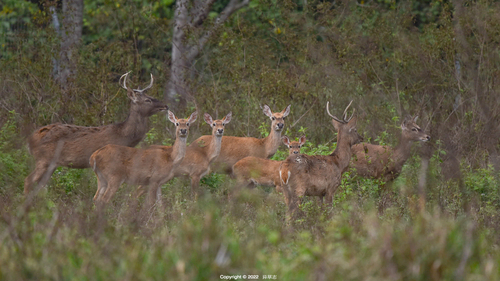
Sambar have a coarse, shaggy coat ranging from yellowish-brown to dark grey or blackish-brown, with a lighter underside. They have a mane-like growth of hair on the neck, especially pronounced in males, and a bushy tail.
Size
Shoulder height of 102-160 cm and body length of 162-246 cm, making it one of the largest deer species in Asia
Weight
Males typically weigh 185-260 kg while females are smaller at 100-150 kg
Distinctive features
Distinguished from other Asian deer by their large size, three-tined antlers (unlike the more branched antlers of some relatives), shaggy coat, and prominent neck mane in males. Their tufted tail and large, rounded ears are also distinctive.
Differences between males and females
Males are significantly larger than females and possess large three-tined antlers that can reach up to 110 cm, while females are antlerless. Males also develop a more pronounced neck mane, especially during rutting season.
Behaviour and diet of the Sambar
Sambar are generally solitary or found in small groups of 2-3 individuals, though larger aggregations may form at good feeding sites. Adult males are typically solitary except during breeding season, while females may form small matriarchal groups with offspring.
When it is active
Primarily nocturnal and crepuscular, being most active during dawn, dusk, and nighttime hours, though activity patterns can shift to be more diurnal in areas with less human disturbance or predation pressure.
Diet
Herbivorous, feeding on a wide variety of grasses, leaves, shrubs, fruits, and aquatic plants. They are both grazers and browsers, adapting their diet based on seasonal availability of vegetation.
Communication
Sambar communicate through vocalizations including a distinctive loud bark or alarm call used to warn of predator presence, as well as scent marking via preorbital glands and urine. Body language including ear positioning and tail movements also conveys information.
Interactions with other species
Sambar are a primary prey species for tigers, leopards, and dholes across their range, playing a crucial role in supporting predator populations. They may also compete with other ungulates like chital and gaur for food resources in shared habitats.
Role in its ecosystem
As a keystone prey species, sambar populations directly influence the density and distribution of large predators like tigers. They also contribute to seed dispersal and vegetation dynamics through their browsing and grazing activities.
Reproduction and lifecycle
Breeding can occur year-round in tropical regions but often peaks during certain seasons; gestation lasts approximately 8 months (235-260 days). Females typically give birth to a single fawn, with twins being rare.
Raising the young
Females provide sole parental care, nursing and protecting the fawn which remains hidden in vegetation for the first few weeks of life. Fawns are weaned by around 6 months but may stay with the mother for up to a year or more.
Maturity and lifespan
Sexual maturity is typically reached at 2-3 years of age. Lifespan in the wild is around 12-16 years, while captive individuals may live up to 20 years or more.
Taxonomy and naming of the Sambar
Classification
Class Mammalia > Order Artiodactyla > Family Cervidae > Genus Rusa > Species Rusa unicolor
Subspecies
Several subspecies recognized including R. u. unicolor (India, Sri Lanka), R. u. equinus (Malay Peninsula, Sumatra), R. u. brookei (Borneo), and R. u. hainana (Hainan Island, China); taxonomy remains debated with some authorities recognizing fewer distinct subspecies.
Scientific synonyms
Cervus unicolor (former genus placement), Rusa aristotelis
What research says
Recent studies
Recent camera-trap and genetic studies have focused on clarifying sambar population densities and connectivity in fragmented Southeast Asian landscapes, revealing alarming declines in areas with heavy snaring pressure.
Genome and DNA
Sambar have a diploid chromosome number of 2n=60; genetic studies have helped clarify subspecies boundaries and relationships within the Rusa genus, though taxonomic uncertainty remains for some populations.
Compared with similar species
Sambar are larger and darker than the related chital (spotted deer) and have simpler three-tined antlers compared to the more complex antlers of red deer or elk. They are closely related to the Javan rusa (Rusa timorensis) but are generally larger with a shaggier coat.
The Sambar and people
Sambar are excellent swimmers and will readily enter water to escape predators or cool down in hot weather. Their loud, resonant alarm call can carry over long distances through dense forest, serving as an important warning system for other wildlife including birds and primates that recognize the call.
Where and how to see it
Best observed in protected areas such as national parks in India (e.g., Ranthambore, Bandhavgarh) during early morning or late evening hours near water sources. Patience and quiet movement are key, as sambar are wary and often flee at the first sign of human presence.
Risks to humans
No notable risk to humans under normal circumstances, though males can become aggressive during the rutting season and should be approached with caution in the wild.
Human uses
Sambar have historically been hunted for meat and their antlers used in traditional medicine and as trophies in various parts of their range. They are also farmed in some regions, including Australia, for venison production.
Myths and legends
In parts of India, the sambar's alarm call is traditionally used by trackers and naturalists as an indicator of tiger presence in the forest, a practice deeply embedded in wildlife tracking folklore. The species holds cultural significance in various indigenous hunting traditions across its range.
Countries where the Sambar is recorded
The 15 countries named in the range description of its IUCN Red List assessment.
Questions about the Sambar
Where does the Sambar live?
The Sambar is recorded in Australia, Bhutan, Cambodia, China and India, among 15 countries in total across Asia, North America and Oceania. These countries come from the range description of its IUCN Red List assessment, and they are what place the species on the interactive map.
Is the Sambar endangered?
Yes. The IUCN Red List assesses the Sambar as Vulnerable, one of the three threatened categories. The species faces a high risk of extinction in the wild. It is the first of the three threatened categories: numbers are falling, the range is shrinking, or the population is small enough that a single bad event could do lasting damage.
How many are left in the wild?
Global population is unknown precisely but believed to be declining; some regional strongholds like protected areas in India maintain stable numbers while Southeast Asian populations have crashed dramatically in many areas. This figure comes from the species assessment on the IUCN Red List; population estimates for wild mammals are ranges, not counts, and are revised at each assessment.
What habitat does the Sambar live in?
Sambar occupy a wide range of habitats including tropical dry and moist deciduous forests, evergreen forests, grasslands, and scrublands.
What is the scientific name of the Sambar?
The Sambar is Rusa unicolor, in the family Cervidae, order Artiodactyla.
Other species in the genus Rusa
Other species in the family Cervidae
Species that share its range

Sources
Conservation status, range description and population estimate come from the IUCN Red List assessment for Rusa unicolor. Countries are derived from that range description, not from a mapped country list. Last refreshed on .
The distribution map is drawn from the IUCN Red List spatial data compiled in 2015. IUCN (International Union for Conservation of Nature)