
Common Fallow Deer
Dama dama
Red List assessment
Least Concernon the IUCN Red List
- EXExtinct
- EWExtinct in the Wild
- CRCritically Endangered
- ENEndangered
- VUVulnerable
- NTNear Threatened
- LCLeast Concern
The Common Fallow Deer is recorded in 8 countries across Africa, Europe, South America and Oceania. The IUCN Red List assesses the Common Fallow Deer as Least Concern. Global population estimated in the hundreds of thousands to low millions when including all introduced and native populations; overall trend is stable to increasing, particularly in parkland and hunting estate populations.
- Family
- Cervidae
- Order
- Artiodactyla
- Genus
- Dama
- Countries recorded
- 8
- Continents
- Africa, Europe, South America and Oceania
- Red List category
- Least Concern
- Data updated
- August 9, 2026
What is the Common Fallow Deer?
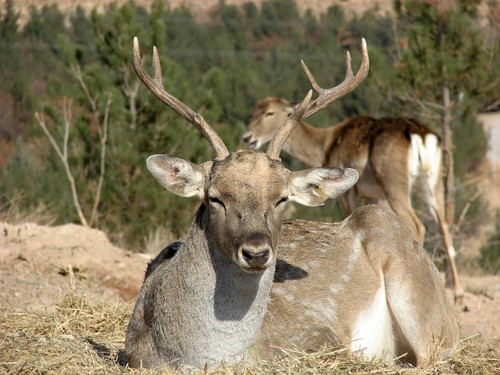
The Common Fallow Deer is a medium-sized deer native to the Mediterranean basin, now widely distributed across Europe due to historical introductions by the Romans and Normans. It is highly adaptable and easily recognized by its palmate antlers and variable coat patterns, most notably its spotted summer coat. Fallow deer are a popular species in parklands and estates due to their attractive appearance and manageable temperament.
Where does the Common Fallow Deer live?
Native to Asia Minor and the Mediterranean region, particularly Turkey; widely introduced and naturalized throughout Europe, and also introduced to parts of North America, South Africa, Australia, and New Zealand.
Native range includes Turkey and parts of the Mediterranean; introduced populations thrive across the UK, France, Germany, Scandinavia, and much of continental Europe. Also established in North America (particularly Texas), Argentina, Chile, South Africa, Australia, and New Zealand.
Altitude and depth
0-1000m, typically found in lowland and hilly woodland areas
Seasonal movements
No true migration, but exhibits seasonal behavioral shifts including the autumn rutting season and antler shedding/regrowth cycle; forms larger mixed herds in winter and smaller groups in summer.
Habitat of the Common Fallow Deer
Prefers deciduous woodland with open glades, parkland, and mixed forest edges; also found in grasslands adjacent to woodland cover. Requires access to both dense cover for shelter and open areas for grazing.
Adaptations to its environment
Coat color varies seasonally and individually (common, menil, melanistic, and white morphs) providing camouflage flexibility; palmate antlers are efficient for both display and combat. Excellent jumping ability and agility allow escape from predators in wooded terrain.
Conservation status and numbers
Listed as Least Concern by the IUCN due to widespread distribution, large introduced populations, and stable to increasing numbers across most of its range, despite native populations in Turkey being more restricted.
Estimated population
Global population estimated in the hundreds of thousands to low millions when including all introduced and native populations; overall trend is stable to increasing, particularly in parkland and hunting estate populations.
What threatens the Common Fallow Deer?
Habitat fragmentation, vehicle collisions, illegal poaching in some regions, and competition with livestock; native Anatolian populations face more localized threats from habitat loss.
Diseases and parasites
Susceptible to bovine tuberculosis, chronic wasting disease (in North America), liver flukes, and various tick-borne illnesses; ticks and lice are common ectoparasites.
What is being done to protect it?
Protected in various national parks and estates across Europe; managed hunting programs help control population density; captive breeding programs support the endangered Persian fallow deer subspecies.
Recommended actions
Continued habitat connectivity efforts, sustainable population management through regulated hunting, and monitoring of native Turkish populations to prevent genetic dilution from introduced stock.
What the Common Fallow Deer looks like
Coat is typically fawn colored with white spots in summer, turning grayish-brown in winter; a distinctive black stripe runs down the tail and rump patch, bordered with white. Color morphs range from very pale (menil) to nearly black (melanistic) or white.
Size
Shoulder height 85-95 cm, body length 130-150 cm
Weight
Males (bucks) 60-100 kg; females (does) 35-55 kg
Distinctive features
Distinguished from other deer species by its uniquely palmate (flattened, shovel-like) antlers in mature bucks, and its characteristic black-and-white rump patch with tail stripe visible when fleeing.
Differences between males and females
Males are notably larger than females and possess palmate antlers that are shed and regrown annually; females are antlerless and smaller in overall body size.
Behaviour and diet of the Common Fallow Deer
Highly social, forming sex-segregated herds outside the rut; bucks form bachelor groups while does and fawns form separate herds, with larger aggregations common in open parkland habitats.
When it is active
Primarily crepuscular, most active during dawn and dusk, though activity patterns shift toward more nocturnal behavior in areas with high human disturbance.
Diet
Herbivorous grazer and browser, feeding on grasses, herbs, acorns, chestnuts, and various shrubs and tree shoots; diet shifts seasonally with fresh grass preferred in spring/summer and woody browse in winter.
Communication
Bucks produce loud belching or groaning calls during the rut to attract does and intimidate rivals; body posturing, ear position, and scent marking via preorbital glands also play communicative roles.
Interactions with other species
Natural predators include wolves and lynx in parts of their range, though in many introduced areas humans are the primary predator through hunting; they may compete with other deer species and livestock for grazing resources.
Role in its ecosystem
As a browsing and grazing herbivore, fallow deer influence woodland understory composition and can shape forest regeneration patterns through selective feeding pressure on saplings and shrubs.
Reproduction and lifecycle
Rutting season occurs in October, during which bucks establish rutting stands and compete for does through vocalizations and antler displays; gestation lasts about 8 months, with does giving birth to a single fawn (rarely twins) in June.
Raising the young
Does provide sole parental care, nursing and protecting fawns for several months; fawns are weaned around 4-6 months but may remain near the mother into their first year.
Maturity and lifespan
Sexual maturity reached around 16-18 months, though bucks typically don't breed successfully until 4-5 years old; lifespan averages 12-16 years in the wild and up to 20+ years in captivity.
Taxonomy and naming of the Common Fallow Deer
Classification
Class Mammalia > Order Artiodactyla > Family Cervidae > Genus Dama > Species Dama dama
Subspecies
Dama dama dama (European fallow deer, widespread) and Dama dama mesopotamica (Persian fallow deer, sometimes classified as a separate species Dama mesopotamica), native to Iran and Israel with reintroduced populations.
Scientific synonyms
Cervus dama (original Linnaean classification)
What research says
Recent studies
Recent genetic research has focused on tracing the ancient Roman-era introduction routes across Europe and assessing genetic diversity loss in isolated island and park populations.
Genome and DNA
Diploid chromosome number of 2n=68; genetic studies have been used to trace introduction histories and distinguish native Anatolian populations from widely dispersed European stock.
Compared with similar species
Distinguished from red deer (Cervus elaphus) by smaller size and palmate rather than branched antlers; differs from roe deer (Capreolus capreolus) by larger size and spotted coat pattern retained into adulthood in some morphs.
The Common Fallow Deer and people
Fallow deer bucks can produce a groaning call during rut so loud it can be heard over a kilometer away; their coat pattern includes at least four distinct color morphs, a rare trait among deer species; fallow deer were spread across Europe largely due to Roman and Norman hunting traditions rather than natural migration.
Where and how to see it
Best observed at dawn or dusk in deer parks such as Richmond Park in London or Phoenix Park in Dublin; autumn rutting season (October) offers the most dramatic viewing opportunities with vocal displays and sparring.
Risks to humans
No notable risk under normal circumstances, though rutting bucks can become aggressive and should be approached with caution; vehicle collisions pose a risk in areas with high deer density near roads.
Human uses
Widely farmed for venison production, valued in traditional and modern hunting estates, and historically kept in ornamental deer parks; antlers are sometimes used decoratively or in traditional crafts.
Myths and legends
In British folklore and medieval hunting culture, fallow deer were considered prestigious quarry for royal hunts, often kept in enclosed deer parks as symbols of aristocratic status and land ownership.
Countries where the Common Fallow Deer is recorded
The 8 countries named in the range description of its IUCN Red List assessment.
Questions about the Common Fallow Deer
Where does the Common Fallow Deer live?
The Common Fallow Deer is recorded in Argentina, Australia, Chile, France and Germany, among 8 countries in total across Africa, Europe, South America and Oceania. These countries come from the range description of its IUCN Red List assessment, and they are what place the species on the interactive map.
Is the Common Fallow Deer endangered?
The IUCN Red List assesses the Common Fallow Deer as Least Concern. The species is widespread and abundant enough not to qualify for any threatened category. It does not mean the species is safe forever, only that nothing in the current data raises an alarm.
How many are left in the wild?
Global population estimated in the hundreds of thousands to low millions when including all introduced and native populations; overall trend is stable to increasing, particularly in parkland and hunting estate populations. This figure comes from the species assessment on the IUCN Red List; population estimates for wild mammals are ranges, not counts, and are revised at each assessment.
What habitat does the Common Fallow Deer live in?
Prefers deciduous woodland with open glades, parkland, and mixed forest edges; also found in grasslands adjacent to woodland cover.
What is the scientific name of the Common Fallow Deer?
The Common Fallow Deer is Dama dama, in the family Cervidae, order Artiodactyla.
Other species in the genus Dama
Other species in the family Cervidae
Species that share its range
Sources
Conservation status, range description and population estimate come from the IUCN Red List assessment for Dama dama. Countries are derived from that range description, not from a mapped country list. Last refreshed on .
The distribution map is drawn from the IUCN Red List spatial data compiled in 2008. IUCN (International Union for Conservation of Nature)