
Calamian Deer
Axis calamianensis
Red List assessment
Endangeredon the IUCN Red List
- EXExtinct
- EWExtinct in the Wild
- CRCritically Endangered
- ENEndangered
- VUVulnerable
- NTNear Threatened
- LCLeast Concern
The Calamian Deer is recorded in one country, Philippines across Asia. The IUCN Red List assesses the Calamian Deer as Endangered. Estimated at fewer than 2,500 mature individuals as of the most recent IUCN assessment, with a declining population trend.
- Family
- Cervidae
- Order
- Artiodactyla
- Genus
- Axis
- Countries recorded
- 1
- Continents
- Asia
- Red List category
- Endangered
- Data updated
- August 9, 2026
What is the Calamian Deer?
The Calamian Deer, also known as the Calamian Hog Deer, is a small to medium-sized island-endemic deer restricted to the Calamian Islands of the Philippines. It is closely related to the mainland hog deer (Axis porcinus) but is recognized as a distinct species adapted to insular conditions. It inhabits open grasslands, forest edges, and coastal scrublands on its native islands. It is remarkable for its characteristic hog-like running posture — head held low and body hunched — and for being one of only a handful of deer species endemic to the Philippines.
Where does the Calamian Deer live?
Endemic to the Calamian Islands (Busuanga, Culion, Calauit, and surrounding smaller islands) in the Palawan province of the Philippines.
Strictly endemic to the Calamian Islands in Palawan province, Philippines. Its range includes the islands of Busuanga, Culion, Calauit, Coron, and a number of smaller surrounding islets. It does not occur on mainland Palawan or elsewhere in the world outside of this archipelago.
Altitude and depth
Primarily lowland species, found from sea level up to approximately 300–400 m elevation. Most activity and sightings are concentrated at or near sea level in coastal and lowland grassland areas.
Seasonal movements
No major seasonal migrations are documented given the species' island confinement. Some behavioral shifts may occur during the dry and wet seasons, with movement potentially concentrating near water sources during dry periods. Rutting activity may peak seasonally but is not fully documented.
Habitat of the Calamian Deer
Primarily open grasslands, savanna-like vegetation, forest edges, and secondary scrub forests on low-lying islands. It may also use mangrove fringes and coastal areas. It generally avoids dense closed-canopy forest, preferring ecotonal habitats with access to both cover and open grazing areas.
Adaptations to its environment
The Calamian Deer has evolved a compact, low-slung body suited to moving quickly through dense island vegetation and scrub. Its characteristic hog-like running posture — with head lowered and body close to the ground — allows it to navigate thick undergrowth efficiently. Its coat coloration provides camouflage in dry grassland environments. Island dwarfism compared to mainland relatives is a noted adaptation.
Conservation status and numbers
Endangered (EN) on the IUCN Red List (assessed 2015). The species qualifies under criteria B1ab(i,ii,iii,v) due to its extremely restricted range (extent of occurrence estimated under 5,000 km²), continuing decline in area of occupancy, habitat quality, and number of mature individuals. The total population is estimated at fewer than 2,500 mature individuals and is declining.
Estimated population
Estimated at fewer than 2,500 mature individuals as of the most recent IUCN assessment, with a declining population trend. Some surveys suggest the actual number may be considerably lower, potentially 900–1,500 individuals across all islands, though precise census data are limited.
What threatens the Calamian Deer?
Primary threats include illegal hunting and poaching for bushmeat, which remains widespread and poorly controlled across the Calamian Islands. Habitat loss and degradation due to agricultural expansion, slash-and-burn farming, and settlement growth reduce available range. Predation by and competition with feral dogs and introduced species is an additional pressure. Disease transmission from domestic livestock is also a concern.
Diseases and parasites
Susceptible to tick infestations (various Ixodidae species) and internal parasites including gastrointestinal helminths. Proximity to domestic livestock increases exposure to diseases such as foot-and-mouth disease and bovine tuberculosis. Flea and louse infestations have also been recorded in related island deer species.
What is being done to protect it?
The Calauit Safari Park (established 1976 on Calauit Island) provides a degree of protection for a semi-wild subpopulation. The species is legally protected under Philippine law (Republic Act 9147 — Wildlife Resources Conservation and Protection Act of 2001). The Calamian Islands are part of the broader Palawan Biosphere Reserve. Some local NGOs conduct monitoring and community-based conservation efforts.
Recommended actions
Priority actions include strengthening anti-poaching enforcement and community education across all Calamian Islands. Formal population surveys should be conducted regularly to establish accurate baseline data. Expansion of protected area coverage and better management of existing reserves are needed. Ex-situ breeding programs should be considered as an insurance population. Controlling feral predators and invasive species is also recommended.
What the Calamian Deer looks like
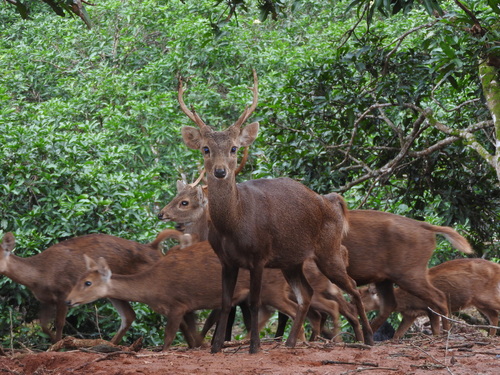
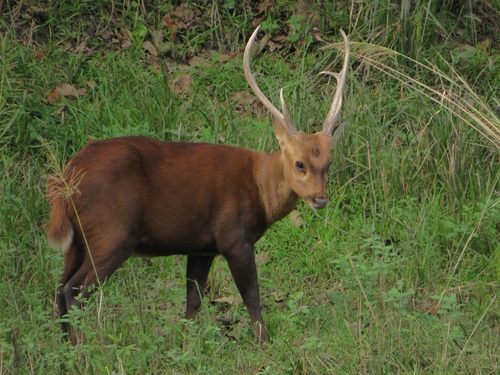
The coat is coarse and generally dark to reddish-brown on the upper parts, fading to paler buff or whitish on the underside and inner legs. Some individuals may show faint pale spots on the flanks, particularly younger animals. The face is relatively plain with a dark muzzle, and the tail is short and dark above.
Size
Body length approximately 100–115 cm; shoulder height approximately 60–65 cm. Tail length approximately 15–20 cm. Antlers in males typically reach 30–45 cm in length.
Weight
Males typically weigh 50–60 kg; females are somewhat smaller at approximately 35–50 kg. Overall smaller and more compact than its mainland hog deer relative.
Distinctive features
The most distinctive feature is the hog-like body shape: a hunched back, low-slung neck, and habit of running with the head held level with or below the body. It is smaller and stockier than the Philippine sambar (Rusa marianna). Compared to mainland hog deer, it is slightly smaller and more uniformly dark in coloration. Males have relatively simple, three-tined antlers.
Differences between males and females
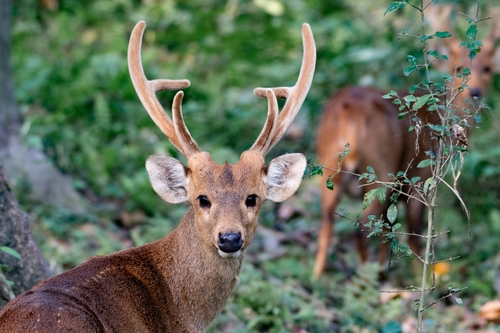
Males are larger and heavier than females and bear antlers, typically with a brow tine and a forked main beam (three points). Females are antlerless. Males may also display thicker necks and more robust builds during the rut.
Behaviour and diet of the Calamian Deer
Generally solitary or found in small, loose groups of 2–5 individuals, often a female with offspring or a temporary association of individuals at feeding sites. Adult males tend to be more solitary and territorial, particularly during the rut. Large aggregations are uncommon.
When it is active
Primarily crepuscular, with peak activity at dawn and dusk. May also be active nocturnally, especially in areas with high human disturbance. During midday, individuals typically rest in dense vegetation cover.
Diet
Strictly herbivorous. Diet consists primarily of grasses and herbaceous plants, supplemented by leaves, shoots, and browse from shrubs and low trees. Will also eat fallen fruits when available. Grazing is the dominant feeding mode in open grassland habitats.
Communication
Like other cervids, the Calamian Deer communicates through vocalizations including alarm barks when startled. Scent marking via interdigital, preorbital, and tarsal glands is used for territory and reproductive signaling. Males engage in antler thrashing on vegetation and possibly ground scraping during the rut.
Interactions with other species
Natural predators are limited on the islands but include reticulated pythons and formerly larger predators. Feral dogs are a significant contemporary predator. The species may compete with feral pigs and domestic livestock for food resources. It potentially acts as a prey base for large raptors targeting fawns.
Role in its ecosystem
As a medium-sized browser and grazer, the Calamian Deer plays a role in shaping vegetation structure and in seed dispersal of certain plant species. It contributes to nutrient cycling through grazing and defecation. It forms part of the prey base supporting local predator communities and scavengers.
Reproduction and lifecycle
Breeding may occur throughout the year, though a seasonal peak is suspected. Gestation lasts approximately 220–230 days (about 7–8 months), similar to related Axis species. Typically a single fawn is born per birth; twins are rare. Fawns are born with spotted coats that fade as they mature.
Raising the young
The female is solely responsible for raising the fawn. After birth, the fawn is hidden in dense vegetation ('hider' strategy) while the mother forages nearby and returns to nurse. The fawn accompanies the mother after a few weeks and is weaned at approximately 3–6 months of age.
Maturity and lifespan
Sexual maturity is reached at approximately 12–18 months for females and somewhat later for males. Lifespan in the wild is estimated at 8–12 years; in captivity, individuals may live up to 15 years under optimal conditions.
Taxonomy and naming of the Calamian Deer
Classification
Mammalia > Artiodactyla > Cervidae > Axis > Axis calamianensis
Scientific synonyms
Formerly treated as a subspecies of the hog deer: Cervus porcinus calamianensis (Heude, 1888). Also referenced as Axis porcinus calamianensis in older literature.
What research says
Recent studies
Recent studies have reinforced the species' full species status (distinct from Axis porcinus), as supported by morphological and limited molecular data. IUCN re-assessments highlight accelerating population decline. Conservation surveys conducted in partnership with Philippine government agencies have attempted to map current distribution across Calamian islands.
Genome and DNA
The diploid chromosome number for Axis deer species is typically 2n = 68, and this is presumed for Axis calamianensis. Limited specific genetic studies exist for this species, though phylogenetic analyses confirm its distinctness from mainland hog deer and its placement within the genus Axis.
Compared with similar species
The Calamian Deer is most closely related to the hog deer (Axis porcinus) of South and Southeast Asia, sharing the characteristic low-running posture and compact build. It differs from the Philippine spotted deer (Rusa alfredi) — another Philippine endemic — in its darker, less conspicuously spotted coat and its hog-like gait. Compared to the more widespread Philippine sambar (Rusa marianna), it is considerably smaller and restricted to a much narrower range.
The Calamian Deer and people
1) The Calamian Deer gets the 'hog' part of its alternate name not from any relation to pigs, but from its peculiar habit of running with its head held low and body hunched, exactly like a charging hog — an adaptation for moving at speed through dense undergrowth. 2) Calauit Island, part of this deer's native range, houses one of the most unusual wildlife parks in the world: in 1976, Philippine President Ferdinand Marcos had African animals including Rothschild's giraffes, zebras, and impalas introduced to the island, where they now coexist alongside the native Calamian Deer. 3) Despite being classified as a hog deer relative, genetic studies show the Calamian Deer has been isolated on its islands long enough to have diverged substantially from its mainland ancestors, making it a textbook example of island speciation in megafauna.
Where and how to see it
The best place to observe Calamian Deer is Calauit Safari Park on Calauit Island, accessible from Busuanga in Palawan, Philippines. Dawn and dusk are the optimal times for observation when animals are most active at the edges of grassland and forest. Open grassy clearings near water sources are particularly productive spots. Visitor access to Calauit is managed by the Palawan Council for Sustainable Development.
Risks to humans
No notable risk. The Calamian Deer is not aggressive towards humans under normal circumstances. Males with antlers during the rut may theoretically be more assertive if cornered, but unprovoked attacks are not documented.
Human uses
The species has historically been hunted by local communities for bushmeat, and this illegal hunting continues to be one of the main threats to its survival. It is no longer legally hunted and is fully protected under Philippine law. No significant uses in traditional medicine or live trade are documented. The species has ecotourism value at Calauit Safari Park.
Myths and legends
Limited documentation exists of specific myths or legends centered on the Calamian Deer among the indigenous Tagbanua and Calamianen peoples of the region. However, deer in general hold cultural significance in Filipino indigenous traditions as symbols of grace and as important game animals. The species is considered part of the natural heritage of Palawan, which is itself regarded as the 'Last Frontier' of Philippine biodiversity.
Countries where the Calamian Deer is recorded
The 1 countries named in the range description of its IUCN Red List assessment.
Questions about the Calamian Deer
Where does the Calamian Deer live?
The Calamian Deer is recorded in Philippines across Asia. These countries come from the range description of its IUCN Red List assessment, and they are what place the species on the interactive map.
Is the Calamian Deer endangered?
Yes. The IUCN Red List assesses the Calamian Deer as Endangered, one of the three threatened categories. The species faces a very high risk of extinction in the wild — a step below Critically Endangered, but still on a trajectory that ends badly without intervention.
How many are left in the wild?
Estimated at fewer than 2,500 mature individuals as of the most recent IUCN assessment, with a declining population trend. This figure comes from the species assessment on the IUCN Red List; population estimates for wild mammals are ranges, not counts, and are revised at each assessment.
What habitat does the Calamian Deer live in?
Primarily open grasslands, savanna-like vegetation, forest edges, and secondary scrub forests on low-lying islands.
What is the scientific name of the Calamian Deer?
The Calamian Deer is Axis calamianensis, in the family Cervidae, order Artiodactyla.
Other species in the genus Axis
Other species in the family Cervidae
Species that share its range
Sources
Conservation status, range description and population estimate come from the IUCN Red List assessment for Axis calamianensis. Countries are derived from that range description, not from a mapped country list. Last refreshed on .
The distribution map is drawn from the IUCN Red List spatial data compiled in 2015. IUCN (International Union for Conservation of Nature)