
Barasingha
Rucervus duvaucelii
Red List assessment
Vulnerableon the IUCN Red List
- EXExtinct
- EWExtinct in the Wild
- CRCritically Endangered
- ENEndangered
- VUVulnerable
- NTNear Threatened
- LCLeast Concern
The Barasingha is recorded in 3 countries across Asia. The IUCN Red List assesses the Barasingha as Vulnerable. Approximately 3,500-5,000 individuals remaining in the wild, with populations generally declining except in a few well-protected reserves like Kaziranga.
- Family
- Cervidae
- Order
- Artiodactyla
- Genus
- Rucervus
- Countries recorded
- 3
- Continents
- Asia
- Red List category
- Vulnerable
- Data updated
- August 9, 2026
What is the Barasingha?
The Barasingha, or swamp deer, is a large Indian deer species renowned for its many-tined antlers, from which its name 'barasingha' (twelve-horned) derives. It inhabits swampy grasslands and floodplains of the Indian subcontinent, where it once roamed in large herds. Its distinctive antler structure and habitat specialization make it ecologically and culturally significant, though populations have drastically declined due to habitat loss.
Where does the Barasingha live?
India (Assam, Uttar Pradesh, Madhya Pradesh) and Nepal
Historically widespread across the Indo-Gangetic plains from Pakistan to Assam, now restricted to fragmented populations in Nepal's terai, Kaziranga and Manas in Assam, Dudhwa in Uttar Pradesh, and Kanha National Park in Madhya Pradesh.
Altitude and depth
Typically found at low elevations, generally below 300 meters, in floodplain and lowland habitats.
Seasonal movements
Seasonal movements occur in response to monsoon flooding, with herds shifting to higher ground during floods and returning to grasslands as waters recede.
Habitat of the Barasingha
Prefers marshy grasslands, floodplains, and tall grass savannas near rivers and wetlands; the hard-ground subspecies inhabits drier sal forest clearings in central India.
Adaptations to its environment
Elongated hooves aid in moving through soft, marshy ground; grazing behavior is adapted to seasonal grass growth cycles in floodplain ecosystems.
Conservation status and numbers
Vulnerable (IUCN); populations have declined over 30% in the past three generations due to habitat loss, hunting, and agricultural conversion of grasslands.
Estimated population
Approximately 3,500-5,000 individuals remaining in the wild, with populations generally declining except in a few well-protected reserves like Kaziranga.
What threatens the Barasingha?
Habitat destruction from agriculture and drainage of wetlands, poaching for meat and antlers, human-wildlife conflict, and isolation of small populations reducing genetic diversity.
Diseases and parasites
Susceptible to parasitic infections such as ticks and gastrointestinal worms; disease transmission risk increases in fragmented, small populations.
What is being done to protect it?
Protected under Indian Wildlife Protection Act and Nepal's National Parks laws; conservation programs exist in Kaziranga, Kanha, Dudhwa, and Manas National Parks, including habitat restoration and anti-poaching patrols.
Recommended actions
Expand protected wetland habitats, strengthen anti-poaching enforcement, promote genetic exchange between isolated populations, and engage local communities in conservation.
What the Barasingha looks like
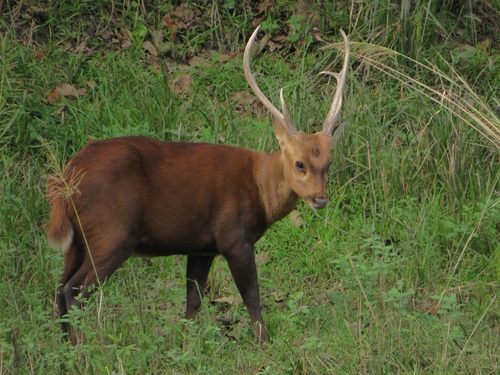
Coat is reddish-brown in summer, turning duller brown in winter, with some subspecies showing faint white spots on the flanks; underparts are lighter or white.
Size
Shoulder height ranges from 115 to 135 cm, with body length of approximately 180 cm.
Weight
Males typically weigh 170-280 kg, while females are smaller, weighing around 130-145 kg.
Distinctive features
Distinguished by multi-tined antlers with up to 10-14 points, larger and more elaborate than in most other deer species, and a more robust body compared to related muntjac or chital.
Differences between males and females
Only males carry antlers, which are large and branching; males are also notably larger and more muscular than females.
Behaviour and diet of the Barasingha
Highly social, forming herds that can range from a few individuals to over 100, especially in habitats like Kaziranga; herd size varies seasonally and with habitat quality.
When it is active
Primarily diurnal, with peak activity during early morning and late afternoon; often rest during the hottest parts of the day.
Diet
Herbivorous, feeding mainly on grasses, aquatic plants, and some browse from shrubs, especially in flooded grasslands.
Communication
Communicates through vocalizations such as bellows during rutting season, along with visual displays of antlers and body posture for dominance and mating.
Interactions with other species
Predators include tigers, leopards, and wild dogs; barasingha may also compete with other grazers like chital and swamp buffalo for grassland resources.
Role in its ecosystem
As a grazer, plays an important role in maintaining grassland ecosystems by controlling vegetation growth and providing prey for large carnivores.
Reproduction and lifecycle
Breeding season (rut) occurs mainly from September to October; gestation lasts about 240-250 days, with females typically giving birth to a single fawn.
Raising the young
Females provide sole parental care, nursing and protecting fawns for several months until they are capable of joining the herd's movements.
Maturity and lifespan
Sexual maturity is reached at around 2-3 years; lifespan in the wild is typically 10-12 years, while in captivity individuals may live up to 15 years.
Taxonomy and naming of the Barasingha
Classification
Mammalia > Artiodactyla > Cervidae > Rucervus > Rucervus duvaucelii
Subspecies
Three recognized subspecies: R. d. duvaucelii (swamp deer, northern India/Nepal terai), R. d. branderi (hard-ground barasingha, central India, Kanha), and R. d. ranjitsinhi (eastern swamp deer, Assam, Kaziranga).
Scientific synonyms
Cervus duvaucelii (original combination); Rucervus duvauceli (spelling variant).
What research says
Recent studies
Recent studies focus on population genetics and habitat connectivity between fragmented reserves to guide reintroduction and management strategies.
Genome and DNA
Diploid chromosome number is 2n=64; genetic studies have identified reduced diversity in isolated populations, informing conservation breeding programs.
Compared with similar species
Compared to the chital (Axis axis), the barasingha is larger with more complex antlers and prefers wetter habitats, while it is less arboreal-adapted than the sambar deer (Rusa unicolor).
The Barasingha and people
The name 'barasingha' means 'twelve-horned' in Hindi, referencing its impressive antlers; it is one of the few deer species specialized for wetland habitats; the eastern subspecies is a flagship species for Kaziranga National Park conservation efforts.
Where and how to see it
Best observed in early morning or late afternoon in Kaziranga National Park (Assam) or Kanha National Park (Madhya Pradesh) during the dry season when herds gather near water sources.
Risks to humans
No notable risk; barasingha are non-aggressive herbivores, though males may show territorial behavior during rutting season.
Human uses
Historically hunted for meat and antlers; today mainly valued for eco-tourism and conservation education rather than direct exploitation.
Myths and legends
In some regional Indian folklore, the barasingha is considered a symbol of grace and forest abundance, occasionally referenced in traditional hunting tales and local wildlife lore.
Countries where the Barasingha is recorded
The 3 countries named in the range description of its IUCN Red List assessment.
Questions about the Barasingha
Where does the Barasingha live?
The Barasingha is recorded in India, Nepal and Pakistan across Asia. These countries come from the range description of its IUCN Red List assessment, and they are what place the species on the interactive map.
Is the Barasingha endangered?
Yes. The IUCN Red List assesses the Barasingha as Vulnerable, one of the three threatened categories. The species faces a high risk of extinction in the wild. It is the first of the three threatened categories: numbers are falling, the range is shrinking, or the population is small enough that a single bad event could do lasting damage.
How many are left in the wild?
Approximately 3,500-5,000 individuals remaining in the wild, with populations generally declining except in a few well-protected reserves like Kaziranga. This figure comes from the species assessment on the IUCN Red List; population estimates for wild mammals are ranges, not counts, and are revised at each assessment.
What habitat does the Barasingha live in?
Prefers marshy grasslands, floodplains, and tall grass savannas near rivers and wetlands; the hard-ground subspecies inhabits drier sal forest clearings in central India.
What is the scientific name of the Barasingha?
The Barasingha is Rucervus duvaucelii, in the family Cervidae, order Artiodactyla.
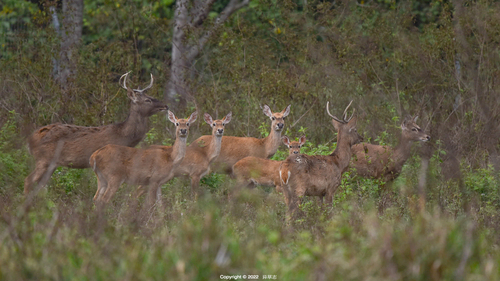
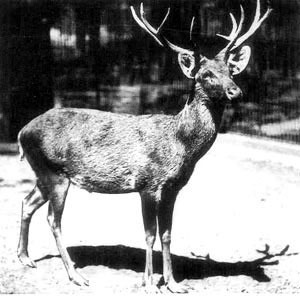
Other species in the genus Rucervus
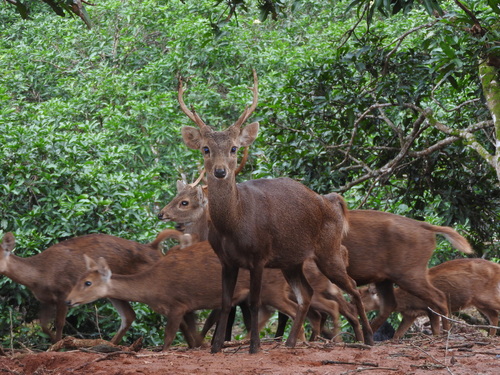
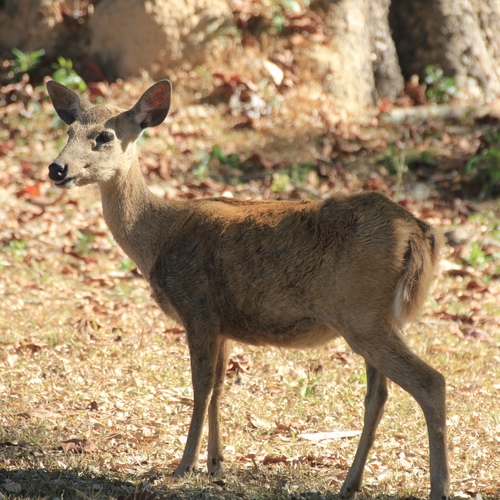
Other species in the family Cervidae
Species that share its range
Sources
Conservation status, range description and population estimate come from the IUCN Red List assessment for Rucervus duvaucelii. Countries are derived from that range description, not from a mapped country list. Last refreshed on .
The distribution map is drawn from the IUCN Red List spatial data compiled in 2008. IUCN (International Union for Conservation of Nature)