
Philippine Deer
Rusa marianna
Red List assessment
Vulnerableon the IUCN Red List
- EXExtinct
- EWExtinct in the Wild
- CRCritically Endangered
- ENEndangered
- VUVulnerable
- NTNear Threatened
- LCLeast Concern
The Philippine Deer is recorded in one country, Philippines across Asia. The IUCN Red List assesses the Philippine Deer as Vulnerable. Exact population figures are uncertain, but the overall trend is declining across most of its range, with some island populations severely reduced or locally extirpated.
- Family
- Cervidae
- Order
- Artiodactyla
- Genus
- Rusa
- Countries recorded
- 1
- Continents
- Asia
- Red List category
- Vulnerable
- Data updated
- August 9, 2026
What is the Philippine Deer?
The Philippine Deer, also known as the Philippine Sambar, is a medium-sized deer endemic to the Philippine archipelago. It inhabits forests and grasslands across many islands, playing a key ecological role as a native herbivore. It is notable for being one of the few native large mammals in the Philippines and for its adaptability to varied island habitats. Historically widespread, it has suffered significant population declines due to hunting and habitat loss.
Where does the Philippine Deer live?
Philippines (endemic)
Endemic to the Philippines, occurring on Luzon, Mindoro, Mindanao, Basilan, and several other islands in the archipelago. Populations are fragmented due to habitat loss and hunting pressure across its range.
Altitude and depth
0-2000m, with most populations concentrated in lowland areas below 1000m
Habitat of the Philippine Deer
Found in tropical lowland and montane forests, secondary growth forests, and grasslands, often at forest edges. It shows tolerance for disturbed and secondary habitats, which has helped it persist in areas with human activity.
Adaptations to its environment
The species shows behavioral flexibility allowing it to survive in secondary and disturbed forests as well as primary forest. Its cryptic coloration provides camouflage in forest understory, and its relatively small size aids movement through dense vegetation.
Conservation status and numbers
Classified as Vulnerable by the IUCN due to ongoing population decline estimated at more than 30% over the last three generations, driven primarily by habitat loss and unsustainable hunting pressure across its restricted island range.
Estimated population
Exact population figures are uncertain, but the overall trend is declining across most of its range, with some island populations severely reduced or locally extirpated.
What threatens the Philippine Deer?
Major threats include habitat destruction from deforestation and agricultural conversion, illegal hunting for meat and antlers, and habitat fragmentation isolating populations on different islands.
Diseases and parasites
Susceptible to various internal and external parasites common to cervids, including ticks and gastrointestinal parasites, though specific studies on this species are limited.
What is being done to protect it?
The species is protected under Philippine wildlife laws, and some populations occur within protected areas and national parks. Captive breeding programs exist in some Philippine zoos and wildlife centers to support conservation.
Recommended actions
Priority actions include strengthening anti-poaching enforcement, expanding protected habitat coverage, conducting island-specific population surveys, and promoting community-based conservation and sustainable land-use practices.
What the Philippine Deer looks like
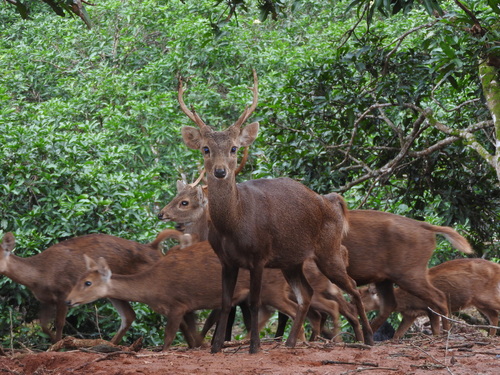
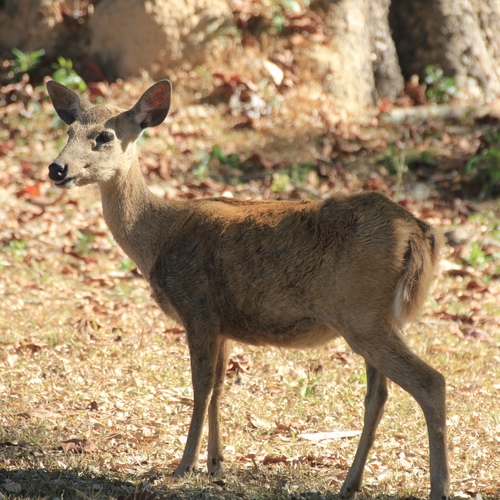
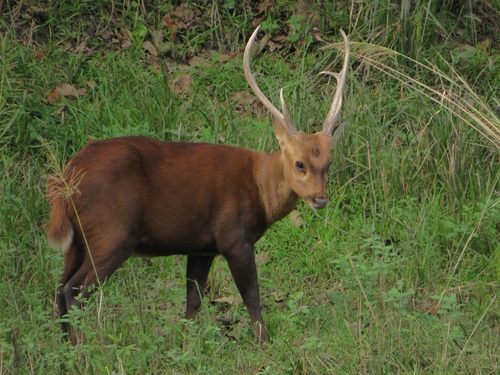
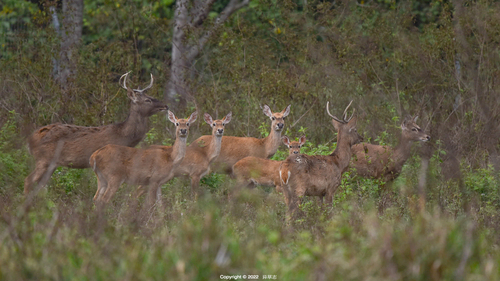
The coat is generally brown to reddish-brown, sometimes darker, with a lighter underside. Males possess relatively small, simple antlers typically with three points per side, characteristic of the genus Rusa.
Size
Shoulder height approximately 60-70 cm, with body length ranging from 110-140 cm
Weight
Males typically weigh 40-60 kg, while females are generally smaller at 30-45 kg
Distinctive features
Distinguished from other Rusa species by its smaller size and specific antler morphology, as well as its restriction to the Philippine archipelago. Regional color and size variation exist among island populations.
Differences between males and females
Males are larger than females and bear antlers, which females lack; males also tend to have thicker necks especially during the rutting period.
Behaviour and diet of the Philippine Deer
Generally solitary or found in small groups, particularly females with young. Males may be more solitary outside of the breeding season and can be territorial during rut.
When it is active
Primarily crepuscular and nocturnal, becoming more active during dawn and dusk to avoid heat and human disturbance, though activity patterns can shift in areas with less hunting pressure.
Diet
Herbivorous, feeding on a variety of grasses, leaves, shoots, fruits, and forest understory vegetation. Diet composition varies seasonally based on food availability.
Communication
Communication includes vocalizations such as barks or alarm calls, along with scent marking and body postures to signal territory or reproductive status.
Interactions with other species
Natural predators historically may have included large raptors and reticulated pythons preying on fawns; today, feral dogs and human hunters represent significant predation pressure. It may compete with introduced ungulates in some areas.
Role in its ecosystem
As a native herbivore, the Philippine Deer plays a role in shaping forest understory vegetation through grazing and browsing, and serves as a prey species and potential seed disperser within its ecosystem.
Reproduction and lifecycle
Breeding can occur somewhat year-round in tropical conditions, though peaks may exist. Gestation lasts approximately 8 months, typically resulting in a single fawn per birth.
Raising the young
Females provide sole parental care, nursing and protecting the fawn until it is capable of independent foraging, with weaning occurring over several months.
Maturity and lifespan
Sexual maturity is typically reached around 1-2 years of age; lifespan in the wild is estimated at 10-15 years, potentially longer in captivity with proper care.
Taxonomy and naming of the Philippine Deer
Classification
Class Mammalia > Order Artiodactyla > Family Cervidae > Genus Rusa > Species Rusa marianna
Subspecies
Several subspecies recognized based on island populations, including R. m. marianna (Luzon), R. m. barandana (Mindoro), R. m. nigella (Basilan), and others across the Philippine archipelago, though taxonomy remains debated.
Scientific synonyms
Cervus mariannus, Cervus philippinus
What research says
Recent studies
Recent research has focused on clarifying the taxonomic status of various island subspecies using genetic analysis, as well as assessing population trends and habitat requirements for conservation planning.
Compared with similar species
Compared to the Sambar deer (Rusa unicolor) of mainland Asia, the Philippine Deer is smaller in body size and antler dimensions, reflecting island adaptation and isolation over evolutionary time.
The Philippine Deer and people
The Philippine Deer is one of only two native deer species found in the Philippines, alongside the Visayan Spotted Deer. Despite significant habitat loss, it has shown remarkable adaptability to secondary and disturbed forest habitats.
Where and how to see it
Best observed in protected forest areas and national parks such as those in Luzon or Mindanao during early morning or late evening hours when the deer are most active; patience and quiet movement improve chances of sighting.
Risks to humans
No notable risk to humans
Human uses
Historically and still in some areas hunted for bushmeat and antlers; also present in some captive breeding and zoo programs for conservation and educational purposes.
Myths and legends
In some Philippine indigenous cultures, deer hunting has traditional and cultural significance, though specific widespread myths about this species are not well documented.
Countries where the Philippine Deer is recorded
The 1 countries named in the range description of its IUCN Red List assessment.
Questions about the Philippine Deer
Where does the Philippine Deer live?
The Philippine Deer is recorded in Philippines across Asia. These countries come from the range description of its IUCN Red List assessment, and they are what place the species on the interactive map.
Is the Philippine Deer endangered?
Yes. The IUCN Red List assesses the Philippine Deer as Vulnerable, one of the three threatened categories. The species faces a high risk of extinction in the wild. It is the first of the three threatened categories: numbers are falling, the range is shrinking, or the population is small enough that a single bad event could do lasting damage.
How many are left in the wild?
Exact population figures are uncertain, but the overall trend is declining across most of its range, with some island populations severely reduced or locally extirpated. This figure comes from the species assessment on the IUCN Red List; population estimates for wild mammals are ranges, not counts, and are revised at each assessment.
What habitat does the Philippine Deer live in?
Found in tropical lowland and montane forests, secondary growth forests, and grasslands, often at forest edges.
What is the scientific name of the Philippine Deer?
The Philippine Deer is Rusa marianna, in the family Cervidae, order Artiodactyla.
Other species in the genus Rusa
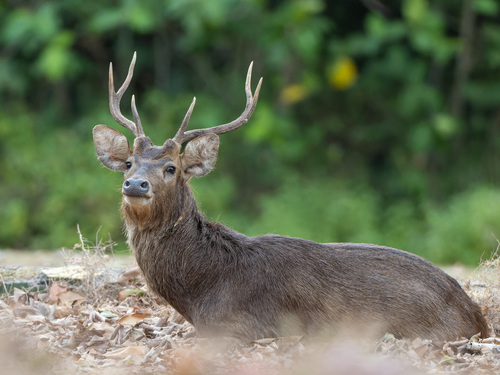
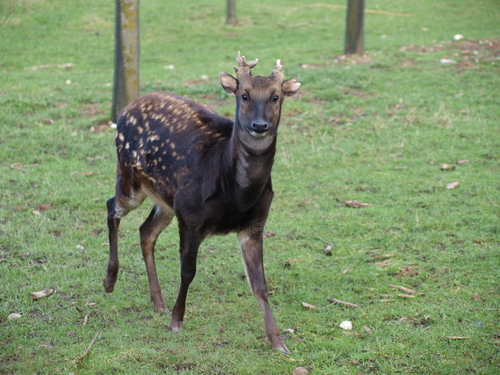
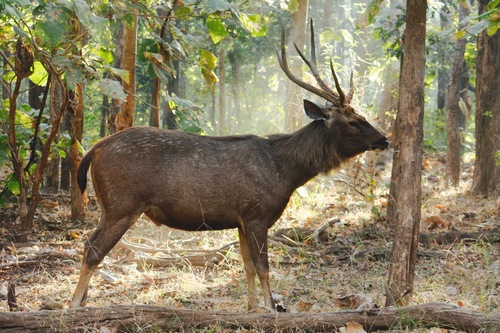
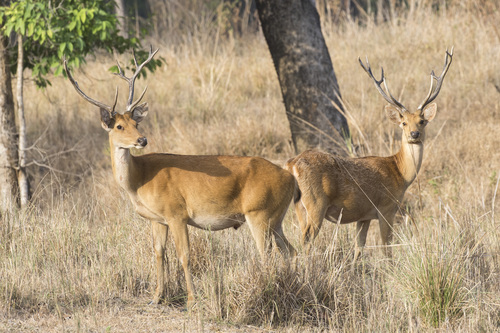
Other species in the family Cervidae
Species that share its range
Sources
Conservation status, range description and population estimate come from the IUCN Red List assessment for Rusa marianna. Countries are derived from that range description, not from a mapped country list. Last refreshed on .
The distribution map is drawn from the IUCN Red List spatial data compiled in 2015. IUCN (International Union for Conservation of Nature)