
Philippine Spotted Deer
Rusa alfredi
Red List assessment
Endangeredon the IUCN Red List
- EXExtinct
- EWExtinct in the Wild
- CRCritically Endangered
- ENEndangered
- VUVulnerable
- NTNear Threatened
- LCLeast Concern
The Philippine Spotted Deer is recorded in one country, Philippines across Asia. The IUCN Red List assesses the Philippine Spotted Deer as Endangered. Estimated fewer than 2,500 mature individuals remaining in the wild, with a continuing declining population trend.
- Family
- Cervidae
- Order
- Artiodactyla
- Genus
- Rusa
- Countries recorded
- 1
- Continents
- Asia
- Red List category
- Endangered
- Data updated
- August 9, 2026
What is the Philippine Spotted Deer?
The Philippine Spotted Deer, also known as the Visayan Spotted Deer, is a critically threatened forest-dwelling deer endemic to the Visayan Islands of the Philippines. It is named after Prince Alfred, Duke of Edinburgh, who visited the Philippines in the 19th century. Once widespread across several islands, it now survives only in small fragmented populations on Panay and Negros due to massive habitat loss and hunting. It is one of the rarest deer species in the world and a flagship species for Philippine biodiversity conservation.
Where does the Philippine Spotted Deer live?
Philippines (Visayan Islands: Panay, Negros; historically also Cebu, Masbate, Guimaras)
Endemic to the Visayan Islands of the central Philippines; historically found on Panay, Negros, Cebu, Masbate, and Guimaras, but now restricted to remnant forest patches on Panay and Negros.
Altitude and depth
Sea level up to approximately 1,500 meters, though most remaining populations are found in mid-elevation forests between 300-1,000 meters due to lowland habitat destruction.
Seasonal movements
No strong migratory behavior; breeding may be slightly more frequent during the wet season though reproduction can occur year-round in captivity and possibly in the wild.
Habitat of the Philippine Spotted Deer
Primarily inhabits primary and secondary lowland to mid-elevation tropical rainforest, including dense understory areas near rivers and forest edges. It prefers closed-canopy forest with thick vegetation for cover.
Adaptations to its environment
Its spotted coat provides camouflage in dappled forest light, helping it evade predators and hunters. It is a shy, secretive animal with keen senses of hearing and smell adapted to dense forest environments where visibility is limited.
Conservation status and numbers
Endangered (IUCN); classified due to a population decline exceeding 50% over the last three generations caused by habitat loss and poaching, with fewer than 2,500 mature individuals estimated to remain, mostly in small fragmented subpopulations.
Estimated population
Estimated fewer than 2,500 mature individuals remaining in the wild, with a continuing declining population trend.
What threatens the Philippine Spotted Deer?
Habitat loss from deforestation, logging, and agricultural conversion, combined with intense hunting pressure for bushmeat and trophies, are the primary threats. Small, fragmented populations also face genetic bottleneck risks.
Diseases and parasites
Susceptible to common cervid parasites such as ticks and gastrointestinal helminths, though specific disease studies in wild populations remain limited.
What is being done to protect it?
Conservation programs include the Negros Forests and Ecological Foundation's captive breeding program, protected areas like the North Negros Natural Park and Mt. Kanlaon Natural Park, and community-based forest protection initiatives on Panay Island.
Recommended actions
Priority actions include strengthening anti-poaching enforcement, expanding and connecting protected forest habitats, continuing captive breeding with eventual reintroduction, and community education to reduce hunting pressure.
What the Philippine Spotted Deer looks like
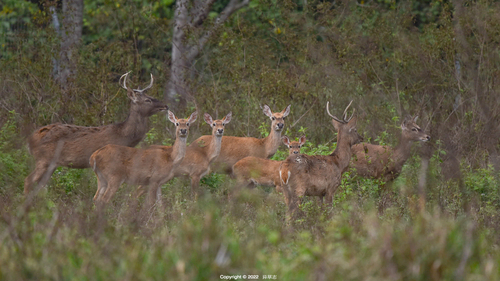
The coat is reddish-brown to dark brown with distinctive white spots scattered along the back and sides, persisting into adulthood unlike many other deer species. The belly and underside are paler, and the legs are relatively slender.
Size
Shoulder height ranges from approximately 60 to 65 cm, with a body length of around 110 to 130 cm.
Weight
Adults typically weigh between 40 and 60 kg, with males generally slightly larger than females.
Distinctive features
Unlike most deer species that lose their spots after infancy, the Philippine Spotted Deer retains white spotting throughout its life, distinguishing it from related Rusa species like the Sambar deer.
Differences between males and females
Males are generally larger and possess antlers, which are relatively small and typically have three tines, while females are smaller and lack antlers entirely.
Behaviour and diet of the Philippine Spotted Deer
Generally solitary or found in small groups of two to three individuals, though larger aggregations may occasionally occur near food sources; males are more solitary outside the breeding season.
When it is active
Primarily crepuscular and nocturnal, being most active during dawn, dusk, and nighttime hours to avoid predation and human disturbance, resting in dense cover during the day.
Diet
Herbivorous, feeding on a variety of forest vegetation including leaves, grasses, fruits, and shoots found in the forest understory.
Communication
Communicates through vocalizations such as barks or grunts, especially during alarm or breeding contexts, along with scent marking and body postures to signal social and reproductive status.
Interactions with other species
Historically preyed upon by large native predators, though today humans are the primary threat; it competes for forest resources with other herbivores and is affected by habitat disturbance from invasive species and livestock.
Role in its ecosystem
As a forest herbivore, it plays a role in seed dispersal and vegetation dynamics within its native tropical forest ecosystem, contributing to forest regeneration processes.
Reproduction and lifecycle
Breeding can occur year-round, though births may peak during certain periods; gestation lasts approximately 8 months, typically resulting in a single fawn per birth.
Raising the young
The mother provides sole parental care, nursing and protecting the fawn, which remains hidden in dense vegetation for the first weeks of life before gradually following the mother.
Maturity and lifespan
Sexual maturity is typically reached around 1 to 2 years of age; lifespan in the wild is estimated at around 10 years, while captive individuals may live up to 15-20 years.
Taxonomy and naming of the Philippine Spotted Deer
Classification
Class Mammalia > Order Artiodactyla > Family Cervidae > Genus Rusa > Species Rusa alfredi
Scientific synonyms
Cervus alfredi
What research says
Recent studies
Recent genetic and population studies focus on assessing genetic diversity in fragmented wild and captive populations to guide effective breeding and reintroduction programs.
Compared with similar species
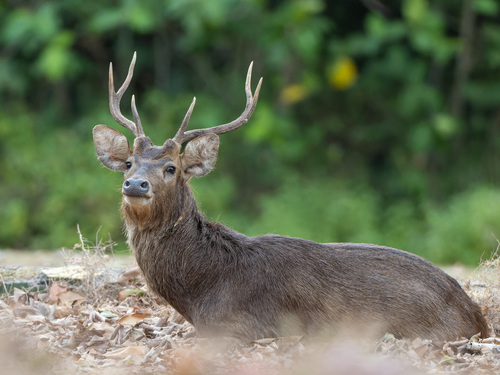
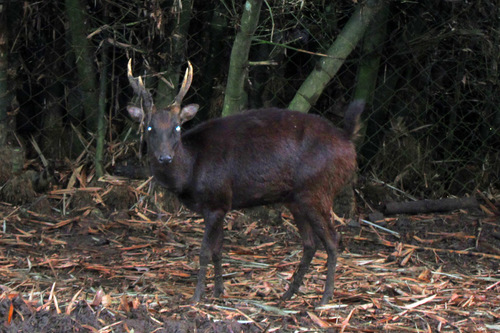
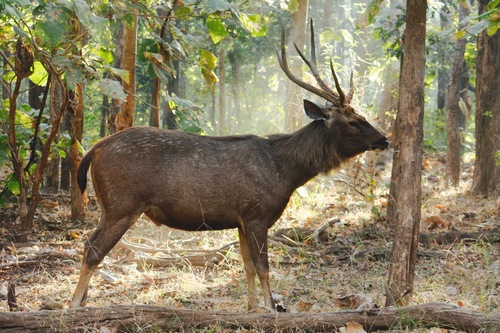
Compared to the more widespread Sambar deer (Rusa unicolor), the Philippine Spotted Deer is smaller, retains its spots into adulthood, and has a much more restricted and threatened range.
The Philippine Spotted Deer and people
This species is one of the rarest deer in the world, surviving only on two Philippine islands. Unlike most deer, it keeps its juvenile spotted coat pattern for life, making it visually distinct among cervids.
Where and how to see it
Best observed in protected areas such as the North Negros Natural Park or Mt. Kanlaon Natural Park on Negros Island, ideally during early morning or late evening when the species is most active; guided tours through local conservation organizations increase chances of sightings.
Risks to humans
No notable risk to humans.
Human uses
Historically hunted for bushmeat and as trophies; today it holds significant value for ecotourism and conservation education rather than commercial use.
Countries where the Philippine Spotted Deer is recorded
The 1 countries named in the range description of its IUCN Red List assessment.
Questions about the Philippine Spotted Deer
Where does the Philippine Spotted Deer live?
The Philippine Spotted Deer is recorded in Philippines across Asia. These countries come from the range description of its IUCN Red List assessment, and they are what place the species on the interactive map.
Is the Philippine Spotted Deer endangered?
Yes. The IUCN Red List assesses the Philippine Spotted Deer as Endangered, one of the three threatened categories. The species faces a very high risk of extinction in the wild — a step below Critically Endangered, but still on a trajectory that ends badly without intervention.
How many are left in the wild?
Estimated fewer than 2,500 mature individuals remaining in the wild, with a continuing declining population trend. This figure comes from the species assessment on the IUCN Red List; population estimates for wild mammals are ranges, not counts, and are revised at each assessment.
What habitat does the Philippine Spotted Deer live in?
Primarily inhabits primary and secondary lowland to mid-elevation tropical rainforest, including dense understory areas near rivers and forest edges.
What is the scientific name of the Philippine Spotted Deer?
The Philippine Spotted Deer is Rusa alfredi, in the family Cervidae, order Artiodactyla.
Other species in the genus Rusa
Other species in the family Cervidae
Species that share its range
Sources
Conservation status, range description and population estimate come from the IUCN Red List assessment for Rusa alfredi. Countries are derived from that range description, not from a mapped country list. Last refreshed on .
The distribution map is drawn from the IUCN Red List spatial data compiled in 2008. IUCN (International Union for Conservation of Nature)