
Agile Antechinus
Antechinus agilis
Red List assessment
Least Concernon the IUCN Red List
- EXExtinct
- EWExtinct in the Wild
- CRCritically Endangered
- ENEndangered
- VUVulnerable
- NTNear Threatened
- LCLeast Concern
The Agile Antechinus is recorded in 2 countries across Europe and Oceania. The IUCN Red List assesses the Agile Antechinus as Least Concern. No precise global population estimate exists.
- Family
- Dasyuridae
- Order
- Dasyuromorphia
- Genus
- Antechinus
- Countries recorded
- 2
- Continents
- Europe and Oceania
- Red List category
- Least Concern
- Data updated
- August 9, 2026
What is the Agile Antechinus?
The Agile Antechinus is a small, insectivorous marsupial in the family Dasyuridae, endemic to the wet forests of southeastern Australia. It was only recognized as a species distinct from the Brown Antechinus (A. stuartii) in 1998. It is most remarkable for its extraordinary semelparous mating strategy, in which all males die within weeks of the annual breeding season due to physiological collapse. Despite its small size, it is an active and agile predator of invertebrates and small vertebrates in dense forest undergrowth.
Where does the Agile Antechinus live?
Southeastern Australia, primarily Victoria and southern New South Wales, including the Australian Capital Territory
Southeastern Australia: mainly Victoria (including the Dandenong Ranges, Central Highlands, Otway Ranges, and Strathbogie Ranges), southern New South Wales, and the Australian Capital Territory. Its range broadly overlaps with the distribution of tall, wet eucalypt forests in the region.
Altitude and depth
Typically found from near sea level up to approximately 1,500 m altitude in montane forests, though most common between 200 and 1,000 m.
Seasonal movements
No long-distance migration or hibernation. Activity patterns shift seasonally with temperature and invertebrate prey availability. The breeding season is tightly synchronized to late July–August, after which all males perish, leaving females to raise young through spring and early summer.
Habitat of the Agile Antechinus
Primarily wet sclerophyll forest and cool temperate rainforest, as well as montane ash forests with dense shrub understories and abundant fallen logs and coarse woody debris. It favors structurally complex habitats that provide both foraging substrate and shelter from predators.
Adaptations to its environment
Highly efficient at foraging in dense vegetation due to its slender, agile body and sharp claws for climbing logs and bark. Its pointed snout and sensitive whiskers aid in locating invertebrate prey in leaf litter. Females have a reduced pouch (mammary patch) typical of dasyurids, allowing young to attach directly to teats from a very early developmental stage.
Conservation status and numbers
Least Concern (LC) on the IUCN Red List. Populations are considered relatively stable across its range, though habitat loss from logging, urban expansion, and climate change pose ongoing local threats. The species does not meet criteria for a more threatened category at this time.
Estimated population
No precise global population estimate exists. The species is locally abundant in suitable habitats but population trends are considered stable to potentially declining in fragmented landscapes due to habitat loss.
What threatens the Agile Antechinus?
Predation by introduced red foxes (Vulpes vulpes) and feral domestic cats is a significant pressure. Habitat loss and fragmentation from timber harvesting, urban development, and altered fire regimes degrade and reduce suitable wet forest habitat. Climate change is an emerging threat as it shifts the phenology of invertebrate prey, potentially causing mismatches with the animals' reproductive timing.
Diseases and parasites
Susceptible to toxoplasmosis (Toxoplasma gondii) transmitted via feral cat feces, which can cause mortality. Hosts a range of endoparasites including nematodes and cestodes, as well as ectoparasites such as ticks (Ixodes spp.), mites, and fleas. Stress-related immunosuppression during the breeding season renders males highly vulnerable to infection.
What is being done to protect it?
Protected under the Australian Environment Protection and Biodiversity Conservation (EPBC) Act in relevant jurisdictions. Occurs within several national parks and nature reserves including Kinglake National Park and Otway National Park (Victoria). Ongoing fox and cat control programs in reserves benefit the species indirectly.
Recommended actions
Continued management and expansion of predator control (fox and feral cat programs) in key habitat areas. Protection and restoration of wet sclerophyll and rainforest habitat, including retention of coarse woody debris and hollow-bearing trees. Long-term population monitoring to detect climate-driven declines in mast years affecting invertebrate prey.
What the Agile Antechinus looks like
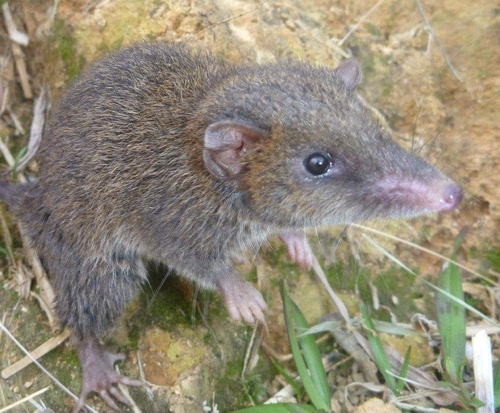
The dorsal fur is medium to dark greyish-brown, often with a slightly warmer, tawny tone on the flanks. The ventral surface is pale grey to creamy-white. The face is pointed with large, dark, prominent eyes. The tail is roughly equal to head-body length, lightly furred, and not noticeably crested.
Size
Head-body length: 75–105 mm in females, 95–115 mm in males. Tail length: 85–110 mm. A compact, mouse-sized marsupial.
Weight
Males: 23–45 g; females: 15–28 g. Males are noticeably heavier than females, particularly in the weeks before the breeding season.
Distinctive features
Closely resembles the Brown Antechinus (A. stuartii) with which it was long confused; reliably distinguished by allozyme electrophoresis and subtle morphological differences including slightly finer, more grizzled fur and a greyer overall dorsal coloration. The Agile Antechinus also tends to have a slightly shorter, broader skull than A. stuartii.
Differences between males and females
Males are significantly larger and heavier than females, particularly in the lead-up to the breeding season when males accumulate condition for the mating effort. No notable differences in coloration between sexes.
Behaviour and diet of the Agile Antechinus
Largely solitary outside the breeding season. Individuals maintain overlapping home ranges but do not form stable social groups. During the brief mating season, males compete intensely for access to females, abandoning normal foraging activity.
When it is active
Primarily nocturnal, with peak activity shortly after sunset and before sunrise. Occasionally active during overcast days. Spends daylight hours resting in nests of shredded bark and leaves within hollow logs, tree hollows, or dense ground debris.
Diet
Carnivorous insectivore, feeding predominantly on invertebrates including beetles, cockroaches, spiders, centipedes, and moth larvae. Also takes small vertebrates such as geckos, skinks, and occasionally small mammals when opportunity arises.
How it feeds and hunts
Forages actively at night along the ground, through leaf litter, under bark, and among logs, using its keen sense of smell and sensitive facial vibrissae to detect prey. Pounces rapidly on mobile prey and subdues it with powerful bites from its sharp, polyprotodont dentition.
Communication
Uses high-pitched squeaks and chittering vocalizations in social and defensive contexts. Scent marking via urine, feces, and glandular secretions plays a role in territory signaling and mate assessment. Males vocalize and engage in wrestling bouts during competitive mating encounters.
Interactions with other species
Predated upon by introduced foxes, feral cats, owls (especially the Powerful Owl, Ninox strenua), brown tree snakes, and tiger snakes. Competes with other small dasyurids (e.g., A. swainsonii, Sminthopsis spp.) and rodents for invertebrate prey. Contributes to controlling invertebrate populations in forest ecosystems.
Role in its ecosystem
Functions as a mid-level predator controlling invertebrate and small vertebrate populations in wet forest ecosystems. As prey, it represents an important energy source for owls and reptiles. The mass die-off of males after breeding provides a notable seasonal pulse of carrion nutrients to the forest floor.
Reproduction and lifecycle
Breeding is strictly seasonal, occurring in a synchronous 1–3 week window in late July to August. Gestation lasts approximately 25–35 days (marsupial pouch young). Litter size ranges from 6 to 10 young, limited by the number of teats available on the mammary patch. Young are weaned and become independent at approximately 90–100 days after birth.
Raising the young
All parental care is provided exclusively by the female. After the young detach from the teats, they remain in the nest while the mother forages, and she carries them on her back once large enough. Females raise a single litter per year and may survive to breed in a second season, unlike males.
Maturity and lifespan
Sexual maturity is reached at approximately 11 months of age, just before the first breeding season. All males die at approximately 11–12 months of age following their sole mating season. Females can survive to breed in a second or occasionally a third year, giving a maximum wild lifespan of about 2–3 years.
Taxonomy and naming of the Agile Antechinus
Classification
Mammalia > Dasyuromorphia > Dasyuridae > Antechinus > Antechinus agilis
Scientific synonyms
Previously treated as a synonym or population of Antechinus stuartii (Brown Antechinus); formally described as a distinct species in 1998 by Dickman, Parnaby, Crowther & King following allozyme and morphological analysis.
What research says
Recent studies
Recent research has highlighted the role of climate change in threatening the Agile Antechinus and related species by altering the phenological timing of invertebrate prey peaks relative to the fixed, hormonally driven mating season. Studies on the neuroendocrinology of male semelparity have used Antechinus species including A. agilis as key model organisms for understanding stress-induced immunosuppression and programmed organismal death.
Genome and DNA
Karyotype: 2n = 14 chromosomes, consistent with most Antechinus species. The species was formally distinguished from A. stuartii primarily on the basis of allozyme electrophoresis revealing fixed genetic differences at multiple loci; subsequent mitochondrial DNA studies confirmed its status as a distinct species.
Compared with similar species
Most closely related to and long confused with the Brown Antechinus (Antechinus stuartii), from which it is separated by its more western and southern distribution, greyer dorsal pelage, and fixed allozyme differences. Distinct from the larger Dusky Antechinus (A. swainsonii), which shares parts of its range, by its smaller size, greyer coloration, and different habitat preferences (A. swainsonii favors wetter, more boggy microhabitats).
The Agile Antechinus and people
All males in a population die within a single 2–3 week window each year following a frenetic mating marathon, a phenomenon called semelparity or 'suicidal reproduction' — making the Agile Antechinus one of very few mammals to reproduce this way. During this mating frenzy, males stop eating, their immune systems collapse, their fur falls out, and they suffer internal bleeding, yet they continue mating until death. Despite looking superficially like a mouse, the Agile Antechinus is more closely related to kangaroos and koalas than to any rodent.
Where and how to see it
Best observed at night in wet sclerophyll forests of the Dandenong Ranges, Kinglake National Park, or the Otway Ranges in Victoria, particularly in areas with abundant fallen logs and dense understory. Use a red-filtered torch to minimize disturbance. Late summer and autumn (February–May) offer the best chances as juveniles from the current year become active. Spotlighting slowly along forest tracks near creek gullies is most productive.
Risks to humans
No notable risk to humans. May bite if handled, but the bite is minor and not venomous. Not known to transmit any significant zoonotic disease to humans under normal circumstances.
Human uses
No commercial use, farming, or traditional medicinal use. Serves as an important scientific model organism in studies of stress physiology, reproductive endocrinology, and the evolution of semelparity in mammals. Occasionally kept in captivity for zoological display and conservation breeding research.
Countries where the Agile Antechinus is recorded
The 2 countries named in the range description of its IUCN Red List assessment.
Questions about the Agile Antechinus
Where does the Agile Antechinus live?
The Agile Antechinus is recorded in Australia and United Kingdom across Europe and Oceania. These countries come from the range description of its IUCN Red List assessment, and they are what place the species on the interactive map.
Is the Agile Antechinus endangered?
The IUCN Red List assesses the Agile Antechinus as Least Concern. The species is widespread and abundant enough not to qualify for any threatened category. It does not mean the species is safe forever, only that nothing in the current data raises an alarm.
How many are left in the wild?
No precise global population estimate exists. This figure comes from the species assessment on the IUCN Red List; population estimates for wild mammals are ranges, not counts, and are revised at each assessment.
What habitat does the Agile Antechinus live in?
Primarily wet sclerophyll forest and cool temperate rainforest, as well as montane ash forests with dense shrub understories and abundant fallen logs and coarse woody debris.
What is the scientific name of the Agile Antechinus?
The Agile Antechinus is Antechinus agilis, in the family Dasyuridae, order Dasyuromorphia.
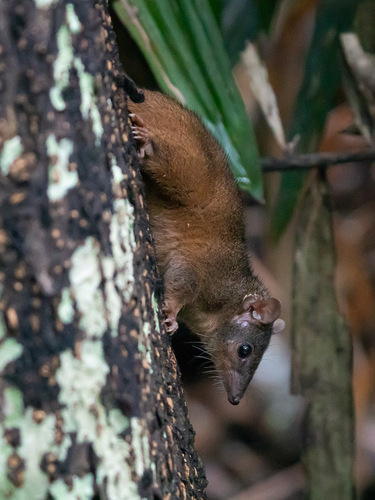
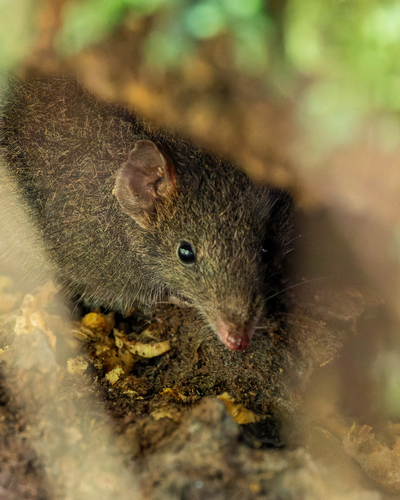
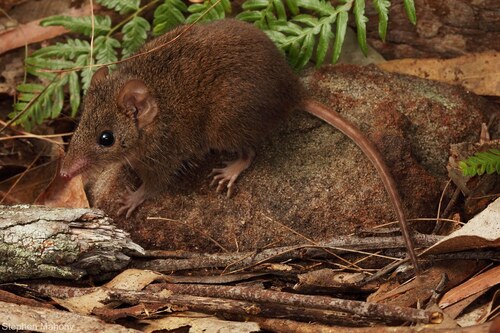
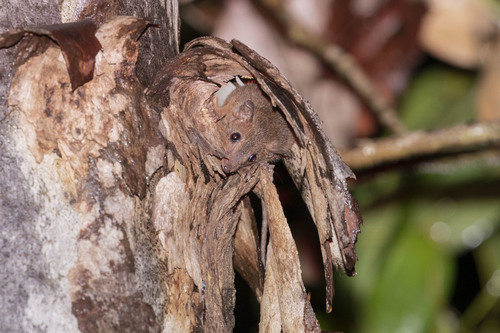
Other species in the genus Antechinus
Other species in the family Dasyuridae

Sources
Conservation status, range description and population estimate come from the IUCN Red List assessment for Antechinus agilis. Countries are derived from that range description, not from a mapped country list. Last refreshed on .
The distribution map is drawn from the IUCN Red List spatial data compiled in 2008. IUCN (International Union for Conservation of Nature)