
Eld's Deer
Rucervus eldii
Red List assessment
Endangeredon the IUCN Red List
- EXExtinct
- EWExtinct in the Wild
- CRCritically Endangered
- ENEndangered
- VUVulnerable
- NTNear Threatened
- LCLeast Concern
The Eld's Deer is recorded in 7 countries across Asia. The IUCN Red List assesses the Eld's Deer as Endangered. Global population estimated at a few thousand individuals, with the Manipur subspecies numbering only around 260 individuals confined to Keibul Lamjao National Park; overall trend is declining or precariously stable due to intensive conservation efforts.
- Family
- Cervidae
- Order
- Artiodactyla
- Genus
- Rucervus
- Countries recorded
- 7
- Continents
- Asia
- Red List category
- Endangered
- Data updated
- August 9, 2026
What is the Eld's Deer?
Eld's Deer is a medium-sized deer species native to South and Southeast Asia, remarkable for its distinctively curved brow-antlers that form a continuous arc from the base to the tip. It inhabits seasonally flooded grasslands, dry deciduous forests and swampy plains. The species is a conservation icon in Manipur, India, where it is the state animal and known locally as 'sangai' or 'dancing deer' due to its graceful movement on floating vegetation mats.
Where does the Eld's Deer live?
Fragmented populations in Manipur (India), Myanmar, Cambodia, and Hainan Island (China); historically also Thailand, Laos and Vietnam
Historically ranged across Northeast India, Myanmar, Thailand, Laos, Cambodia, Vietnam and Hainan Island in China; now restricted to small fragmented populations in Keibul Lamjao National Park (India), scattered reserves in Myanmar, and protected areas in Cambodia, with the Thai and Lao populations extirpated in the wild.
Altitude and depth
Typically found at low elevations, generally below 200m, in floodplain and lowland habitats
Seasonal movements
Movements are influenced by seasonal flooding, with deer shifting to higher or drier ground during monsoon floods and returning to floodplain grasslands during dry seasons; no long-distance migration occurs.
Habitat of the Eld's Deer
Seasonally flooded grasslands, floodplain marshes, open dry dipterocarp forests, and grassy plains with scattered tree cover; the Manipur subspecies uniquely inhabits floating biomass ('phumdi') wetlands in Loktak Lake.
Adaptations to its environment
Elongated hooves and light body build allow Manipur sangai to walk on floating phumdi mats; a grazing-adapted digestive system suits grassland diets, and cryptic brownish coloration provides camouflage in tall grass habitats.
Conservation status and numbers
Endangered (EN) according to IUCN, having suffered massive population declines exceeding 50% over the last three generations due to habitat loss, hunting and fragmentation; some subspecies populations are critically low with fewer than a few hundred individuals.
Estimated population
Global population estimated at a few thousand individuals, with the Manipur subspecies numbering only around 260 individuals confined to Keibul Lamjao National Park; overall trend is declining or precariously stable due to intensive conservation efforts.
What threatens the Eld's Deer?
Habitat loss from agricultural conversion and wetland drainage, poaching for meat and antlers, human encroachment into floodplain habitats, and isolation of small populations leading to genetic bottlenecks.
Diseases and parasites
Susceptible to common cervid parasites including ticks, gastrointestinal helminths, and occasionally diseases transmitted by domestic livestock such as foot-and-mouth disease.
What is being done to protect it?
Protected in Keibul Lamjao National Park (India), Alaungdaw Kathapa National Park (Myanmar), and various sanctuaries in Cambodia; captive breeding programs, reintroduction attempts, and community-based conservation initiatives are ongoing in several range countries.
Recommended actions
Strengthen anti-poaching patrols, restore and protect floodplain and grassland habitats, expand and connect protected areas, support genetic management of small isolated populations, and increase community engagement in conservation.
What the Eld's Deer looks like
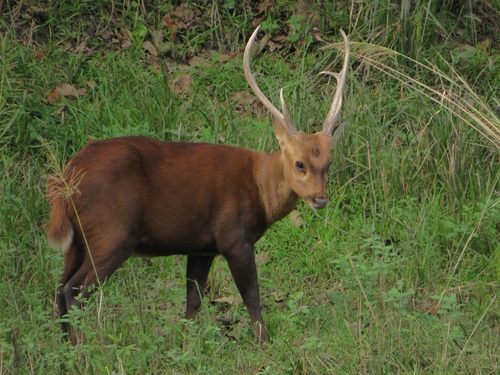
Coat color varies from reddish-brown in summer to darker grayish-brown in winter, with a pale rump patch and white spots sometimes visible on fawns; males possess long, distinctively curved antlers.
Size
Shoulder height ranges from 110-130 cm, with body length between 150-180 cm
Weight
Adult males typically weigh 95-150 kg, while females are smaller at 60-95 kg
Distinctive features
The species is best identified by its unique lyre-shaped brow-antlers where the main beam curves forward in a continuous sweeping arc, unlike the more angular antlers of related cervids such as sambar or barasingha.
Differences between males and females
Males are notably larger than females and possess the characteristic curved antlers, which females lack entirely; males also develop a thicker neck during rutting season.
Behaviour and diet of the Eld's Deer
Generally forms small groups of 2-10 individuals, typically composed of females and young, while males are more solitary outside the breeding season and form temporary bachelor groups.
When it is active
Primarily crepuscular and nocturnal, being most active during dawn, dusk and night hours, resting in cover during the heat of the day.
Diet
Herbivorous, feeding mainly on grasses, aquatic plants, and floodplain vegetation; also consumes leaves, shoots and occasionally agricultural crops when available near human settlements.
Communication
Communication includes vocalizations such as barking or bellowing calls during the rut, scent marking via preorbital and other glands, and visual displays including antler posturing between males.
Interactions with other species
Natural predators historically included tigers and leopards, though these predator populations have sharply declined in most range areas; the species also faces competition with domestic livestock for grazing resources in shared habitats.
Role in its ecosystem
As a grazing herbivore, Eld's Deer plays a role in shaping grassland and floodplain vegetation structure and serves as a prey base for large predators in intact ecosystems.
Reproduction and lifecycle
Breeding season (rut) typically occurs between February and April; gestation lasts approximately 220-240 days, usually resulting in a single fawn, born during the following winter or early spring.
Raising the young
Females provide sole parental care, nursing and protecting the fawn for several months; fawns are hidden in dense vegetation during early life and gradually join the maternal group as they mature.
Maturity and lifespan
Sexual maturity is reached around 1-2 years of age; lifespan in the wild is typically 10-15 years, while captive individuals can live up to 20 years with proper care.
Taxonomy and naming of the Eld's Deer
Classification
Mammalia > Artiodactyla > Cervidae > Rucervus > Rucervus eldii
Subspecies
Rucervus eldii eldii (Manipur brow-antlered deer, 'sangai', India); Rucervus eldii thamin (Myanmar, Thailand region, 'thamin'); Rucervus eldii siamensis (Indochina and Hainan, considered by some the most endangered subspecies)
Scientific synonyms
Panolia eldii; Cervus eldii; Rucervus eldii is sometimes placed in the genus Panolia by some taxonomists
What research says
Recent studies
Recent conservation genetics studies have focused on assessing genetic diversity and inbreeding risk in the critically small Manipur population to guide potential genetic rescue or translocation strategies.
Genome and DNA
Diploid chromosome number is reported as 2n=58-60 depending on subspecies; genetic studies have highlighted low genetic diversity in isolated populations such as the Manipur sangai due to severe historical bottlenecks.
Compared with similar species
Compared to the related barasingha (Rucervus duvaucelii), Eld's Deer has a more slender build and uniquely curved brow-antlers rather than the many-tined antlers of barasingha; it is also smaller than sambar deer (Rusa unicolor) found in similar habitats.
The Eld's Deer and people
The Manipur subspecies is called the 'dancing deer' because its delicate gait on floating vegetation mats resembles a graceful dance; it is also the state animal of Manipur, India, symbolizing the region's unique ecology.
Where and how to see it
Best observed during early morning or late afternoon at Keibul Lamjao National Park in Manipur, India, particularly during the dry season when deer congregate more visibly on higher ground within the floating phumdi habitat.
Risks to humans
No notable risk to humans; Eld's Deer is a shy, non-aggressive herbivore that typically avoids human contact.
Human uses
Historically hunted for meat and antlers as trophies or traditional medicine ingredients in some regions; today it holds significant cultural and ecotourism value, particularly in Manipur where it attracts wildlife tourism.
Myths and legends
In Manipuri culture, the sangai is considered a bridge between the physical and spiritual worlds and features prominently in local folklore, art, and traditional dance performances celebrating its graceful movement.
Countries where the Eld's Deer is recorded
The 7 countries named in the range description of its IUCN Red List assessment.
Questions about the Eld's Deer
Where does the Eld's Deer live?
The Eld's Deer is recorded in Cambodia, China, India, Laos and Myanmar, among 7 countries in total across Asia. These countries come from the range description of its IUCN Red List assessment, and they are what place the species on the interactive map.
Is the Eld's Deer endangered?
Yes. The IUCN Red List assesses the Eld's Deer as Endangered, one of the three threatened categories. The species faces a very high risk of extinction in the wild — a step below Critically Endangered, but still on a trajectory that ends badly without intervention.
How many are left in the wild?
Global population estimated at a few thousand individuals, with the Manipur subspecies numbering only around 260 individuals confined to Keibul Lamjao National Park; overall trend is declining or precariously stable due to intensive conservation efforts. This figure comes from the species assessment on the IUCN Red List; population estimates for wild mammals are ranges, not counts, and are revised at each assessment.
What habitat does the Eld's Deer live in?
Seasonally flooded grasslands, floodplain marshes, open dry dipterocarp forests, and grassy plains with scattered tree cover; the Manipur subspecies uniquely inhabits floating biomass ('phumdi') wetlands in Loktak Lake.
What is the scientific name of the Eld's Deer?
The Eld's Deer is Rucervus eldii, in the family Cervidae, order Artiodactyla.
Other species in the genus Rucervus
Other species in the family Cervidae
Species that share its range
Sources
Conservation status, range description and population estimate come from the IUCN Red List assessment for Rucervus eldii. Countries are derived from that range description, not from a mapped country list. Last refreshed on .
The distribution map is drawn from the IUCN Red List spatial data compiled in 2015. IUCN (International Union for Conservation of Nature)