
Wrinkle-faced Bat
Centurio senex
Red List assessment
Least Concernon the IUCN Red List
- EXExtinct
- EWExtinct in the Wild
- CRCritically Endangered
- ENEndangered
- VUVulnerable
- NTNear Threatened
- LCLeast Concern
The Wrinkle-faced Bat is recorded in 9 countries across North America and South America. The IUCN Red List assesses the Wrinkle-faced Bat as Least Concern. No precise global population estimate exists, but the species is considered locally common in parts of its range with a presumed stable population trend.
- Family
- Phyllostomidae
- Order
- Chiroptera
- Genus
- Centurio
- Countries recorded
- 9
- Continents
- North America and South America
- Red List category
- Least Concern
- Data updated
- August 9, 2026
What is the Wrinkle-faced Bat?
The Wrinkle-faced Bat is a small, distinctive Neotropical fruit bat known for the bizarre, deeply folded and wrinkled skin on its face, giving it a unique and somewhat unsettling appearance. It inhabits lowland tropical forests from Mexico through Central America into parts of northern South America. Its unusual facial morphology and skin fold that can be pulled up like a mask over its face during roosting have fascinated bat researchers for decades. It is a member of the leaf-nosed bat family Phyllostomidae, though it lacks the typical nose-leaf structure.
Where does the Wrinkle-faced Bat live?
Mexico, Central America, and northern South America
Ranges from central Mexico through Belize, Guatemala, Honduras, Nicaragua, Costa Rica, Panama, and into Colombia, Venezuela, and Trinidad in northern South America.
Altitude and depth
Sea level up to approximately 1,600 meters elevation
Seasonal movements
No long-distance migration is known; activity patterns may shift slightly with fruit availability across wet and dry seasons.
Habitat of the Wrinkle-faced Bat
Primarily found in lowland tropical evergreen and deciduous forests, forest edges, and secondary growth; also occurs in agricultural areas with fruiting trees nearby. Prefers areas with abundant fig trees and other fruit-bearing vegetation.
Adaptations to its environment
The species possesses a unique facial skin fold that can be drawn up over the face like a mask, possibly for protection while feeding or roosting. Its short, broad muzzle and strong jaw are adapted for crushing fruit, and males have glandular skin folds used in scent communication.
Conservation status and numbers
Listed as Least Concern by the IUCN due to its wide distribution across Central and northern South America and presumed large population size, with no major evidence of rapid decline.
Estimated population
No precise global population estimate exists, but the species is considered locally common in parts of its range with a presumed stable population trend.
What threatens the Wrinkle-faced Bat?
Habitat loss from deforestation for agriculture and logging is the primary threat, along with fragmentation of tropical forest habitats. Pesticide use in agricultural areas may also affect food availability.
Diseases and parasites
Like many bat species, it can host ectoparasites such as bat flies (Streblidae) and may carry various viruses typical of Neotropical bat populations, though specific pathogen studies are limited.
What is being done to protect it?
Benefits indirectly from protected areas and forest reserves throughout its range in Central America and South America, though no species-specific conservation programs exist. Included in general bat conservation and biodiversity monitoring efforts in Mesoamerica.
Recommended actions
Continued protection and connectivity of lowland tropical forest habitats, monitoring of population trends, and further ecological research to better understand its life history and habitat requirements.
What the Wrinkle-faced Bat looks like
The bat has grayish-brown to yellowish fur and a short, blunt snout, but its most notable feature is the heavily wrinkled, folded skin on its face, especially pronounced in males. Males possess a unique flap of skin below the chin that can be pulled up to cover the face like a mask.
Size
Body length approximately 5.5-6.5 cm; forearm length around 39-45 mm; wingspan estimated at 30-35 cm.
Weight
Approximately 15-25 grams, with males generally slightly smaller than females.
Distinctive features
Unlike most phyllostomid bats, it lacks a nose-leaf and instead has this dramatic wrinkled facial skin, making it instantly recognizable among Neotropical bats. The masking behavior of pulling skin over the face is unique among bats.
Differences between males and females
Males have more pronounced facial wrinkles and a distinctive chin flap used for masking and possibly scent dispersal, while females lack these exaggerated skin folds and have smoother faces.
Behaviour and diet of the Wrinkle-faced Bat
Generally roosts alone or in small groups, often under large leaves rather than in caves or hollow trees, distinguishing it from many other bat species. Social structure is not well studied but appears to be solitary or loosely associative.
When it is active
Nocturnal, becoming active after dusk to forage on fruit, with peak activity during the first few hours of the night.
Diet
Primarily frugivorous, feeding heavily on figs (Ficus) and other soft, pulpy fruits; may occasionally supplement diet with nectar or insects.
How it feeds and hunts
Forages by flying to fruiting trees and plucking ripe fruit in flight or while briefly landing, then carrying it to a feeding roost to consume the pulp and discard seeds and skin.
Communication
Communication is thought to involve echolocation calls for navigation and possibly chemical signaling via facial and chin gland secretions, particularly in males during social or reproductive interactions.
Interactions with other species
Preyed upon by owls, opossums, and other nocturnal predators; interacts with fruiting plants as a seed disperser and occasional pollinator through nectar feeding.
Role in its ecosystem
Plays an important ecological role as a seed disperser for fig trees and other fruiting plants in tropical forest ecosystems, contributing to forest regeneration and plant diversity.
Reproduction and lifecycle
Breeding appears to occur seasonally correlated with fruit abundance, with females typically giving birth to a single offspring after a gestation period of a few months, though exact timing varies regionally.
Raising the young
Females are the primary caregivers, carrying and nursing the single pup until it is capable of independent flight and foraging within a few weeks to months.
Maturity and lifespan
Sexual maturity is reached within the first year of life; lifespan in the wild is estimated at around 5-10 years, with limited data from captivity.
Taxonomy and naming of the Wrinkle-faced Bat
Classification
Mammalia > Chiroptera > Phyllostomidae > Centurio > Centurio senex
Scientific synonyms
Centurio flavogularis; Centurio senex greenhalli (sometimes treated as subspecies, now often synonymized)
What research says
Recent studies
Recent research has focused on the function of the unique facial wrinkles and masking behavior, suggesting possible roles in acoustic camouflage, protection during feeding, or chemical communication via associated glands.
Compared with similar species
Unlike related frugivorous phyllostomids such as Artibeus or Carollia, which have prominent nose-leaves, Centurio senex lacks this structure entirely and instead has its signature wrinkled face, making it visually unique within the family.
The Wrinkle-faced Bat and people
The Wrinkle-faced Bat can pull a flap of skin up over its face like a built-in mask, possibly to protect its face while feeding on juicy fruit. Its bizarre wrinkled visage has earned it nicknames related to its unsettling, almost 'old man' appearance, which inspired its species name 'senex' (Latin for 'old man').
Where and how to see it
Best observed at dusk near fruiting fig trees in lowland tropical forests of Central America, such as in Costa Rica or Belize, using a flashlight or bat detector to spot them foraging. Patience and knowledge of local fruiting tree locations increase chances of sighting.
Risks to humans
No notable risk to humans; like other bats, it should not be handled due to general risks of zoonotic disease transmission through bites or scratches.
Countries where the Wrinkle-faced Bat is recorded
The 9 countries named in the range description of its IUCN Red List assessment.
Questions about the Wrinkle-faced Bat
Where does the Wrinkle-faced Bat live?
The Wrinkle-faced Bat is recorded in Belize, Colombia, Costa Rica, Guatemala and Honduras, among 9 countries in total across North America and South America. These countries come from the range description of its IUCN Red List assessment, and they are what place the species on the interactive map.
Is the Wrinkle-faced Bat endangered?
The IUCN Red List assesses the Wrinkle-faced Bat as Least Concern. The species is widespread and abundant enough not to qualify for any threatened category. It does not mean the species is safe forever, only that nothing in the current data raises an alarm.
How many are left in the wild?
No precise global population estimate exists, but the species is considered locally common in parts of its range with a presumed stable population trend. This figure comes from the species assessment on the IUCN Red List; population estimates for wild mammals are ranges, not counts, and are revised at each assessment.
What habitat does the Wrinkle-faced Bat live in?
Primarily found in lowland tropical evergreen and deciduous forests, forest edges, and secondary growth; also occurs in agricultural areas with fruiting trees nearby.
What is the scientific name of the Wrinkle-faced Bat?
The Wrinkle-faced Bat is Centurio senex, in the family Phyllostomidae, order Chiroptera.
Other species in the family Phyllostomidae
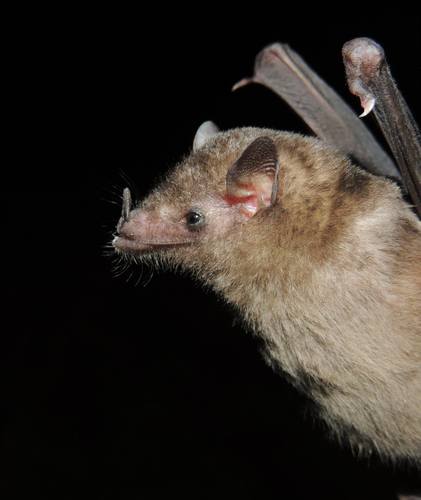
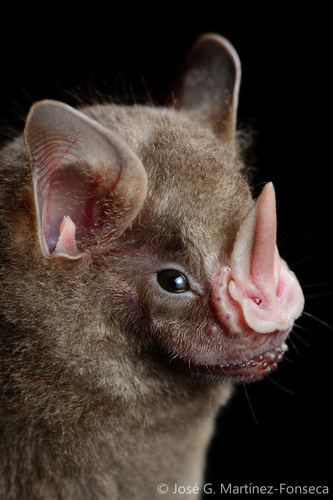
Species that share its range

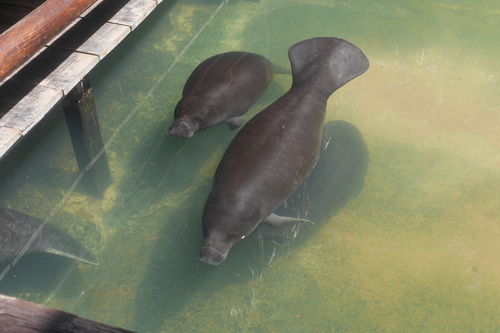
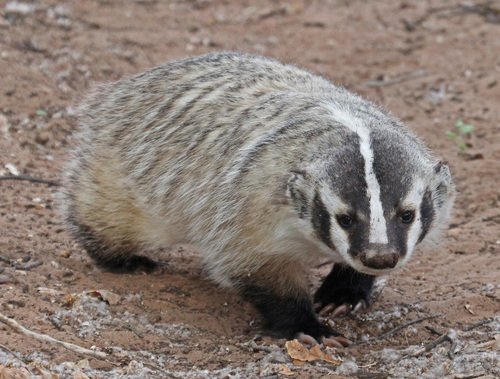
Sources
Conservation status, range description and population estimate come from the IUCN Red List assessment for Centurio senex. Countries are derived from that range description, not from a mapped country list. Last refreshed on .
The distribution map is drawn from the IUCN Red List spatial data compiled in 2011. IUCN (International Union for Conservation of Nature)