
American Pika
Ochotona princeps
Red List assessment
Least Concernon the IUCN Red List
- EXExtinct
- EWExtinct in the Wild
- CRCritically Endangered
- ENEndangered
- VUVulnerable
- NTNear Threatened
- LCLeast Concern
The American Pika is recorded in 3 countries across North America. The IUCN Red List assesses the American Pika as Least Concern. Global population is not precisely quantified but considered large and widespread; overall trend is stable to declining, with notable local extinctions documented in the Great Basin region of Nevada and Oregon.
- Family
- Ochotonidae
- Order
- Lagomorpha
- Genus
- Ochotona
- Countries recorded
- 3
- Continents
- North America
- Red List category
- Least Concern
- Data updated
- August 9, 2026
What is the American Pika?
The American pika is a small, round-bodied lagomorph found in high-elevation rocky habitats of western North America. Known for its distinctive high-pitched alarm call, it is a cold-adapted species highly sensitive to temperature changes. It plays an important ecological role in alpine talus ecosystems and is often considered an indicator species for climate change impacts. Despite its small size, it is remarkably industrious, spending summers gathering vegetation into 'haypiles' for winter survival.
Where does the American Pika live?
Mountainous regions of western North America, including the United States and Canada
Found throughout the mountainous regions of western North America, including the Rocky Mountains, Sierra Nevada, Cascade Range, and Great Basin ranges in the United States and southwestern Canada, from British Columbia to New Mexico.
Altitude and depth
Typically found between 2,500 and 3,900 meters, though populations at lower latitudes occur at higher elevations while northern populations can be found closer to sea level in some areas.
Seasonal movements
Does not hibernate; remains active year-round beneath snow cover, relying on cached food (haypiles) gathered during summer and fall to survive winter months.
Habitat of the American Pika
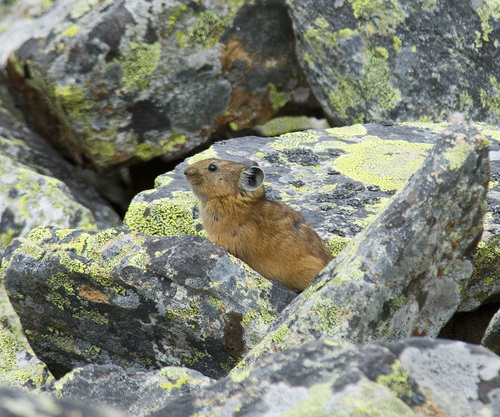
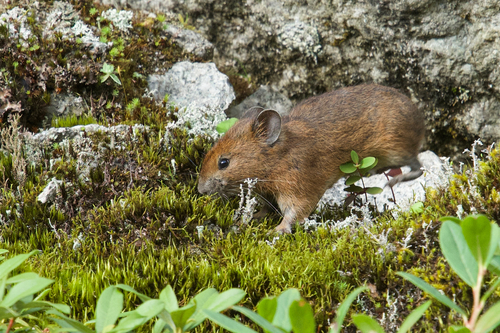
Primarily found in talus slopes and rockpiles adjacent to alpine meadows, where crevices provide shelter from predators and temperature extremes. Requires a mix of open rocky habitat for cover and nearby vegetation for foraging.
Adaptations to its environment
Possesses a thick fur coat and high metabolic rate suited to cold environments, but is highly intolerant of heat, with body temperatures becoming lethal above 78°F (25.5°C) if exposed for extended periods. Behavioral adaptations include haying behavior, seeking shelter in cool rock crevices during hot days, and being most active during cooler parts of the day.
Conservation status and numbers
Listed as Least Concern by the IUCN overall due to its wide distribution and many stable populations, though certain regional populations, particularly in the Great Basin, have experienced significant local extirpations linked to climate change.
Estimated population
Global population is not precisely quantified but considered large and widespread; overall trend is stable to declining, with notable local extinctions documented in the Great Basin region of Nevada and Oregon.
What threatens the American Pika?
Primary threats include climate change and rising temperatures causing habitat loss at lower elevations, habitat fragmentation limiting dispersal between mountain 'islands,' and potential increased disease or parasite loads under thermal stress.
Diseases and parasites
Susceptible to various ectoparasites such as fleas and ticks, as well as internal parasites like nematodes; disease dynamics may be exacerbated by heat stress under climate change.
What is being done to protect it?
Protected in various national parks and wilderness areas across its range; monitored extensively by research programs studying climate change impacts, including citizen science initiatives like the Pika Patrol and Front Range Pika Project.
Recommended actions
Recommended actions include continued long-term population monitoring, protection of high-elevation refugia, maintaining habitat connectivity between mountain ranges, and further research into genetic adaptation potential to warming climates.
What the American Pika looks like
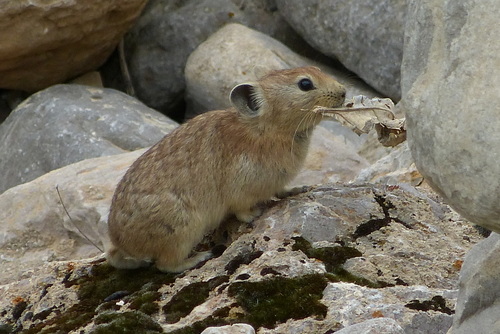
Small, egg-shaped body with short limbs, rounded ears, and no visible tail; fur is grayish-brown to cinnamon in summer, becoming longer and paler in winter.
Size
Body length ranges from 16.2 to 21.6 cm, with no visible external tail.
Weight
Adults typically weigh between 121 and 176 grams, with minimal difference between sexes.
Distinctive features
Distinguished from related pika species by its specific vocalization patterns, slightly larger ear size, and geographic range restricted to North America, unlike its Asian relatives.
Behaviour and diet of the American Pika
Generally solitary and highly territorial, defending individual haypiles and rock crevice territories from neighboring pikas, though individuals may live in loose colonies within suitable talus habitat.
When it is active
Diurnal, with activity peaks in early morning and late afternoon during warmer months to avoid heat stress, and more evenly distributed activity during cooler seasons.
Diet
Herbivorous, feeding on a wide variety of grasses, sedges, forbs, and shrubs; also collects and dries vegetation into haypiles cached in rock crevices for winter consumption.
Communication
Uses a distinctive short, high-pitched call to signal alarm at predators and to communicate territorial boundaries; also employs a longer 'song' call primarily during the breeding season.
Interactions with other species
Preyed upon by weasels, martens, foxes, coyotes, and raptors such as hawks and owls; competes with other herbivores like marmots and ground squirrels for alpine vegetation resources.
Role in its ecosystem
Serves as an important prey species in alpine food webs and contributes to nutrient cycling in talus ecosystems through foraging and haypile creation, indirectly influencing plant community composition.
Reproduction and lifecycle
Breeding occurs in early spring, with females capable of producing two litters per year; gestation lasts approximately 30 days, and litter size averages 2 to 5 young.
Raising the young
Young are altricial at birth and cared for solely by the mother in a nest within rock crevices; weaning occurs at approximately 4 weeks, after which juveniles disperse to establish their own territories.
Maturity and lifespan
Reaches sexual maturity at about one year of age; typical lifespan in the wild is 3 to 7 years.
Taxonomy and naming of the American Pika
Classification
Class Mammalia > Order Lagomorpha > Family Ochotonidae > Genus Ochotona > Species O. princeps
Subspecies
Around 36 subspecies have been described historically, distributed across isolated mountain ranges such as the Rockies, Sierra Nevada, and Cascades, though many are now considered questionable or synonymized based on genetic data.
Scientific synonyms
Lagomys princeps (original name used by Richardson in 1828)
What research says
Recent studies
Recent research has focused on documenting local extinctions linked to climate warming, particularly in low-elevation Great Basin populations, and on genetic studies revealing potential adaptive capacity in some populations to withstand higher temperatures.
Genome and DNA
Diploid chromosome number is 2n=68; genetic studies have been used to delineate distinct evolutionary lineages and assess population connectivity across fragmented mountain habitats.
Compared with similar species
Similar to the collared pika (Ochotona collaris) found further north in Alaska and Yukon, but the American pika has a more southern distribution and lacks the distinct grayish collar marking; both differ from Asian pika species by habitat preference and vocalization patterns.
The American Pika and people
American pikas can die from overheating within about an hour if exposed to temperatures above 78°F (25.5°C), despite living in cold mountain environments. They are sometimes called 'rock rabbits' or 'whistling hares' due to their sharp alarm calls. Their haypiles can contain over 60 different plant species carefully dried and stored for winter.
Where and how to see it
Best observed during summer mornings or late afternoons in talus fields near alpine meadows in areas such as Rocky Mountain National Park, Yosemite, or the Cascades; listen for their sharp alarm calls as an indicator of nearby presence.
Risks to humans
No notable risk to humans.
Countries where the American Pika is recorded
The 3 countries named in the range description of its IUCN Red List assessment.
Questions about the American Pika
Where does the American Pika live?
The American Pika is recorded in Canada, Mexico and United States across North America. These countries come from the range description of its IUCN Red List assessment, and they are what place the species on the interactive map.
Is the American Pika endangered?
The IUCN Red List assesses the American Pika as Least Concern. The species is widespread and abundant enough not to qualify for any threatened category. It does not mean the species is safe forever, only that nothing in the current data raises an alarm.
How many are left in the wild?
Global population is not precisely quantified but considered large and widespread; overall trend is stable to declining, with notable local extinctions documented in the Great Basin region of Nevada and Oregon. This figure comes from the species assessment on the IUCN Red List; population estimates for wild mammals are ranges, not counts, and are revised at each assessment.
What habitat does the American Pika live in?
Primarily found in talus slopes and rockpiles adjacent to alpine meadows, where crevices provide shelter from predators and temperature extremes.
What is the scientific name of the American Pika?
The American Pika is Ochotona princeps, in the family Ochotonidae, order Lagomorpha.
Other species in the genus Ochotona

Species that share its range
Sources
Conservation status, range description and population estimate come from the IUCN Red List assessment for Ochotona princeps. Countries are derived from that range description, not from a mapped country list. Last refreshed on .
The distribution map is drawn from the IUCN Red List spatial data compiled in 2016. IUCN (International Union for Conservation of Nature)