
Toltec Fruit-eating Bat
Dermanura tolteca
Red List assessment
Least Concernon the IUCN Red List
- EXExtinct
- EWExtinct in the Wild
- CRCritically Endangered
- ENEndangered
- VUVulnerable
- NTNear Threatened
- LCLeast Concern
The Toltec Fruit-eating Bat is recorded in 12 countries across North America and South America. The IUCN Red List assesses the Toltec Fruit-eating Bat as Least Concern. No precise global population estimate is available.
- Family
- Phyllostomidae
- Order
- Chiroptera
- Genus
- Dermanura
- Countries recorded
- 12
- Continents
- North America and South America
- Red List category
- Least Concern
- Data updated
- August 9, 2026
What is the Toltec Fruit-eating Bat?
The Toltec Fruit-eating Bat is a small neotropical leaf-nosed bat of the family Phyllostomidae, named after the pre-Columbian Toltec civilization of Mesoamerica. It is characterized by four distinct white facial stripes, a prominent triangular nose-leaf, and a greatly reduced uropatagium giving the appearance of having no tail. Inhabiting tropical and subtropical forests from Mexico through Central and northwestern South America, it plays a critical ecological role as a prolific seed disperser and frugivore. It represents a remarkable example of specialized co-evolution with tropical fruit-bearing plants.
Where does the Toltec Fruit-eating Bat live?
Mexico (from Sinaloa, Jalisco, Morelos, Oaxaca, Chiapas, and Veracruz southward), all Central American countries (Guatemala, Belize, Honduras, El Salvador, Nicaragua, Costa Rica, Panama), and northwestern South America (Colombia, Venezuela, Ecuador, Peru)
Ranges continuously from western and eastern Mexico south through Guatemala, Belize, Honduras, El Salvador, Nicaragua, Costa Rica, and Panama, extending into Colombia, Venezuela, Ecuador, and Peru in South America. In Mexico, recorded in states including Sinaloa, Nayarit, Jalisco, Colima, Guerrero, Morelos, Oaxaca, Chiapas, and Veracruz.
Altitude and depth
Recorded from near sea level up to approximately 2,500 m elevation. Most abundant between 500–1,800 m in montane and submontane forest zones, though it is found at lower elevations too.
Seasonal movements
Non-migratory; a year-round resident throughout its range. Reproductive activity often shows a bimodal seasonal pattern correlated with peaks in local fruit availability and the transition between wet and dry seasons. No hibernation occurs given the tropical climate.
Habitat of the Toltec Fruit-eating Bat
Primarily occupies tropical and subtropical moist broadleaf forests, including semi-evergreen, semi-deciduous, and cloud forests. Also found in secondary growth forests, forest edges, and riparian gallery forests, occasionally foraging into adjacent agricultural landscapes with remnant fruit trees. Shows affinity for areas with high density of fig trees (Ficus spp.) and other pioneer plants.
Adaptations to its environment
Possesses a specialized nose-leaf that enhances directional sensitivity of echolocation calls, allowing precise navigation in dense, cluttered forest environments. Strong, robust jaws and broad molars are adapted for processing fibrous or hard-skinned fruits. The ability to construct leaf-tent roosts by selectively biting leaf veins provides camouflage, rain shelter, and thermoregulation advantages.
Conservation status and numbers
Least Concern (LC) on the IUCN Red List. The species has a broad geographic range, occurs in numerous protected areas, and can tolerate moderate habitat disturbance including secondary forest growth. No significant population-wide declines have been documented, and it does not approach the thresholds for a more threatened category.
Estimated population
No precise global population estimate is available. The species is considered relatively common throughout much of its range based on survey data and consistent detection in tropical forest inventories. Population trend is presumed stable.
What threatens the Toltec Fruit-eating Bat?
Deforestation and habitat fragmentation driven by agricultural expansion, cattle ranching, logging, and urban development are the primary threats. Pesticide use in adjacent agricultural areas may indirectly reduce fruit tree availability and insect prey. Persecution by humans due to widespread misconceptions about bats, and incidental mortality through cave disturbance or roost destruction, are secondary concerns.
Diseases and parasites
Parasitized by ectoparasites including bat flies (families Streblidae and Nycteribiidae) and mites (Acari). As a New World bat, it is part of the rabies surveillance landscape, though phyllostomid fruit-eating bats are considered low-risk reservoirs compared to hematophagous vampire bats. Internal parasites (helminths, protozoa) have been documented in related species.
What is being done to protect it?
Benefits from legal protection within numerous national parks and biosphere reserves across its range, including the Sierra Gorda Biosphere Reserve (Mexico), El Triunfo Biosphere Reserve (Chiapas), La Amistad International Park (Costa Rica/Panama), and others. Protected under CITES Appendix II indirectly through broader bat conservation frameworks and Mexico's NOM-059-SEMARNAT wildlife protection standard.
Recommended actions
Standardized population monitoring through mist-net surveys across the range; expanded protection of montane and submontane tropical forests that serve as core habitat; public education campaigns to reduce bat persecution; integration of bat-friendly practices in shade-grown coffee and cacao agroforestry systems where this species forages.
What the Toltec Fruit-eating Bat looks like
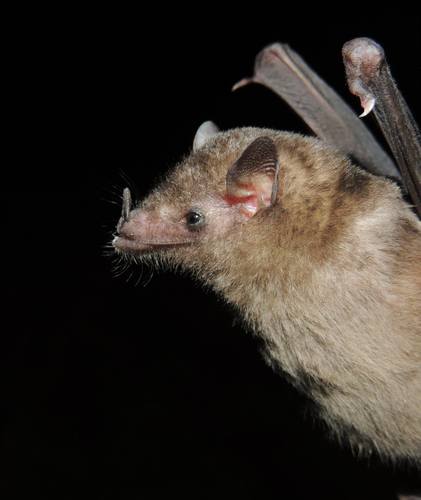
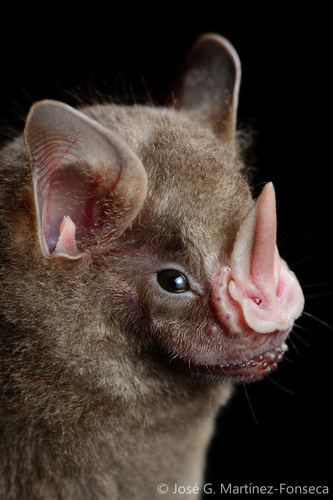
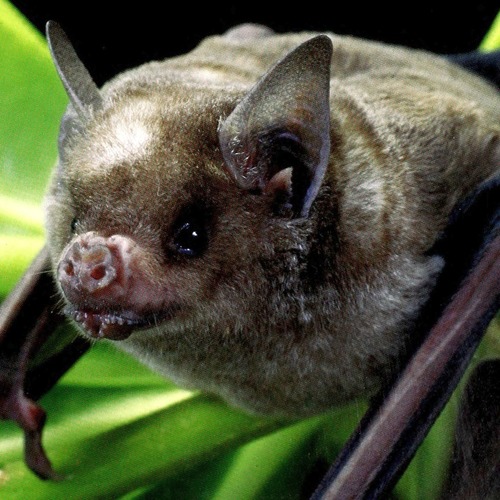
A small, compact bat with dark brownish-gray to medium brown dorsal fur and paler grayish-white to creamy ventral fur. The face bears four conspicuous white stripes: one running above each eye and one running below each eye from nose to ear. The nose-leaf is triangular and moderately sized. Ears are dark, short, and rounded. Wings are dark brown to blackish.
Size
Head-body length approximately 55–75 mm; forearm length 36–43 mm; wingspan approximately 28–34 cm. Tail is vestigial or absent externally; ears are short and rounded (approximately 15–18 mm).
Weight
Approximately 10–19 g. Females are generally slightly heavier than males, particularly during pregnancy and lactation, when they may reach the upper end of the weight range.
Distinctive features
Distinguished from the closely related and co-occurring Dermanura azteca (Aztec Fruit-eating Bat) primarily by its larger body and forearm size (D. azteca forearm typically 32–38 mm vs. 36–43 mm in D. tolteca). Subtle cranial and dental morphology differences, including condylobasal length, further separate the two species. Both share the four-stripe facial pattern common to the Dermanura/Artibeus group.
Differences between males and females
Minimal sexual dimorphism. Females tend to be marginally larger on average, a pattern typical of phyllostomid bats. No notable color differences between sexes. Females possess two pectoral mammary glands.
Behaviour and diet of the Toltec Fruit-eating Bat
Roosts in small to medium-sized groups, typically ranging from a few individuals to several dozen. Social structure may include harem groups with one dominant male attending several females during the breeding season. Also documented in mixed-species roosting assemblages with other small phyllostomid bats.
When it is active
Strictly nocturnal. Foraging activity typically begins shortly after dusk, with peak activity in the first 1–3 hours of the night. Returns to daytime roosts (leaf tents, palm fronds, tree hollows, or dense foliage) before dawn.
Diet
Primarily frugivorous, with figs (Ficus spp.) constituting a major dietary component due to their year-round availability. Also consumes fruits of Cecropia, Piper, Solanum, Vismia, and other pioneer and understory plants. Diet is supplemented with pollen, nectar, and occasionally soft-bodied insects, especially during periods of low fruit availability.
How it feeds and hunts
Forages by flying through forest understory and canopy, detecting ripe fruits largely by olfaction (smell) and echolocation. Upon locating a fruit, the bat plucks it with its mouth and typically carries it to a nearby feeding roost (a branch or perch away from the main roost) to consume, reducing the risk of predation while feeding. Emits short, low-intensity, broad-band echolocation pulses adapted to cluttered forest environments.
Communication
Primary navigation and prey/fruit detection via ultrasonic echolocation calls (broad-band frequency-modulated sweeps). Social communication within roost groups involves a repertoire of audible chirps, squeaks, and chattering vocalizations. Olfactory signals via facial and gular glands may contribute to individual recognition and social bonding within colonies.
Interactions with other species
Functions as a major mutualistic seed disperser for dozens of tropical plant species, ingesting pulp and defecating seeds away from parent plants, enhancing forest regeneration. Natural predators include barn owls (Tyto alba), mottled owls (Ciccaba virgata), arboreal snakes, and opportunistic carnivores such as opossums. Competes with other frugivorous bats (e.g., Artibeus jamaicensis) and frugivorous birds for shared food resources.
Role in its ecosystem
Acts as a keystone seed disperser in Neotropical forest ecosystems, contributing substantially to forest regeneration, especially in disturbed areas dominated by pioneer plant species. Its leaf-tent construction behavior modifies local microhabitats. Occasional flower visits may make it a minor pollinator of certain plant species.
Reproduction and lifecycle
Exhibits bimodal polyestry in many parts of its range, with two reproductive peaks per year often corresponding to the late dry and late wet seasons. Gestation lasts approximately 3.5–4 months. Litter size is invariably one pup per birth. Females can become pregnant again shortly after parturition.
Raising the young
The mother provides all direct parental care. Newborn pups are initially carried by the mother during foraging flights and cling to her ventrally. As they grow heavier, pups are left at the roost while the mother forages. Nursing continues for approximately 1–2 months until the young bat is capable of independent flight and foraging.
Maturity and lifespan
Sexual maturity is likely attained within the first year of life, consistent with other phyllostomid bats of similar size. Wild lifespan is estimated at 5–10 years, while potential longevity in captivity may exceed this range, as documented for related species. No long-term banding studies specific to this species are available.
Taxonomy and naming of the Toltec Fruit-eating Bat
Classification
Mammalia > Chiroptera > Phyllostomidae > Dermanura > Dermanura tolteca (Saussure, 1860)
Scientific synonyms
Artibeus toltecus Saussure, 1860 (original combination); long classified within the genus Artibeus before molecular phylogenetic studies supported elevation of Dermanura to full genus status distinct from Artibeus.
What research says
Recent studies
Molecular systematics studies in the early 2000s–2010s firmly established the phylogenetic distinctness of Dermanura from Artibeus, reshaping classification of this entire bat radiation. Ecological studies in Mexican and Central American forests have documented the species' contribution to seed rain and tropical forest recovery in secondary habitats. Echolocation call databases for Neotropical bats have incorporated recordings of D. tolteca to support acoustic monitoring programs.
Genome and DNA
The diploid chromosome number (2n) for Dermanura/Artibeus-complex species is typically reported as 2n=30 or 2n=31; the exact count for D. tolteca specifically requires confirmation. Molecular phylogenetic analyses (e.g., Hoofer & Van Den Bussche 2003; Solari et al.) provided the genetic evidence supporting elevation of Dermanura to full genus status, separate from Artibeus sensu stricto.
Compared with similar species
Most closely related to Dermanura azteca (Aztec Fruit-eating Bat), from which it is distinguished primarily by larger body size and longer forearm. Both species share overlapping distributions in Mexico and Central America and similar frugivorous ecology, making field identification challenging. Within the genus Dermanura, also related to D. cinerea, D. phaeotis, and D. watsoni, all of which are small, stripe-faced fruit-eating bats of Neotropical forests.
The Toltec Fruit-eating Bat and people
Despite being named after the powerful Toltec civilization that flourished in Mexico around 900–1150 CE, this bat was not formally described by Western science until 1860, long after the Toltec empire had disappeared. A single individual may disperse hundreds of seeds per night across the forest, making it one of the most prolific long-distance seed dispersers in its ecosystem. Like several relatives, it 'modifies' large leaves such as Heliconia or palm fronds into makeshift tent-roosts by biting the midrib so the leaf folds downward, creating a ready-made shelter that blends seamlessly with surrounding vegetation.
Where and how to see it
Best observed at dusk near fruiting fig (Ficus) or Cecropia trees in tropical forests of Mexico and Central America. The Sierra Gorda Biosphere Reserve (Querétaro), the forests of Morelos state, Los Tuxtlas Biosphere Reserve (Veracruz), and lowland to mid-elevation reserves in Costa Rica (e.g., Monteverde, Corcovado) offer excellent opportunities. Mist-netting conducted by licensed researchers is the most reliable detection and study method; acoustic detectors programmed for Neotropical bat calls can also detect flight activity.
Risks to humans
No notable risk to humans under normal circumstances. As with all wild bat species, direct handling without protective gloves should be avoided due to the theoretical, low-probability risk of rabies exposure through bite or scratch. The species does not attack humans and bites only in self-defense when carelessly handled.
Human uses
Not commercially exploited and not used in traditional medicine to any documented extent. Of immense indirect ecological value to human agriculture and forestry through its seed dispersal services, which support tropical forest regeneration and biodiversity. Increasingly used as a model organism in ecological research on frugivory, seed dispersal networks, and Neotropical bat community dynamics.
Myths and legends
Bats held profound symbolic significance throughout Mesoamerican cultures, including the Toltecs. The Maya bat deity Camazotz ('death bat' in Kiche Maya) was portrayed as a death and sacrifice god associated with the underworld, caves, and darkness—themes appearing in the Popol Vuh epic. While no myth is specifically attributed to Dermanura tolteca, the naming of this species after the Toltec people reflects the deep cultural entanglement between these bats and pre-Columbian Mesoamerican civilizations, for whom bats were powerful symbols of night, death, and regeneration.
Countries where the Toltec Fruit-eating Bat is recorded
The 12 countries named in the range description of its IUCN Red List assessment.
Questions about the Toltec Fruit-eating Bat
Where does the Toltec Fruit-eating Bat live?
The Toltec Fruit-eating Bat is recorded in Belize, Colombia, Costa Rica, Ecuador and El Salvador, among 12 countries in total across North America and South America. These countries come from the range description of its IUCN Red List assessment, and they are what place the species on the interactive map.
Is the Toltec Fruit-eating Bat endangered?
The IUCN Red List assesses the Toltec Fruit-eating Bat as Least Concern. The species is widespread and abundant enough not to qualify for any threatened category. It does not mean the species is safe forever, only that nothing in the current data raises an alarm.
How many are left in the wild?
No precise global population estimate is available. This figure comes from the species assessment on the IUCN Red List; population estimates for wild mammals are ranges, not counts, and are revised at each assessment.
What habitat does the Toltec Fruit-eating Bat live in?
Primarily occupies tropical and subtropical moist broadleaf forests, including semi-evergreen, semi-deciduous, and cloud forests.
What is the scientific name of the Toltec Fruit-eating Bat?
The Toltec Fruit-eating Bat is Dermanura tolteca, in the family Phyllostomidae, order Chiroptera.
Other species in the genus Dermanura
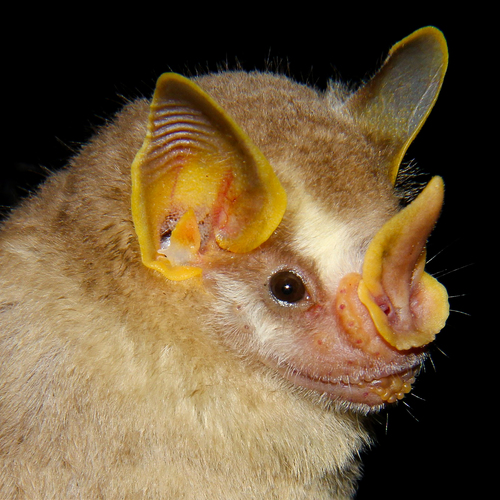
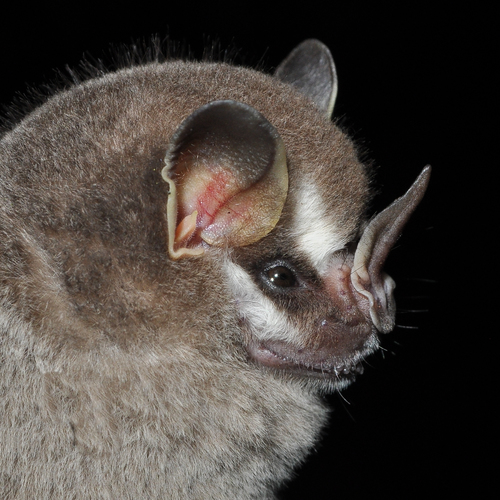
Other species in the family Phyllostomidae
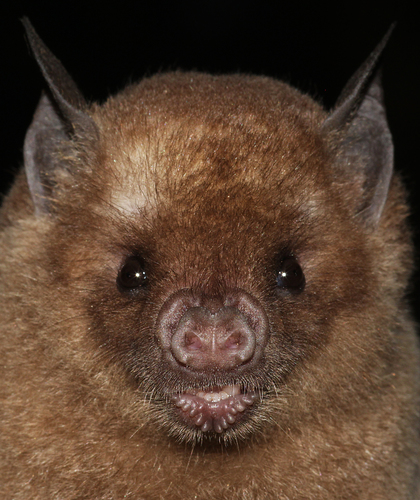
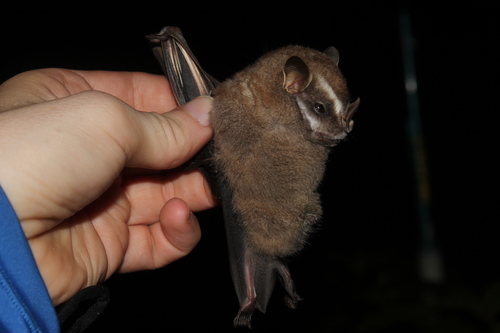
Sources
Conservation status, range description and population estimate come from the IUCN Red List assessment for Dermanura tolteca. Countries are derived from that range description, not from a mapped country list. Last refreshed on .
The distribution map is drawn from the IUCN Red List spatial data compiled in 2015. International Union for the Conservation of Nature