
Dwarf Fruit-eating Bat
Dermanura gnoma
Red List assessment
Least Concernon the IUCN Red List
- EXExtinct
- EWExtinct in the Wild
- CRCritically Endangered
- ENEndangered
- VUVulnerable
- NTNear Threatened
- LCLeast Concern
The Dwarf Fruit-eating Bat is recorded in 6 countries across South America. The IUCN Red List assesses the Dwarf Fruit-eating Bat as Least Concern. No precise global population estimate is available.
- Family
- Phyllostomidae
- Order
- Chiroptera
- Genus
- Dermanura
- Countries recorded
- 6
- Continents
- South America
- Red List category
- Least Concern
- Data updated
- August 9, 2026
What is the Dwarf Fruit-eating Bat?
The Dwarf Fruit-eating Bat (Dermanura gnoma) is a small neotropical leaf-nosed bat of the family Phyllostomidae, formally described by Handley in 1987. It inhabits lowland Amazonian rainforests and is characterized by its diminutive size, prominent triangular nose leaf, and paired white facial stripes above and below the eyes. As a dedicated frugivore, it serves a vital ecological function as a seed disperser in some of the world's most biodiverse tropical forests. It is considered closely related to Dermanura phaeotis and represents an important model for studies of bat ecology and Amazonian biodiversity.
Where does the Dwarf Fruit-eating Bat live?
Amazon basin of South America; primarily Peru, Brazil, Colombia, Ecuador, Bolivia, and Venezuela
Distributed across the western and central Amazon basin in South America, with records from northeastern Peru (notably the Loreto region), Colombia, Ecuador, Bolivia, Brazil, and Venezuela. The precise boundaries of its range relative to the closely related D. phaeotis remain under investigation.
Altitude and depth
Predominantly found from near sea level to approximately 1,500 m elevation. Most records come from lowland Amazonian forests below 500 m, though it may occasionally occur at moderate altitudes along the Andean foothills.
Seasonal movements
No long-distance seasonal migrations documented. Foraging intensity and reproductive timing appear loosely correlated with seasonal fruit availability and rainfall patterns in the Amazon basin. Activity patterns may shift subtly between wet and dry seasons.
Habitat of the Dwarf Fruit-eating Bat
Primarily occupies tropical and subtropical moist broadleaf forests, especially lowland Amazonian rainforest with dense canopy cover. It is found in both primary and advanced secondary forest, favoring areas with abundant fruiting trees, particularly fig trees (Ficus spp.). It also uses forest edges and gallery forests along rivers.
Adaptations to its environment
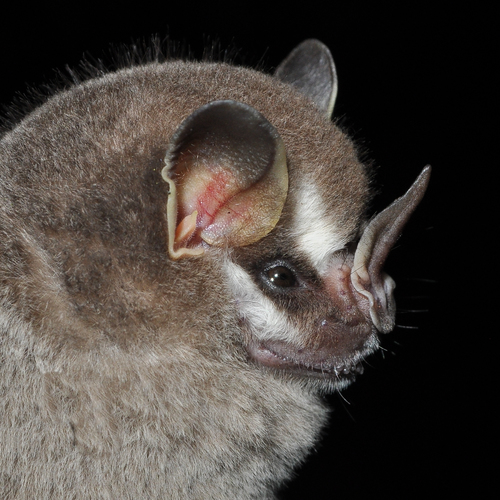
The prominent nose leaf enhances ultrasonic echolocation, enabling precise orientation in dense rainforest interiors. Short, broad wings provide high maneuverability in cluttered canopy environments. Facial white stripes may play a role in individual recognition within dark roost sites. Its small body size allows access to fruit on slender terminal branches.
Conservation status and numbers
Listed as Least Concern (LC) on the IUCN Red List. The species has a relatively wide distribution across the Amazon basin, is considered locally common within suitable habitat, and no major population-level declines have been documented. However, ongoing deforestation in Amazonia warrants continued monitoring.
Estimated population
No precise global population estimate is available. The species is considered relatively common and widespread within its range; the population trend is presumed stable based on current data, though detailed surveys are lacking.
What threatens the Dwarf Fruit-eating Bat?
Deforestation from agricultural expansion (cattle ranching, soy cultivation), illegal logging, and infrastructure development (roads, dams) in the Amazon basin represent the primary threats. Climate change may alter fruiting phenology and seasonal food availability. Pesticide use in agricultural areas may reduce invertebrate prey availability.
Diseases and parasites
Hosts ectoparasites including bat flies (family Streblidae and Nycteribiidae) and mites (Acari). Internal parasites such as helminths and protozoa have been recorded in related species. As a wild bat, it may harbor rabies-related lyssaviruses and other bat-associated viruses, though documented spillover to humans is extremely rare for this genus.
What is being done to protect it?
The species benefits indirectly from Amazonian protected areas such as Reserva Nacional Allpahuayo-Mishana (Peru), Parque Nacional Yasuní (Ecuador), and various Brazilian Amazon reserves. It is protected under national wildlife legislation in range countries. No targeted species-specific conservation programs exist.
Recommended actions
Priority actions include systematic population monitoring across the range, continued protection and expansion of Amazonian reserves, clarification of species limits relative to D. phaeotis through integrative taxonomic studies, and research into the species' role as a seed disperser in degraded forest landscapes.
What the Dwarf Fruit-eating Bat looks like
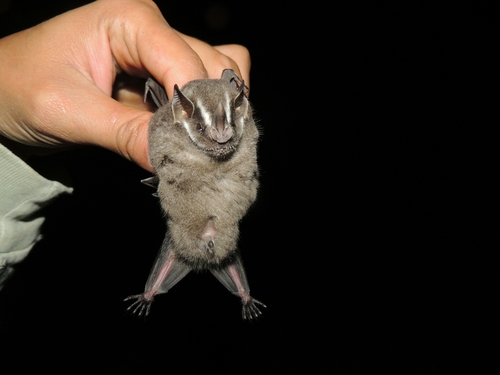
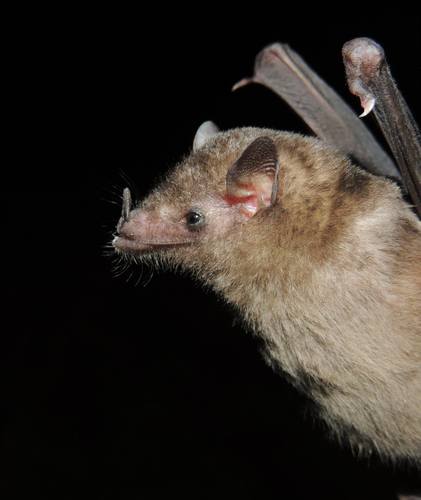
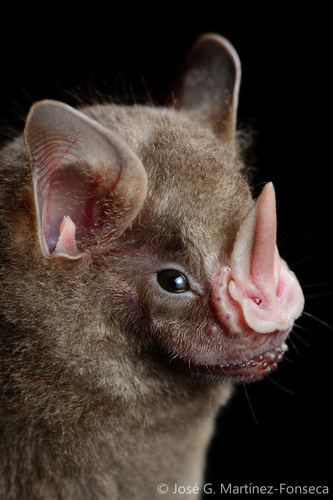
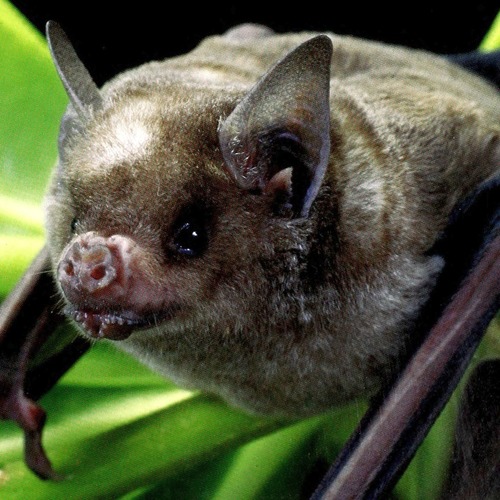
Small bat with brownish-gray to dark brown dorsal fur and paler grayish-white underparts. Bears two distinct pairs of narrow white facial stripes: one running from the nose to above each eye, and one below each eye toward the ear. The triangular nose leaf is well developed. Ears are moderately sized and rounded. Wing and tail membranes are dark brown.
Size
Body length approximately 50–65 mm; forearm length approximately 36–42 mm; wingspan estimated at 25–30 cm. No visible external tail; the uropatagium (tail membrane) is greatly reduced, as in most stenodermatine bats.
Weight
Typically 10–16 g. Females may be marginally heavier, particularly during pregnancy or lactation. No strong sexual mass dimorphism is documented.
Distinctive features
Distinguished from the closely related Dermanura phaeotis by its predominantly South American (Amazonian) distribution and subtle differences in skull proportions and dental measurements. Larger and generally darker than D. watsoni. The combination of white facial stripes, reduced tail membrane, and small size distinguishes it from larger Artibeus species in the same habitat.
Differences between males and females
Sexual dimorphism is minimal. Females may be marginally larger and heavier than males, particularly during pregnancy, a pattern common among phyllostomid bats. No differences in coloration or facial ornamentation between sexes.
Behaviour and diet of the Dwarf Fruit-eating Bat
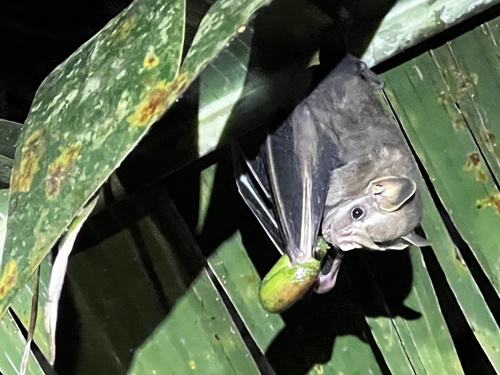
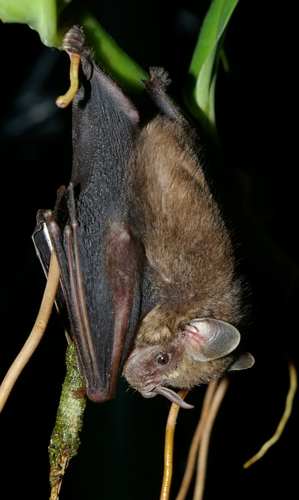
Typically roosts in small groups, often in foliage tents made by biting the midribs of large leaves (e.g., Heliconia spp.) to fold them into shelters, a behavior shared with related species. Social structure often consists of a single adult male with a small harem of females and their offspring. Solitary roosting in tree hollows also occurs.
When it is active
Strictly nocturnal. Foraging activity typically peaks within the first two hours after sunset, with a secondary period later in the night. Rests at a temporary feeding roost while consuming fruit, then returns to the main day roost before dawn.
Diet
Primarily frugivorous, with a strong preference for soft, pulpy tropical fruits. Figs (Ficus spp.) are particularly important dietary components. Also known to consume fruits of Cecropia, Solanum, and other pioneer and canopy species. May opportunistically take insects, pollen, or nectar during periods of low fruit availability.
How it feeds and hunts
Locates ripe fruit using a combination of echolocation, olfaction, and vision (including sensitivity to UV patterns on fruit). Typically plucks a fruit in flight and carries it — sometimes items approaching its own weight — to a nearby feeding roost where it can be consumed safely away from competitors.
Communication
Uses frequency-modulated (FM) ultrasonic echolocation calls for navigation and obstacle avoidance; calls are relatively low-intensity, suited to clutter-rich forest environments. Social vocalizations — including squeaks and chatters — are used between roost members. Scent glands likely play a role in group cohesion and male harem maintenance.
Interactions with other species
Predated upon by barn owls (Tyto alba), other nocturnal raptors, and possibly arboreal snakes. Competes with other frugivorous bats (e.g., Artibeus jamaicensis, Carollia spp.) and birds for fruit. Is an important mutualistic partner for many tropical plants as a primary seed disperser, contributing to plant recruitment and forest regeneration.
Role in its ecosystem
Functions as a keystone seed disperser in Amazonian forest ecosystems. By carrying seeds away from parent trees and depositing them in distant forest clearings or gaps through defecation, D. gnoma facilitates forest regeneration and plant community diversity. It may also serve as a minor pollinator for certain night-blooming plants.
Reproduction and lifecycle
Exhibits bimodal polyestry in many parts of its range, with two seasonal breeding peaks corresponding to periods of maximum fruit availability. Gestation lasts approximately 3–4 months; litter size is almost invariably one pup. Birth timing is coordinated to maximize food availability during the energetically expensive lactation period.
Raising the young
The mother is the sole direct caregiver. Neonates are relatively precocial and cling to the mother during early life. The pup is progressively left at the roost while the mother forages. Weaning occurs at approximately 4–6 weeks, though juveniles may remain associated with the maternal roost group longer.
Maturity and lifespan
Sexual maturity is estimated at 6–12 months of age, typical for small phyllostomid bats. Lifespan in the wild is estimated at 5–10 years; captive individuals of related Artibeus-complex species can survive longer. Species-specific longevity data for D. gnoma remain limited.
Taxonomy and naming of the Dwarf Fruit-eating Bat
Classification
Mammalia > Chiroptera > Phyllostomidae (subfamily Stenodermatinae) > Dermanura > Dermanura gnoma
Scientific synonyms
Artibeus gnoma Handley, 1987; previously classified as Artibeus (Dermanura) gnoma before Dermanura was elevated to full generic rank based on molecular phylogenetic evidence.
What research says
Recent studies
Recent phylogenomic analyses have reinforced the monophyly of Dermanura and clarified its divergence from Artibeus sensu stricto. Ongoing biodiversity surveys in the Peruvian and Brazilian Amazon continue to document D. gnoma's distribution and ecological role. Its cryptic similarity to D. phaeotis continues to prompt integrative taxonomic reassessment using geometric morphometrics and genomics.
Genome and DNA
Karyotype reported as 2n=30, consistent with most members of the Artibeus-Dermanura complex. Molecular phylogenetic studies using mitochondrial and nuclear DNA markers have supported the elevation of Dermanura to full generic status and helped clarify species boundaries within the group.
Compared with similar species
Most closely related to Dermanura phaeotis (Pygmy Fruit-eating Bat) of Central America and northwestern South America, from which it differs mainly by range and subtle morphometrics. Distinctly smaller than the widely studied Artibeus jamaicensis. Like Dermanura cinerea, it shares the white facial stripe pattern but differs in body size, skull shape, and range. All members of the Dermanura clade are smaller than typical Artibeus and specialize in maneuvering in denser forest microhabitats.
The Dwarf Fruit-eating Bat and people
Despite being called 'dwarf,' this bat can carry individual fruits nearly as heavy as itself back to its feeding roost — a remarkable feat of aerial strength. The species name 'gnoma' derives from Latin for 'gnome,' a whimsical reference to its tiny stature. As a tent-roosting bat, it may modify a fresh leaf to create a new shelter every few days, essentially building a new home repeatedly throughout its life.
Where and how to see it
Best observed in intact lowland Amazonian rainforest during the first two hours after sunset, particularly near fruiting fig trees or forest clearings. Loreto region (Peru), Yasuní National Park (Ecuador), and Tambopata (Peru) offer excellent opportunities. Mist-netting under scientific permits is the most reliable detection method; harp traps near forest edges are also effective.
Risks to humans
No notable direct risk to humans under normal circumstances. As with all wild bats, direct handling without protection is discouraged due to the theoretical — though very low — risk of rabies virus exposure. The species is not aggressive and will not seek contact with humans.
Human uses
No significant direct human uses are documented for this species. It has scientific value as a research subject in studies of tropical bat ecology, seed dispersal dynamics, Amazonian biodiversity, and bat phylogenetics. It is not known to be harvested for food, used in traditional medicine, or traded in any capacity.
Myths and legends
No myths or legends specific to Dermanura gnoma are documented. In several Amazonian indigenous traditions, fruit bats in general are regarded as benevolent forest spirits or 'seed carriers' that help regenerate the forest, reflecting an intuitive ecological understanding of their role as dispersers. Bats broadly appear in Amazonian cosmologies as liminal beings connecting day and night worlds.
Countries where the Dwarf Fruit-eating Bat is recorded
The 6 countries named in the range description of its IUCN Red List assessment.
Questions about the Dwarf Fruit-eating Bat
Where does the Dwarf Fruit-eating Bat live?
The Dwarf Fruit-eating Bat is recorded in Bolivia, Brazil, Colombia, Ecuador and Peru, among 6 countries in total across South America. These countries come from the range description of its IUCN Red List assessment, and they are what place the species on the interactive map.
Is the Dwarf Fruit-eating Bat endangered?
The IUCN Red List assesses the Dwarf Fruit-eating Bat as Least Concern. The species is widespread and abundant enough not to qualify for any threatened category. It does not mean the species is safe forever, only that nothing in the current data raises an alarm.
How many are left in the wild?
No precise global population estimate is available. This figure comes from the species assessment on the IUCN Red List; population estimates for wild mammals are ranges, not counts, and are revised at each assessment.
What habitat does the Dwarf Fruit-eating Bat live in?
Primarily occupies tropical and subtropical moist broadleaf forests, especially lowland Amazonian rainforest with dense canopy cover.
What is the scientific name of the Dwarf Fruit-eating Bat?
The Dwarf Fruit-eating Bat is Dermanura gnoma, in the family Phyllostomidae, order Chiroptera.
Other species in the genus Dermanura
Other species in the family Phyllostomidae
Sources
Conservation status, range description and population estimate come from the IUCN Red List assessment for Dermanura gnoma. Countries are derived from that range description, not from a mapped country list. Last refreshed on .
The distribution map is drawn from the IUCN Red List spatial data compiled in 2015. IUCN (International Union for Conservation of Nature)