
Gervais's Fruit-eating Bat
Dermanura cinerea
Red List assessment
Least Concernon the IUCN Red List
- EXExtinct
- EWExtinct in the Wild
- CRCritically Endangered
- ENEndangered
- VUVulnerable
- NTNear Threatened
- LCLeast Concern
The Gervais's Fruit-eating Bat is recorded in 10 countries across North America and South America. The IUCN Red List assesses the Gervais's Fruit-eating Bat as Least Concern. No precise global population estimate is available; the species is considered locally common across its range, with the overall population trend presumed to be stable in the absence of evidence of significant decline.
- Family
- Phyllostomidae
- Order
- Chiroptera
- Genus
- Dermanura
- Countries recorded
- 10
- Continents
- North America and South America
- Red List category
- Least Concern
- Data updated
- August 9, 2026
What is the Gervais's Fruit-eating Bat?
Gervais's Fruit-eating Bat is a small neotropical leaf-nosed bat of the family Phyllostomidae, recognized by its characteristic ash-gray dorsal fur and four white facial stripes. It inhabits tropical and subtropical lowland forests across northern South America and the islands of Trinidad and Tobago. The species is ecologically remarkable as an efficient seed disperser, playing a vital role in maintaining tropical forest diversity and regeneration. It was long classified within the large genus Artibeus and remains closely related to that group of stenodermatine fruit bats.
Where does the Gervais's Fruit-eating Bat live?
Trinidad and Tobago, Venezuela, Colombia, Guyana, Suriname, French Guiana, northern and central Brazil, Ecuador, Peru, and Bolivia
Found across northern South America, including Venezuela, Colombia, Trinidad and Tobago, Guyana, Suriname, French Guiana, and northern and central Brazil, with the range extending westward into Ecuador, Peru, and Bolivia. The provided coordinates correspond to southeastern Trinidad, which represents the northeastern limit of its range.
Altitude and depth
Typically recorded from sea level to approximately 1,500 m elevation; the majority of occurrences are in lowland areas below 1,000 m, consistent with its preference for tropical lowland forest.
Seasonal movements
No documented seasonal migrations; however, local foraging activity and reproductive timing appear to track peaks in fruit availability, which are in turn tied to wet and dry season cycles across the range.
Habitat of the Gervais's Fruit-eating Bat
Primarily occupies tropical lowland rainforests, gallery forests, and forest edges; also found in secondary growth and disturbed habitats adjacent to primary forest. It shows preference for areas with abundant fruiting trees, especially Ficus species.
Adaptations to its environment
Possesses a well-developed noseleaf that enhances the directionality of echolocation pulses for navigating dense forest. Its reduced uropatagium and very short tail allow exceptional maneuverability within cluttered vegetation. The ash-gray pelage may provide cryptic coloration at daytime roost sites among lichens or bark.
Conservation status and numbers
Least Concern (LC) on the IUCN Red List. The species has a broad geographic range, appears to be relatively common throughout, and does not currently meet the thresholds for a more threatened category based on range size or rate of population decline.
Estimated population
No precise global population estimate is available; the species is considered locally common across its range, with the overall population trend presumed to be stable in the absence of evidence of significant decline.
What threatens the Gervais's Fruit-eating Bat?
The primary long-term threat is deforestation and habitat degradation driven by agricultural expansion, logging, and urban development across its neotropical range. Roost disturbance, pesticide use reducing fruit and insect availability, and climate-driven shifts in fruiting phenology are secondary concerns.
Diseases and parasites
Hosts a variety of ectoparasites typical of neotropical bats, including batfly parasites (Streblidae) and mites. Studies on phyllostomid bats in Trinidad and surrounding regions have detected bat-associated coronaviruses and other RNA viruses in this bat family, though specific pathogen data for D. cinerea remain sparse.
What is being done to protect it?
The species benefits indirectly from protected areas across its range, including national parks in Venezuela, Brazil, and Colombia, as well as private reserves such as the Asa Wright Nature Centre in Trinidad. Regional bat conservation networks in the neotropics (e.g., RELCOM) support broader phyllostomid conservation.
Recommended actions
Priority actions include continued population monitoring via standardized mist-netting surveys, protection and expansion of primary forest reserves, further taxonomic and distributional research to resolve any cryptic diversity within the species, and public education on the ecological value of frugivorous bats.
What the Gervais's Fruit-eating Bat looks like
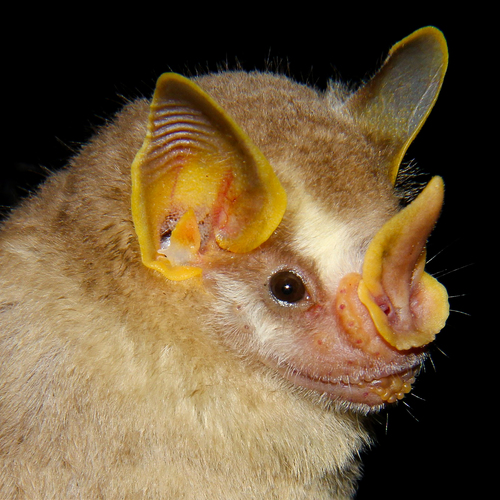
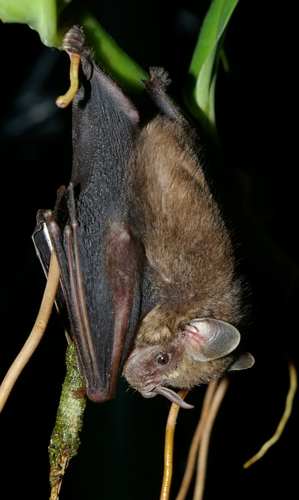
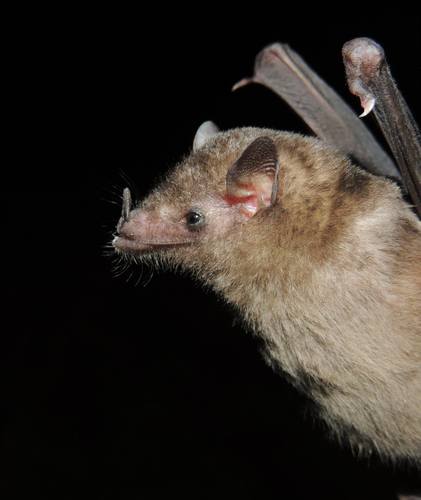
Dorsal pelage is ash-gray to grayish-brown (reflected in the Latin epithet cinerea, meaning ash-colored), contrasting with paler, whitish-gray ventral fur. Four white facial stripes are present: two supraorbital stripes above the eyes and two submandibular stripes below the jaw. The noseleaf is well-developed and lanceolate, and the ears are relatively short and rounded.
Size
Forearm length 36–42 mm; total body length approximately 55–72 mm; wingspan approximately 25–30 cm. The tail is vestigial or absent, and the uropatagium is narrow and reduced.
Weight
Typically 10–18 g; no pronounced sexual dimorphism in mass has been reported, though females may be marginally heavier when pregnant or lactating.
Distinctive features
The distinctly grayish (rather than reddish-brown or dark brown) dorsal fur is the most diagnostic visual character relative to congeners such as Dermanura gnoma and Dermanura phaeotis. It is also smaller than most Artibeus species with which it may co-occur, and its forearm length measurements help separate it from similar taxa in the field.
Differences between males and females
Sexual dimorphism is minimal; males and females are very similar in size and coloration. Females may appear slightly larger during pregnancy, which is common among phyllostomid bats generally.
Behaviour and diet of the Gervais's Fruit-eating Bat
Roosts in small groups, typically composed of a few individuals up to around a dozen, often in family-based or harem-style clusters. It may use natural shelters such as tree hollows, dense foliage clusters, or modified leaf tents as daytime retreats. It does not form the large colonies typical of some other bat families.
When it is active
Strictly nocturnal; foraging activity begins shortly after dusk, with peak activity in the early hours of the night. Individuals return to roost sites before dawn.
Diet
Primarily frugivorous, consuming a wide diversity of small, soft tropical fruits; figs (Ficus spp.) are among the most important dietary items. May supplement the diet with pollen, nectar, and occasional arthropods, providing opportunistic dietary flexibility.
How it feeds and hunts
Locates ripe fruit through a combination of olfaction and echolocation while in flight. Individuals pluck fruit while hovering or in brief contact with the plant, then carry the item to a regular feeding perch away from the fruiting tree, where it is consumed and seeds are spat out.
Communication
Navigates and detects obstacles using frequency-modulated (FM) echolocation calls in the ultrasonic range. Social communication involves softer audible and ultrasonic vocalizations among roost members. Chemical cues and scent marking likely contribute to roost-site fidelity and individual recognition.
Interactions with other species
Natural predators include nocturnal raptors such as barn owls (Tyto alba) and spectacled owls (Pulsatrix perspicillata), as well as arboreal snakes. It competes for fruit resources with other frugivorous bats, including larger Artibeus species, and may be subordinate to them at rich food sources. It has mutualistic relationships with many tropical plant species whose seeds it disperses.
Role in its ecosystem
Functions as a key seed disperser in neotropical forests, swallowing or spitting out seeds of a wide array of plant species at distances from parent trees, thereby promoting seedling recruitment, forest regeneration, and plant community diversity. It may also contribute marginally to pollination when feeding on nectar-rich flowers.
Reproduction and lifecycle
The species is likely polyestrous, with at least two reproductive peaks per year correlated with seasonal fruit abundance, as documented for related phyllostomids. Litter size is one pup per birth; gestation is estimated at approximately 90–120 days based on data from congeners.
Raising the young
The mother provides all direct parental care; newborn pups cling to the mother and are carried initially before being cached at the roost during nocturnal foraging bouts. Weaning occurs at approximately 4–6 weeks, after which juveniles progressively learn to forage independently.
Maturity and lifespan
Sexual maturity is likely attained within the first year of life, consistent with other small phyllostomid bats. Lifespan in the wild is estimated at 5–10 years; captive longevity data are not well established for this species specifically.
Taxonomy and naming of the Gervais's Fruit-eating Bat
Classification
Mammalia > Chiroptera > Phyllostomidae > Dermanura > Dermanura cinerea
Subspecies
No well-recognized subspecies are currently accepted; past taxonomic confusion with closely related small Artibeus-group bats has complicated subspecific assessments, and further revisionary work may be needed.
Scientific synonyms
Artibeus cinereus Gervais, 1856 (original description); formerly placed within the broad genus Artibeus before molecular and morphological studies supported its reassignment to the resurrected genus Dermanura.
What research says
Recent studies
Molecular systematic work in the 2000s and 2010s confirmed the monophyly of Dermanura and validated D. cinerea as a distinct species from closely related taxa. Ecological studies in Trinidad have documented the species as part of frugivore assemblages important for forest regeneration. Some regional surveillance projects have screened phyllostomid bats for zoonotic viruses, including this species.
Genome and DNA
Specific karyotype data for Dermanura cinerea are not well documented in the literature. Molecular phylogenetic studies using mitochondrial and nuclear markers have supported the recognition of Dermanura as a genus distinct from Artibeus, and have clarified the evolutionary relationships among the small stenodermatine fruit bats.
Compared with similar species
Most closely related to other small stenodermatine bats of the genus Dermanura, including D. gnoma (Dwarf Fruit-eating Bat), D. phaeotis (Pygmy Fruit-eating Bat), and D. tolteca (Toltec Fruit-eating Bat), from which it is distinguished primarily by pelage color and biometric characters. Compared to the larger Artibeus jamaicensis and A. lituratus, D. cinerea is considerably smaller and more ash-colored. It fills a similar ecological niche to Carollia species but belongs to a separate subfamily (Stenodermatinae vs. Carolliinae).
The Gervais's Fruit-eating Bat and people
The species name cinerea is Latin for 'ash-gray,' making this bat literally named after its most striking visual feature. A single individual can disperse seeds of dozens of plant species in one night of foraging, functioning as a remarkably efficient 'forest gardener.' Like several of its close relatives, Gervais's Fruit-eating Bat may modify large leaves by biting along the midrib to create a tent-like structure that serves as a secluded daytime roost.
Where and how to see it
Best observed after dusk in tropical forest habitats near fruiting Ficus trees, which reliably attract foraging individuals. The Asa Wright Nature Centre in the Northern Range of Trinidad is an outstanding location, given its protected forest and the species' presence on the island. Patience near fruiting trees or use of night-vision equipment significantly improves detection odds.
Risks to humans
No notable direct risk to humans under normal circumstances. As with all wild bats, handling without protective equipment should be avoided due to the theoretical risk of rabies or other zoonotic pathogens; the species poses no aggressive threat and will seek to escape rather than bite when disturbed.
Human uses
No direct commercial or traditional use documented. The species is of scientific interest and is regularly captured in mist-netting studies as part of biodiversity assessments, bat diversity surveys, and viral surveillance programs across its neotropical range.
Myths and legends
No specific myths or legends are documented for this species. Bats in general carry complex cultural symbolism across Latin American and Caribbean traditions, sometimes regarded as omens, guardians of the night, or associated with underworld spirits in various indigenous cosmologies, but D. cinerea has not been individually distinguished in these narratives.
Countries where the Gervais's Fruit-eating Bat is recorded
The 10 countries named in the range description of its IUCN Red List assessment.
Questions about the Gervais's Fruit-eating Bat
Where does the Gervais's Fruit-eating Bat live?
The Gervais's Fruit-eating Bat is recorded in Bolivia, Brazil, Colombia, Ecuador and French Guiana, among 10 countries in total across North America and South America. These countries come from the range description of its IUCN Red List assessment, and they are what place the species on the interactive map.
Is the Gervais's Fruit-eating Bat endangered?
The IUCN Red List assesses the Gervais's Fruit-eating Bat as Least Concern. The species is widespread and abundant enough not to qualify for any threatened category. It does not mean the species is safe forever, only that nothing in the current data raises an alarm.
How many are left in the wild?
No precise global population estimate is available; the species is considered locally common across its range, with the overall population trend presumed to be stable in the absence of evidence of significant decline. This figure comes from the species assessment on the IUCN Red List; population estimates for wild mammals are ranges, not counts, and are revised at each assessment.
What habitat does the Gervais's Fruit-eating Bat live in?
Primarily occupies tropical lowland rainforests, gallery forests, and forest edges; also found in secondary growth and disturbed habitats adjacent to primary forest.
What is the scientific name of the Gervais's Fruit-eating Bat?
The Gervais's Fruit-eating Bat is Dermanura cinerea, in the family Phyllostomidae, order Chiroptera.
Other species in the genus Dermanura
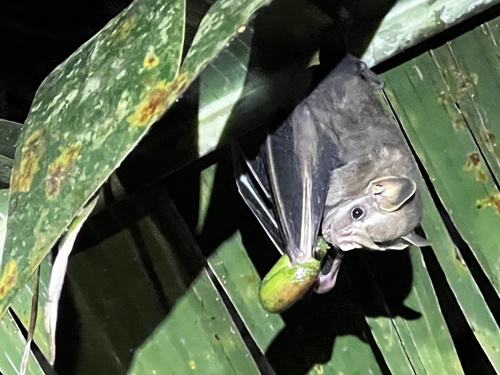
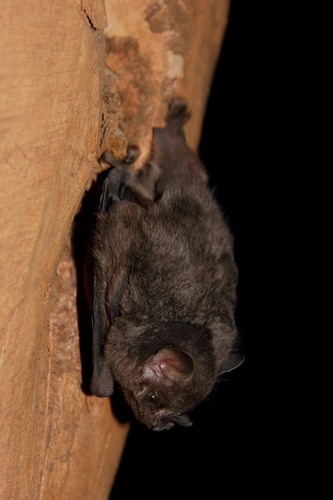
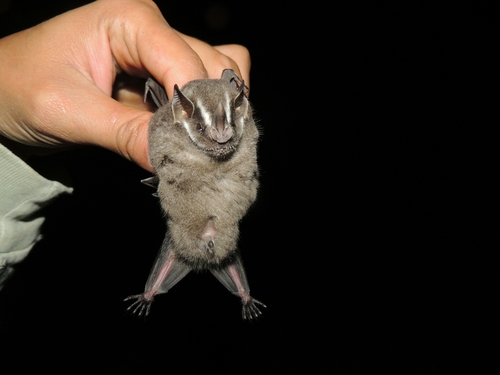
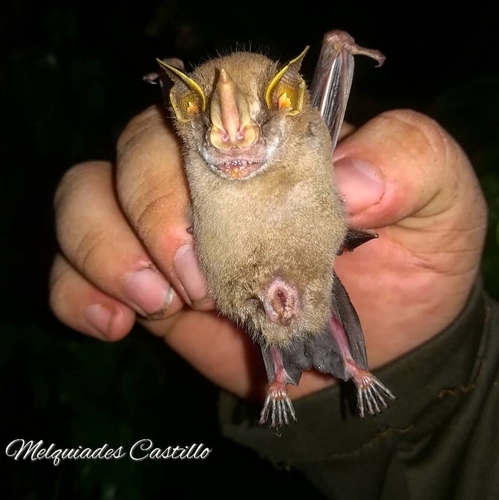
Other species in the family Phyllostomidae
Sources
Conservation status, range description and population estimate come from the IUCN Red List assessment for Dermanura cinerea. Countries are derived from that range description, not from a mapped country list. Last refreshed on .
The distribution map is drawn from the IUCN Red List spatial data compiled in 2016. IUCN (International Union for Conservation of Nature)