
Silver Mountain Vole
Alticola argentatus
Red List assessment
Least Concernon the IUCN Red List
- EXExtinct
- EWExtinct in the Wild
- CRCritically Endangered
- ENEndangered
- VUVulnerable
- NTNear Threatened
- LCLeast Concern
The Silver Mountain Vole is recorded in 6 countries across Asia. The IUCN Red List assesses the Silver Mountain Vole as Least Concern. No formal global population estimate is available.
- Family
- Cricetidae
- Order
- Rodentia
- Genus
- Alticola
- Countries recorded
- 6
- Continents
- Asia
- Red List category
- Least Concern
- Data updated
- August 9, 2026
What is the Silver Mountain Vole?
The Silver Mountain Vole is a small to medium-sized arvicoline rodent of the family Cricetidae, named for its striking pale, silvery-gray dorsal pelage. It is endemic to the extreme high-altitude rocky landscapes of Central and South Asia, occupying one of the harshest environments of any vole species. Remarkably, it remains active year-round without hibernating, surviving Himalayan and Pamir winters partly through food-caching behavior. It plays an essential ecological role as an abundant herbivore and critical prey species in high-altitude food webs.
Where does the Silver Mountain Vole live?
High mountain ranges of Central and South Asia, including the Pamirs (Tajikistan, Afghanistan), Karakoram (Pakistan, northern India), western Himalayas (Ladakh, India), and western China (Xinjiang, Qinghai-Tibetan Plateau)
Distributed across several major Central and South Asian mountain systems: the Pamirs of Tajikistan and NE Afghanistan; the Hindu Kush (Afghanistan, Pakistan); the Karakoram (Pakistan, northern India); the western Himalayas including Ladakh, Gilgit-Baltistan, and northern Himachal Pradesh; and western China including parts of southern Xinjiang and the Qinghai-Tibetan Plateau. Possible occurrence in parts of Kyrgyzstan.
Altitude and depth
Typically occurs between 2,500 m and 5,500 m above sea level. Peak densities are recorded between 3,000 m and 4,500 m. Among the highest-altitude voles in Asia, capable of persisting above 5,000 m.
Seasonal movements
Non-hibernating; active throughout the year even in deep winter. Breeding activity peaks from April to September, coinciding with snow melt and maximum vegetation growth. Foraging range and surface activity are reduced during severe winter conditions but not entirely suspended.
Habitat of the Silver Mountain Vole
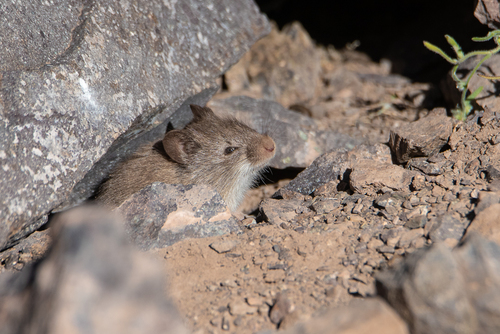
Rocky alpine and subalpine terrain is strongly preferred, including scree slopes, boulder fields, cliff faces, and rock-strewn alpine meadows. Rock crevices and inter-boulder spaces serve as essential nest sites and escape refuges. Secondarily uses alpine grasslands and dwarf-shrub tundra immediately adjacent to rocky outcrops.
Adaptations to its environment
Dense, silvery-gray fur provides superb insulation against sub-zero temperatures and effective camouflage against pale granite and limestone rocks. Compact body plan with relatively small ears and short tail reduces surface-area-to-volume ratio, minimizing heat loss (Allen's Rule). Constructs haypile food caches of dried grasses and forbs near burrow entrances to supplement winter diet. Short, powerful limbs are well-suited for navigating rocky substrates.
Conservation status and numbers
Least Concern (LC) on the IUCN Red List (assessed 2016). The species has a broad distribution across multiple mountain ranges, occurs in reasonably stable habitat, and faces no major identified threats that would cause a significant population decline. Population is believed to be stable across its range.
Estimated population
No formal global population estimate is available. The species is considered locally common to abundant in suitable rocky alpine habitat throughout its range. Population trend is presumed stable.
What threatens the Silver Mountain Vole?
No acute major threats have been identified. Potential emerging threats include: climate change causing upward vegetation zone shifts and glacial retreat that may compress available habitat; overgrazing by livestock degrading alpine vegetation; and increasing human disturbance (tourism, road construction, mining) in previously remote mountain areas.
Diseases and parasites
As with other arvicoline rodents, it likely hosts ectoparasites including fleas (Siphonaptera), mites (Acarina), and ticks. Endoparasites such as cestodes and nematodes are probable. It may serve as a reservoir host for tick-borne pathogens prevalent in Central Asian mountain ecosystems. Targeted parasitological studies on this species are limited.
What is being done to protect it?
Portions of its range fall within protected areas including Hemis National Park (Ladakh, India), various national parks in Tajikistan (e.g., Tajik National Park, a UNESCO World Heritage Site), and nature reserves in Xinjiang and Qinghai (China). No dedicated species-specific conservation program exists, consistent with its Least Concern status.
Recommended actions
Systematic long-term population monitoring to detect any climate-driven decline. Assessment of livestock grazing impacts on alpine habitat quality. Resolution of taxonomic uncertainties through comprehensive molecular surveys to better characterize genetic diversity and potential cryptic species. Inclusion in high-altitude biodiversity assessments for the Himalaya-Karakoram region.
What the Silver Mountain Vole looks like
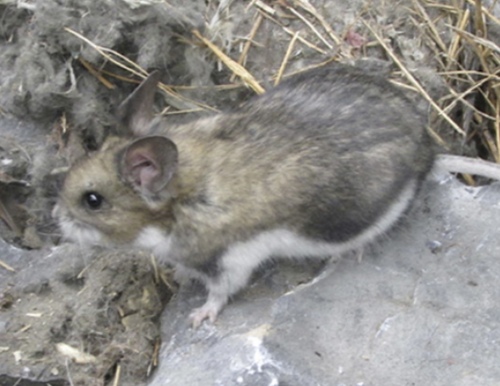
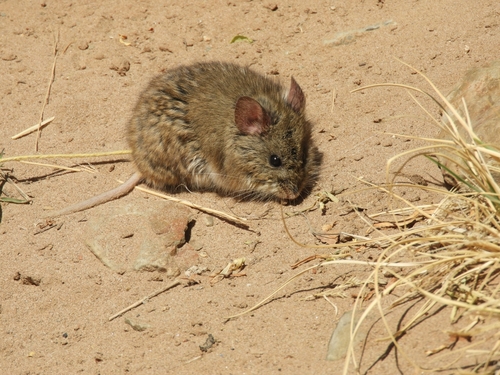
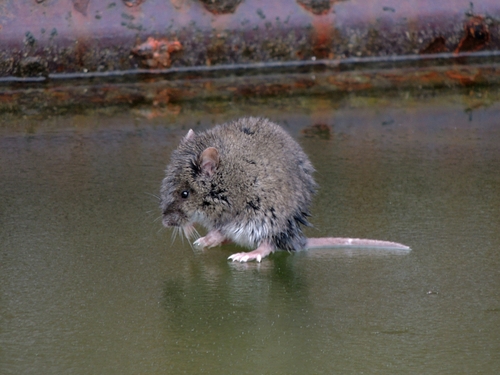
Dorsal fur is distinctively pale silvery-gray to grayish-buff, dense and soft. The venter is whitish to pale cream-gray. The tail is short and bicolored — slightly darker dorsally, paler ventrally. The ears are moderately large, rounded, and well-furred internally. Eyes are small and black. The overall impression is a pale, compact rodent blending naturally with rocky substrates.
Size
Head-body length approximately 95–140 mm; tail length 25–55 mm (notably short relative to body); hind foot approximately 14–19 mm; ear length approximately 12–17 mm.
Weight
Typically 25–60 g. No significant documented sexual size dimorphism, though males may be marginally larger on average.
Distinctive features
The unusually pale, silvery-gray dorsal coloration is the most immediate distinguishing feature. Compared to the sympatric Alticola roylei (Royle's Mountain Vole), A. argentatus is considerably paler and more silvery rather than brownish. It is smaller-bodied and shorter-tailed than many superficially similar rodents in its range, such as high-altitude Apodemus species.
Differences between males and females
Sexual dimorphism is minimal in this species. Males and females are nearly identical in size and pelage coloration. Females possess multiple pairs of inguinal and abdominal mammae to nurse relatively large litters.
Behaviour and diet of the Silver Mountain Vole
Semi-social or loosely colonial; individuals often live in close proximity in productive rocky outcrops but maintain separate burrow and shelter sites. Population density can be locally high in optimal habitat. Dominance hierarchies and territorial behavior are not well characterized.
When it is active
Primarily diurnal to crepuscular, with activity concentrated during warmer daylight hours. Activity may shift toward midday in cold seasons to exploit peak temperatures. Tends to dart quickly between rock crevices and shelters, making prolonged observation difficult.
Diet
Strictly herbivorous. Diet includes grasses, sedges, forbs, roots, bulbs, and seasonally available plant material. Lichens and dried plant matter are consumed in lean seasons. Actively constructs haypile caches of cut and dried vegetation close to burrow entrances for winter food storage.
How it feeds and hunts
Not applicable; this species is a strict herbivore. It forages by cropping vegetation close to rocky shelter, minimizing exposure to aerial and terrestrial predators. Food is actively cut, carried, and stored in haypiles — a behavioral trait shared with pikas (Ochotona spp.) in the same habitat.
Communication
Produces high-pitched squeaks and chattering vocalizations used for alarm calls and intraspecific interactions. Scent marking via urine and specialized skin glands is presumed to play a role in territory and mate recognition, as is common in arvicolines. Foot-drumming behavior has been reported in some Alticola species as a potential alarm or communication signal.
Interactions with other species
Important prey for a range of high-altitude predators including the snow leopard (Panthera uncia), red fox (Vulpes vulpes), Tibetan fox (Vulpes ferrilata), upland buzzard (Buteo hemilasius), golden eagle (Aquila chrysaetos), and various owls. It shares rocky boulder habitats with Ochotona pikas, with which it may compete for food and space. Pikas are its most ecologically analogous coinhabitant.
Role in its ecosystem
Functions as a key prey species sustaining several apex and meso-predator populations in fragile high-altitude ecosystems. As an herbivore, it influences local vegetation structure and dynamics. Food-caching behavior may inadvertently facilitate limited seed dispersal. Contributes to nutrient cycling through waste deposition in rocky soil environments.
Reproduction and lifecycle
Breeding season spans approximately April to September. Gestation is about 19–21 days, typical for arvicolines. Litter size ranges from 3 to 8 young (commonly 4–6). Multiple litters per breeding season are likely. Neonates are altricial — born blind, hairless, and fully dependent on the mother.
Raising the young
The female is the primary caregiver, nursing young in a grass- and fur-lined nest within a rock crevice or shallow burrow. Weaning occurs at approximately 14–21 days. Juveniles reach independence relatively quickly, consistent with the short lifespan and high reproductive rate typical of small arvicolines. Paternal care has not been documented.
Maturity and lifespan
Sexual maturity is likely reached at 4–8 weeks of age, consistent with other small arvicolines. Wild lifespan is typically 1–2 years due to high predation pressure. Captive individuals may survive up to 3 years under favorable conditions.
Taxonomy and naming of the Silver Mountain Vole
Classification
Mammalia > Rodentia > Cricetidae (subfamily Arvicolinae) > Alticola > Alticola argentatus
Subspecies
Several subspecies are tentatively recognized: A. a. argentatus (nominate; Pamirs, Tajikistan, NE Afghanistan), A. a. blanfordii (Karakoram, N Pakistan, Ladakh, India), A. a. jacksoni (Xinjiang, China), and A. a. vinogradovi (parts of Central Asia). Subspecific boundaries remain debated and under ongoing taxonomic revision.
Scientific synonyms
Originally described as Arvicola argentata Severtzov, 1879. Some populations were formerly treated as conspecific with Alticola strelzowi. Also referred to under Alticola argentatus blanfordii in older Indian mammal literature.
What research says
Recent studies
Recent molecular phylogenetic studies on the genus Alticola have refined species boundaries and suggested that some populations historically assigned to A. argentatus may represent distinct cryptic taxa. Ecological research in Ladakh and the Pamirs has highlighted the species as an indicator of high-altitude ecosystem health. Climate change projections for its Himalayan and Pamir habitats are generating interest in its long-term vulnerability.
Genome and DNA
The diploid chromosome number for Alticola argentatus has been reported as approximately 2n = 54 in some cytogenetic studies, though precise karyotypic data are limited and may vary across subspecies. Recent molecular phylogenetic analyses have confirmed A. argentatus as a distinct species within a well-supported Alticola clade and have helped delineate its relationships to congeners across Central Asia.
Compared with similar species
Most closely related to other Alticola species: A. roylei (Royle's Mountain Vole) is darker, more brownish-gray, and distributed across overlapping areas at similar elevations; A. strelzowi (Flat-headed Vole) is distributed further north and east with a flatter skull profile; A. macrotis (Large-eared Vole) is distinguished by proportionally much larger pinnae. Ecologically, A. argentatus convergently resembles pikas (Ochotona spp.) in its food-caching behavior and rocky habitat preference, despite being unrelated.
The Silver Mountain Vole and people
The genus name Alticola literally means 'mountain dweller' in Latin, and A. argentatus earns that title by thriving above 5,000 m — altitudes where most mammals struggle to survive at all. Despite weighing barely 30–50 g, it braves Himalayan and Pamir winters without hibernating, relying on its haypile larder and rocky shelters when temperatures plummet far below freezing. Its silvery coat — the inspiration for both its English and Latin names — is not just beautiful but also functional, providing near-perfect camouflage against the pale, frost-bleached rocks of its mountain home.
Where and how to see it
Best observed in summer (June–September) when snow retreats and surface activity peaks. Prime locations include the boulder fields and scree slopes of Hemis National Park and the Nubra and Shyok Valleys in Ladakh, India, as well as the Wakhan Corridor in Afghanistan and Tajik National Park. Approach rocky outcrops slowly and quietly; use binoculars to scan for movement between boulders. Dawn and mid-morning are the most productive observation windows.
Risks to humans
No notable risk to humans. As with any wild rodent, direct handling should be avoided to prevent ectoparasite transfer. Not currently recognized as a significant reservoir or vector of major zoonotic diseases in its range.
Human uses
No significant traditional or commercial uses documented. Occasionally captured in live-traps during scientific small-mammal surveys assessing high-altitude biodiversity. Not subject to hunting, trade, or use in traditional medicine within its range.
Myths and legends
No widely documented myths or legends are specifically associated with this species. In some Ladakhi and Central Asian pastoralist traditions, the presence of abundant small rodents on a mountain slope is informally taken as an indicator of good grazing ground and ecological health. The snow leopard's dependency on such small prey species is well recognized in local ecological knowledge.
Countries where the Silver Mountain Vole is recorded
The 6 countries named in the range description of its IUCN Red List assessment.
Questions about the Silver Mountain Vole
Where does the Silver Mountain Vole live?
The Silver Mountain Vole is recorded in Afghanistan, China, India, Kyrgyzstan and Pakistan, among 6 countries in total across Asia. These countries come from the range description of its IUCN Red List assessment, and they are what place the species on the interactive map.
Is the Silver Mountain Vole endangered?
The IUCN Red List assesses the Silver Mountain Vole as Least Concern. The species is widespread and abundant enough not to qualify for any threatened category. It does not mean the species is safe forever, only that nothing in the current data raises an alarm.
How many are left in the wild?
No formal global population estimate is available. This figure comes from the species assessment on the IUCN Red List; population estimates for wild mammals are ranges, not counts, and are revised at each assessment.
What habitat does the Silver Mountain Vole live in?
Rocky alpine and subalpine terrain is strongly preferred, including scree slopes, boulder fields, cliff faces, and rock-strewn alpine meadows.
What is the scientific name of the Silver Mountain Vole?
The Silver Mountain Vole is Alticola argentatus, in the family Cricetidae, order Rodentia.
Other species in the genus Alticola

Other species in the family Cricetidae
Sources
Conservation status, range description and population estimate come from the IUCN Red List assessment for Alticola argentatus. Countries are derived from that range description, not from a mapped country list. Last refreshed on .
The distribution map is drawn from the IUCN Red List spatial data compiled in 2008. IUCN (International Union for Conservation of Nature)