
Little White-shouldered Bat
Ametrida centurio
Red List assessment
Least Concernon the IUCN Red List
- EXExtinct
- EWExtinct in the Wild
- CRCritically Endangered
- ENEndangered
- VUVulnerable
- NTNear Threatened
- LCLeast Concern
The Little White-shouldered Bat is recorded in 10 countries across North America and South America. The IUCN Red List assesses the Little White-shouldered Bat as Least Concern. No precise global population estimate exists.
- Family
- Phyllostomidae
- Order
- Chiroptera
- Genus
- Ametrida
- Countries recorded
- 10
- Continents
- North America and South America
- Red List category
- Least Concern
- Data updated
- August 9, 2026
What is the Little White-shouldered Bat?
Ametrida centurio is a small, frugivorous bat belonging to the family Phyllostomidae and the sole member of the monotypic genus Ametrida. It inhabits lowland tropical rainforests of northern South America and Trinidad, remaining closely associated with dense, humid forest canopy. The species is remarkable for its striking white shoulder patches, which give it its common name, and for the males' strongly wrinkled, warty facial skin that superficially resembles that of the distantly related Wrinkle-faced Bat (Centurio senex). It represents an unusual case among bats where females are noticeably larger than males.
Where does the Little White-shouldered Bat live?
Northern South America (Venezuela, Colombia, Guyana, Suriname, French Guiana, Brazil, Ecuador, Peru, Bolivia) and Trinidad and Tobago
The species ranges across northern South America, including Venezuela, Colombia, Guyana, Suriname, French Guiana, and northern and western Brazil (Amazon basin), with records from Ecuador, Peru, and possibly Bolivia. It also occurs on the island of Trinidad in Trinidad and Tobago.
Altitude and depth
Primarily found from sea level up to approximately 500 m elevation, though occasional records exist up to around 1,000 m in foothill forests.
Seasonal movements
No documented long-distance seasonal migrations are known. Like many tropical bats, its activity and reproductive cycles may be loosely correlated with seasonal peaks in fruit availability, but it remains resident year-round within its range.
Habitat of the Little White-shouldered Bat
Primarily lowland tropical rainforest, including terra firme and seasonally flooded forest (várzea). It is also found in forest edges and secondary growth adjacent to primary forest, as well as gallery forests. The species appears to prefer humid forested environments with abundant fruiting trees.
Adaptations to its environment
Its short, broad wings are adapted for maneuverable flight within cluttered forest understory and midstory. The noseleaf, characteristic of phyllostomids, assists in directing echolocation calls. The strongly wrinkled facial skin of males, whose function is not fully understood, may play a role in sexual signaling or sensory enhancement. White shoulder patches may serve as visual signals among conspecifics in low-light forest conditions.
Conservation status and numbers
Least Concern (LC) on the IUCN Red List. The species is assessed as LC because it has a large range, is presumed to have a reasonably large population, and there is no evidence of rapid population decline. However, it remains dependent on intact tropical forest and could be affected by large-scale deforestation.
Estimated population
No precise global population estimate exists. The species is considered uncommon to locally rare throughout much of its range based on specimen and survey records. Population trend is unknown but presumed stable given LC status and large extent of remaining habitat.
What threatens the Little White-shouldered Bat?
The principal threat is deforestation and forest fragmentation across its Amazonian and Guianan range, driven by agricultural expansion, logging, and infrastructure development. While currently not at critical risk, continued habitat loss could reduce carrying capacity. It may also be locally affected by hunting pressure and general disturbance near human settlements.
Diseases and parasites
No species-specific parasite or disease studies are known. Like other Neotropical bats, it is likely host to various ectoparasites (bat flies of the family Streblidae, mites) and endoparasites. Bats broadly serve as reservoirs for diverse coronaviruses and other viruses, though nothing specific has been documented for this species.
What is being done to protect it?
The species benefits indirectly from protected areas across its range, including the Amazon basin national parks and reserves in Brazil, Venezuela, Colombia, and the protected natural areas of French Guiana (such as the Parc Amazonien de Guyane). No species-specific conservation programs are known to be in place.
Recommended actions
Priority actions include continued monitoring of populations using standardized bat survey methods (mist-netting), protection and expansion of tropical forest reserves within its range, and further ecological research to clarify habitat requirements, roost site fidelity, and responses to habitat fragmentation.
What the Little White-shouldered Bat looks like
A small, compact bat with short, broad wings and a distinctive short muzzle bearing a well-developed noseleaf. Dorsal fur is brown to dark brown, while the ventral surface is paler. The most distinctive feature is a pair of white or cream-colored patches on the shoulders, contrasting sharply with the otherwise dark fur. Males develop prominently wrinkled, fleshy facial skin.
Size
Forearm length approximately 34–40 mm; total body length roughly 45–55 mm. No external tail or a very short one. Wingspan not precisely documented but estimated at 25–30 cm.
Weight
Approximately 8–15 g; females tend to be larger and heavier than males.
Distinctive features
The combination of white shoulder patches and the strongly wrinkled facial skin in males makes this species visually unique among Neotropical bats. Its monotypic genus status underscores its morphological distinctiveness within Stenodermatinae. The lack of a visible tail (uropatagium greatly reduced) and the compact body shape further set it apart.
Differences between males and females
Pronounced sexual dimorphism: females are larger and heavier than males, which is relatively unusual among mammals. Males possess strongly wrinkled, warty facial skin that females lack or show to a lesser degree. This reversed size dimorphism may be related to reproductive energetics in females.
Behaviour and diet of the Little White-shouldered Bat
Poorly documented. Like many phyllostomid bats, it is presumed to roost in small groups or individually in dense foliage or tree cavities. No detailed social structure studies are available for this species.
When it is active
Strictly nocturnal. Foraging activity begins after dark and is concentrated in the forest understory and midstory. Roosts during the day in foliage or tree hollows.
Diet
Frugivorous, feeding primarily on soft, fleshy fruits found in the forest understory and midstory. Like other stenodermatine bats, it likely favors small, odorous fruits from families such as Moraceae, Piperaceae, and Solanaceae. It may also occasionally consume nectar or pollen.
How it feeds and hunts
Forages by flying through the forest interior, using low-intensity echolocation combined with olfaction and vision to locate ripe fruits. It likely plucks fruit while hovering or in slow flight, then carries fruit to a feeding roost to consume it.
Communication
Uses echolocation for navigation and obstacle avoidance; echolocation calls are relatively low-intensity (as typical of phyllostomids using nose-emitted calls). Social vocalizations likely occur at roosts. The white shoulder patches may function as visual signals for conspecific recognition in dim forest light.
Interactions with other species
Likely subject to predation by forest owls (e.g., Glaucidium, Pulsatrix), snakes, and possibly arboreal felids. As a frugivore, it acts as a seed disperser for the plant species it feeds on. It competes with other frugivorous bats and birds sharing the same fruiting trees.
Role in its ecosystem
Functions as a seed disperser in tropical rainforest ecosystems, potentially contributing to forest regeneration by depositing seeds at distance from parent trees. Its role in the forest food web as prey for nocturnal predators is also ecologically relevant.
Reproduction and lifecycle
Reproductive biology is poorly known. Like most phyllostomid bats in the tropics, it likely produces a single pup per birth event, potentially twice per year if bimodal seasonality exists. Gestation is estimated at approximately 3–4 months based on related species.
Raising the young
Maternal care is presumed to be the primary form of parental investment, as in most bat species. The mother nurses and carries the pup until it is large enough to fly independently. Weaning likely occurs within 2–3 months of birth.
Maturity and lifespan
Age of sexual maturity is unknown but estimated at approximately 1 year based on related phyllostomid species. Lifespan in the wild is unknown; small phyllostomids generally live 5–10 years in the wild, with some exceeding this in captivity.
Taxonomy and naming of the Little White-shouldered Bat
Classification
Mammalia > Chiroptera > Phyllostomidae (subfamily Stenodermatinae) > Ametrida > Ametrida centurio Gray, 1847
What research says
Recent studies
This species remains one of the less-studied Neotropical bats. Recent phylogenomic analyses of Phyllostomidae have confirmed the monotypic status of Ametrida and its placement within Stenodermatinae. No landmark recent species-specific ecological or behavioral studies are known.
Genome and DNA
No specific chromosome count or genomic study has been published for Ametrida centurio. Broader phylogenomic studies of Phyllostomidae place it firmly within the Stenodermatinae clade.
Compared with similar species
Ametrida centurio shares the wrinkled facial skin of males with the distantly related Centurio senex (Wrinkle-faced Bat), suggesting convergent evolution of this trait. It is morphologically similar in size and diet to other small stenodermatines such as Artibeus and Platyrrhinus species but is distinguished by its monotypic genus status, white shoulder patches, and extreme sexual dimorphism.
The Little White-shouldered Bat and people
Males of this species have such dramatically wrinkled faces that the species was named 'centurio' in reference to a Roman centurion's helmet-like appearance. Unlike most mammals, females are significantly larger than males — a rare reversal of the typical mammalian pattern. The white shoulder patches are visible even in low-light forest conditions and may help bats recognize each other at roost sites.
Where and how to see it
The best chance of observing this species is through mist-netting surveys conducted at night along forest streams or forest edges in the Guiana Shield region (French Guiana, Suriname, Guyana) or in Venezuelan and Colombian lowland rainforest. It is uncommon and requires targeted bat survey methods; visiting protected reserves such as the Parc Amazonien de Guyane maximizes chances of encounter.
Risks to humans
No notable risk to humans. Like all wild bats, it should not be handled without proper protective equipment due to the theoretical risk of rabies virus transmission, though this species has not been documented as a significant rabies vector.
Countries where the Little White-shouldered Bat is recorded
The 10 countries named in the range description of its IUCN Red List assessment.
Questions about the Little White-shouldered Bat
Where does the Little White-shouldered Bat live?
The Little White-shouldered Bat is recorded in Bolivia, Brazil, Colombia, Ecuador and French Guiana, among 10 countries in total across North America and South America. These countries come from the range description of its IUCN Red List assessment, and they are what place the species on the interactive map.
Is the Little White-shouldered Bat endangered?
The IUCN Red List assesses the Little White-shouldered Bat as Least Concern. The species is widespread and abundant enough not to qualify for any threatened category. It does not mean the species is safe forever, only that nothing in the current data raises an alarm.
How many are left in the wild?
No precise global population estimate exists. This figure comes from the species assessment on the IUCN Red List; population estimates for wild mammals are ranges, not counts, and are revised at each assessment.
What habitat does the Little White-shouldered Bat live in?
Primarily lowland tropical rainforest, including terra firme and seasonally flooded forest (várzea).
What is the scientific name of the Little White-shouldered Bat?
The Little White-shouldered Bat is Ametrida centurio, in the family Phyllostomidae, order Chiroptera.
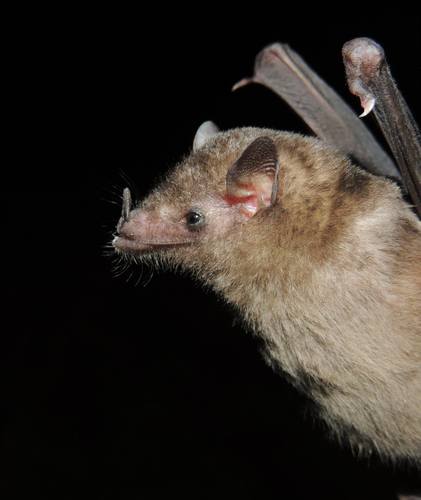
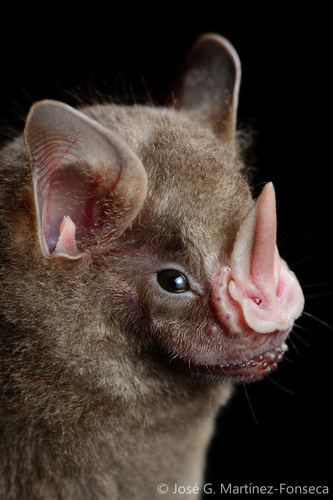
Other species in the family Phyllostomidae
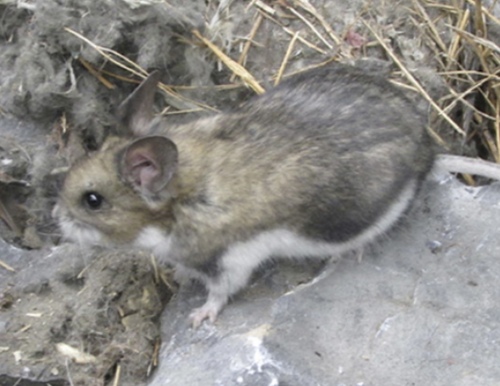
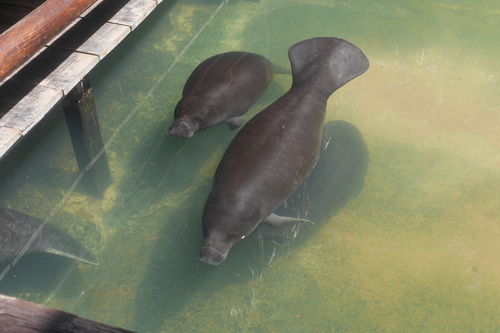
Species that share its range

Sources
Conservation status, range description and population estimate come from the IUCN Red List assessment for Ametrida centurio. Countries are derived from that range description, not from a mapped country list. Last refreshed on .
The distribution map is drawn from the IUCN Red List spatial data compiled in 2008. IUCN (International Union for Conservation of Nature)