
Godman's Long-tailed Bat
Choeroniscus godmani
Red List assessment
Least Concernon the IUCN Red List
- EXExtinct
- EWExtinct in the Wild
- CRCritically Endangered
- ENEndangered
- VUVulnerable
- NTNear Threatened
- LCLeast Concern
The Godman's Long-tailed Bat is recorded in 9 countries across North America and South America. The IUCN Red List assesses the Godman's Long-tailed Bat as Least Concern. No precise global population estimate exists; the population trend is presumed stable, though local declines may occur due to habitat degradation.
- Family
- Phyllostomidae
- Order
- Chiroptera
- Genus
- Choeroniscus
- Countries recorded
- 9
- Continents
- North America and South America
- Red List category
- Least Concern
- Data updated
- August 9, 2026
What is the Godman's Long-tailed Bat?
Godman's Long-tailed Bat is a small nectarivorous bat belonging to the leaf-nosed bat family, found from Mexico through Central America into northern South America. It is remarkable for its elongated rostrum and long extensible tongue, adaptations for feeding on nectar from tubular flowers. This species plays an important ecological role as a pollinator of night-blooming plants such as certain cacti and Bombacaceae. It is generally uncommon but widespread across lowland tropical forests.
Where does the Godman's Long-tailed Bat live?
Mexico, Central America, and northern South America (Colombia, Venezuela)
Ranges from southern Mexico (Oaxaca, Veracruz, Chiapas) through Central America (Belize, Guatemala, Honduras, Nicaragua, Costa Rica, Panama) into northern Colombia and Venezuela.
Altitude and depth
Typically found from sea level up to about 1,500 meters elevation.
Seasonal movements
No long-distance migration is documented, but local movements may track seasonal flowering of preferred nectar plants.
Habitat of the Godman's Long-tailed Bat
Primarily found in lowland tropical dry and moist forests, gallery forests, and forest edges, often near caves or rocky crevices used as roosts. It also occurs in secondary growth and disturbed habitats where nectar-producing plants are available.
Adaptations to its environment
Possesses an elongated snout and a long, brush-tipped tongue for extracting nectar deep within flowers, along with reduced dentition suited to a liquid diet. Its small size and maneuverable flight allow it to hover briefly while feeding.
Conservation status and numbers
Listed as Least Concern by the IUCN due to its wide distribution and presumed large population, though it is patchily recorded and considered uncommon in many areas.
Estimated population
No precise global population estimate exists; the population trend is presumed stable, though local declines may occur due to habitat degradation.
What threatens the Godman's Long-tailed Bat?
Habitat loss from deforestation, agricultural expansion, and disturbance of roosting caves are the primary threats. Pesticide use may also reduce availability of nectar and insect food sources.
Diseases and parasites
Like many bats, it may host ectoparasites such as mites and bat flies, as well as being a potential reservoir for certain bat-associated viruses, though specific studies on this species are limited.
What is being done to protect it?
The species benefits indirectly from protected areas and forest reserves within its range in Mexico, Central America, and Colombia. No species-specific conservation programs are currently in place.
Recommended actions
Recommended actions include protecting roosting caves, maintaining forest connectivity, and further research into population status and ecological requirements.
What the Godman's Long-tailed Bat looks like
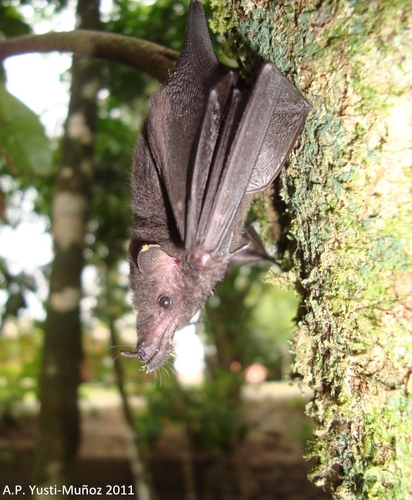
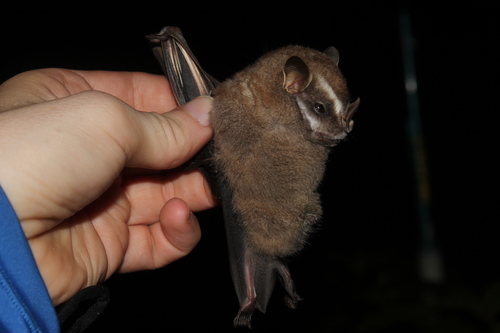
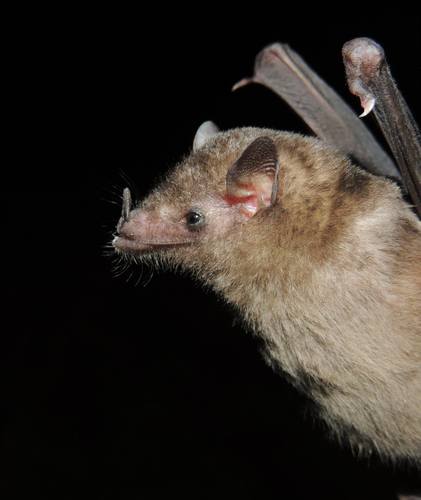
It has soft brownish-gray fur, a long narrow muzzle, small eyes, and a reduced tail that is largely enclosed within the interfemoral membrane. The nose leaf is small and simple, typical of nectar-feeding phyllostomids.
Size
Body length approximately 5-7 cm, with a forearm length of about 32-37 mm.
Weight
Typically weighs between 7 and 10 grams.
Distinctive features
Distinguished from related Choeroniscus species by subtle differences in skull shape, tooth structure, and forearm length; overall it is very similar in appearance to its congeners, requiring careful measurement for identification.
Differences between males and females
Sexual dimorphism is minimal, with males and females similar in size and coloration.
Behaviour and diet of the Godman's Long-tailed Bat
Generally roosts in small groups or solitarily in caves, hollow trees, or rock crevices, though larger aggregations may occur at favorable roost sites.
When it is active
Nocturnal, becoming active after dusk to forage for nectar and return to roosts before dawn.
Diet
Primarily feeds on nectar and pollen from a variety of night-blooming flowers, supplementing its diet with some fruit and insects.
How it feeds and hunts
Uses hovering flight and its long tongue to probe deep into tubular flowers, extracting nectar while inadvertently transferring pollen between plants.
Communication
Communicates through echolocation calls for navigation and social vocalizations within roosts; body contact and olfactory cues may also play a role in social interactions.
Interactions with other species
Interacts with various nectar-producing plants as a key pollinator and may share roosts with other bat species. Predators likely include owls, snakes, and small carnivorous mammals.
Role in its ecosystem
Serves as an important pollinator for various tropical plants, particularly those with bat-pollination syndromes (chiropterophily), contributing to forest regeneration and plant diversity.
Reproduction and lifecycle
Breeding details are not fully documented, but as with related species, gestation likely lasts around 3-4 months, with females typically giving birth to a single pup per litter.
Raising the young
Females carry and nurse a single pup, which clings to the mother during early development until capable of independent flight and foraging.
Maturity and lifespan
Sexual maturity is reached within the first year of life; lifespan in the wild is estimated at several years, though exact data are scarce.
Taxonomy and naming of the Godman's Long-tailed Bat
Classification
Mammalia > Chiroptera > Phyllostomidae > Choeroniscus > Choeroniscus godmani
Scientific synonyms
Hylonycteris godmani; Choeronycteris godmani
What research says
Recent studies
Recent taxonomic and phylogenetic studies have refined the classification of Choeroniscus species using molecular data, helping distinguish it from closely related nectar-feeding bats.
Genome and DNA
Specific genomic studies on Choeroniscus godmani are limited, though phylogenetic analyses have helped clarify its placement within the Glossophaginae subfamily.
Compared with similar species
Similar to other members of the genus Choeroniscus, such as Choeroniscus minor, but can be differentiated through cranial measurements and geographic range; it is also ecologically similar to other glossophagine nectar bats like Glossophaga species.
The Godman's Long-tailed Bat and people
Its tongue can extend far beyond its snout to reach deep into flowers, functioning much like a hummingbird's. Despite its small size, it plays an outsized role in pollinating night-blooming tropical plants.
Where and how to see it
Best observed at dusk near flowering plants such as Bombacaceae or columnar cacti in tropical lowland forests of Mexico or Central America; using a bat detector can help identify its echolocation calls.
Risks to humans
No notable risk to humans; it does not bite defensively and poses minimal direct threat.
Countries where the Godman's Long-tailed Bat is recorded
The 9 countries named in the range description of its IUCN Red List assessment.
Questions about the Godman's Long-tailed Bat
Where does the Godman's Long-tailed Bat live?
The Godman's Long-tailed Bat is recorded in Belize, Colombia, Costa Rica, Guatemala and Honduras, among 9 countries in total across North America and South America. These countries come from the range description of its IUCN Red List assessment, and they are what place the species on the interactive map.
Is the Godman's Long-tailed Bat endangered?
The IUCN Red List assesses the Godman's Long-tailed Bat as Least Concern. The species is widespread and abundant enough not to qualify for any threatened category. It does not mean the species is safe forever, only that nothing in the current data raises an alarm.
How many are left in the wild?
No precise global population estimate exists; the population trend is presumed stable, though local declines may occur due to habitat degradation. This figure comes from the species assessment on the IUCN Red List; population estimates for wild mammals are ranges, not counts, and are revised at each assessment.
What habitat does the Godman's Long-tailed Bat live in?
Primarily found in lowland tropical dry and moist forests, gallery forests, and forest edges, often near caves or rocky crevices used as roosts.
What is the scientific name of the Godman's Long-tailed Bat?
The Godman's Long-tailed Bat is Choeroniscus godmani, in the family Phyllostomidae, order Chiroptera.
Other species in the genus Choeroniscus

Other species in the family Phyllostomidae
Species that share its range

Sources
Conservation status, range description and population estimate come from the IUCN Red List assessment for Choeroniscus godmani. Countries are derived from that range description, not from a mapped country list. Last refreshed on .
The distribution map is drawn from the IUCN Red List spatial data compiled in 2008. IUCN (International Union for Conservation of Nature)