
Greater Long-tailed Bat
Choeroniscus periosus
Red List assessment
Vulnerableon the IUCN Red List
- EXExtinct
- EWExtinct in the Wild
- CRCritically Endangered
- ENEndangered
- VUVulnerable
- NTNear Threatened
- LCLeast Concern
The Greater Long-tailed Bat is recorded in 2 countries across South America. The IUCN Red List assesses the Greater Long-tailed Bat as Vulnerable. No precise population estimate exists, but the population is considered small and declining due to continued habitat degradation across its limited range.
- Family
- Phyllostomidae
- Order
- Chiroptera
- Genus
- Choeroniscus
- Countries recorded
- 2
- Continents
- South America
- Red List category
- Vulnerable
- Data updated
- August 9, 2026
What is the Greater Long-tailed Bat?
Choeroniscus periosus is a small nectar-feeding bat endemic to the Chocó bioregion of western Colombia and northwestern Ecuador. It belongs to the subfamily Glossophaginae, specialized in feeding on nectar and pollen from tropical flowers. This species is remarkable for its elongated rostrum and tongue adaptations that allow it to access deep tubular flowers, making it an important pollinator in its restricted range. It is one of the rarer and less-studied members of the long-tailed bat genus.
Where does the Greater Long-tailed Bat live?
Western Colombia and northwestern Ecuador
Endemic to the Chocó biogeographic region, occurring along the Pacific slope of the Andes in western Colombia and extending into northwestern Ecuador. Its range is narrow and fragmented, closely tied to remaining forest patches.
Altitude and depth
0-1500 meters above sea level, with most records from lowland to lower montane forests.
Seasonal movements
No long-distance migration is documented; the species may show localized movements tracking seasonal flowering patterns of key nectar plant species.
Habitat of the Greater Long-tailed Bat
Primarily found in humid tropical lowland and premontane forests, including primary and secondary growth. It also occurs in forest edges and areas with abundant flowering plants that provide nectar resources.
Adaptations to its environment
Possesses an elongated snout and extensible, brush-tipped tongue specialized for nectarivory, allowing efficient extraction of nectar from deep corolla flowers. Reduced dentition and a lightweight skull structure are adaptations for a liquid-based diet and agile hovering flight.
Conservation status and numbers
Classified as Vulnerable (VU) by the IUCN due to its restricted geographic range, ongoing habitat loss from deforestation, and fragmented, small population size. The species meets criteria under B1ab(iii) due to a small area of occupancy and continuing decline in habitat quality.
Estimated population
No precise population estimate exists, but the population is considered small and declining due to continued habitat degradation across its limited range.
What threatens the Greater Long-tailed Bat?
Major threats include deforestation for agriculture, cattle ranching, and logging within the Chocó region, along with habitat fragmentation that isolates populations and reduces availability of nectar-producing plants.
What is being done to protect it?
Some populations occur within protected areas in the Chocó region of Colombia and Ecuador, though enforcement and habitat connectivity remain challenges. Broader Chocó conservation initiatives indirectly benefit this species.
Recommended actions
Priority actions include expanding protected forest areas within the Chocó bioregion, promoting reforestation and habitat corridors, and conducting further field surveys to clarify population status and ecological requirements.
What the Greater Long-tailed Bat looks like
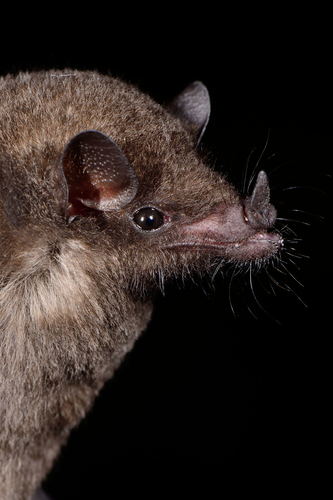
Small bat with brownish-gray fur, an elongated snout typical of nectar-feeding phyllostomids, and a small, simple nose-leaf. The tail is relatively long compared to related species, giving rise to its common name.
Size
Body length approximately 5-6 cm, with a forearm length of around 33-36 mm.
Weight
Approximately 8-10 grams.
Distinctive features
Distinguished from other Choeroniscus species by its notably elongated rostrum and specific cranial measurements, as well as a proportionally longer tail membrane structure.
Differences between males and females
Minimal sexual dimorphism reported; males and females are similar in size and coloration.
Behaviour and diet of the Greater Long-tailed Bat
Likely roosts in small groups or solitarily in tree hollows, caves, or foliage, though detailed social structure data is limited due to the species' rarity and elusiveness.
When it is active
Nocturnal, foraging at night for nectar-producing flowers.
Diet
Primarily nectarivorous, feeding on nectar and pollen from tropical flowering plants; may supplement diet with occasional insects for protein.
How it feeds and hunts
Uses hovering flight and its long tongue to extract nectar from tubular flowers, similar to hummingbird foraging strategies, often visiting multiple flowers in sequence to maximize energy intake.
Communication
Likely uses echolocation calls for navigation and orientation, along with possible olfactory cues for locating flowers; social vocalizations are not well documented.
Interactions with other species
Serves as a pollinator for various Chocó forest plant species; potential predators include owls and other nocturnal raptors, though specific predator-prey relationships are not well studied.
Role in its ecosystem
Plays an important ecological role as a pollinator of tropical flowering plants in the Chocó rainforest, contributing to plant reproduction and forest regeneration.
Reproduction and lifecycle
Reproductive biology is poorly documented, but likely follows patterns of related glossophagine bats with possible seasonal breeding tied to flowering cycles, single offspring per litter, and gestation of around 3-4 months.
Raising the young
Presumed maternal care typical of bats, with females nursing a single pup until it is capable of flight and independent foraging, though specific data for this species is lacking.
Maturity and lifespan
Specific data unavailable, but related glossophagine bats typically reach sexual maturity within the first year and can live 5-10 years in the wild.
Taxonomy and naming of the Greater Long-tailed Bat
Classification
Mammalia > Chiroptera > Phyllostomidae > Choeroniscus > Choeroniscus periosus
What research says
Recent studies
Recent studies have focused on Chocó bat diversity and conservation prioritization, though species-specific research on Choeroniscus periosus remains limited due to its rarity.
Compared with similar species
Similar to other Choeroniscus species such as Choeroniscus minor, but distinguished by its longer rostrum and larger body size; occupies a narrower geographic range than its more widespread relatives.
The Greater Long-tailed Bat and people
This bat's tongue can extend far beyond its snout to reach nectar deep within flowers, functioning much like a hummingbird's bill. It is one of the least documented bat species in South America, making every sighting scientifically valuable.
Where and how to see it
Best observed at night near flowering trees and shrubs in Chocó lowland forests of Colombia, particularly in protected reserves with intact forest cover; patience and specialized bat detection equipment are recommended due to its rarity.
Risks to humans
No notable risk to humans.
Countries where the Greater Long-tailed Bat is recorded
The 2 countries named in the range description of its IUCN Red List assessment.
Questions about the Greater Long-tailed Bat
Where does the Greater Long-tailed Bat live?
The Greater Long-tailed Bat is recorded in Colombia and Ecuador across South America. These countries come from the range description of its IUCN Red List assessment, and they are what place the species on the interactive map.
Is the Greater Long-tailed Bat endangered?
Yes. The IUCN Red List assesses the Greater Long-tailed Bat as Vulnerable, one of the three threatened categories. The species faces a high risk of extinction in the wild. It is the first of the three threatened categories: numbers are falling, the range is shrinking, or the population is small enough that a single bad event could do lasting damage.
How many are left in the wild?
No precise population estimate exists, but the population is considered small and declining due to continued habitat degradation across its limited range. This figure comes from the species assessment on the IUCN Red List; population estimates for wild mammals are ranges, not counts, and are revised at each assessment.
What habitat does the Greater Long-tailed Bat live in?
Primarily found in humid tropical lowland and premontane forests, including primary and secondary growth.
What is the scientific name of the Greater Long-tailed Bat?
The Greater Long-tailed Bat is Choeroniscus periosus, in the family Phyllostomidae, order Chiroptera.
Other species in the genus Choeroniscus
Other species in the family Phyllostomidae
Species that share its range
Sources
Conservation status, range description and population estimate come from the IUCN Red List assessment for Choeroniscus periosus. Countries are derived from that range description, not from a mapped country list. Last refreshed on .
The distribution map is drawn from the IUCN Red List spatial data compiled in 2008. IUCN (International Union for Conservation of Nature)