
Clouded Leopard
Neofelis nebulosa
Red List assessment
Vulnerableon the IUCN Red List
- EXExtinct
- EWExtinct in the Wild
- CRCritically Endangered
- ENEndangered
- VUVulnerable
- NTNear Threatened
- LCLeast Concern
The Clouded Leopard is recorded in 9 countries across Asia. The IUCN Red List assesses the Clouded Leopard as Vulnerable. Estimated at fewer than 10,000 mature individuals globally, with a declining population trend across most of its range
- Family
- Felidae
- Order
- Carnivora
- Genus
- Neofelis
- Countries recorded
- 9
- Continents
- Asia
- Red List category
- Vulnerable
- Data updated
- August 9, 2026
What is the Clouded Leopard?
The clouded leopard is a medium-sized wild cat renowned for its striking cloud-like coat patterns and exceptional arboreal agility. It inhabits dense forests across mainland Southeast Asia and the Himalayan foothills, occupying a unique evolutionary position as a link between big cats (Pantherinae) and small cats. Its extraordinarily long canine teeth relative to skull size have earned it the nickname 'modern-day saber-tooth cat'. This elusive and rarely observed species is considered one of the most arboreally adapted of all cats.
Where does the Clouded Leopard live?
Mainland Southeast Asia, southern China, and the Himalayan foothills including Nepal, Bhutan, and northeastern India
Ranges from Nepal and northeastern India through Bhutan, Myanmar, Thailand, Laos, Cambodia, Vietnam, and into southern China (Yunnan). Historically more widespread but now fragmented into isolated populations across this range.
Altitude and depth
Sea level up to approximately 2,500 meters, with most populations concentrated in lowland to mid-elevation forests below 1,500 meters
Habitat of the Clouded Leopard
Dense tropical and subtropical evergreen forests, moist deciduous forests, and secondary forests; also found in mangrove swamps and grassland-forest mosaics at lower densities. Prefers areas with substantial canopy cover for climbing and hunting.
Adaptations to its environment
Exceptionally flexible ankle joints that rotate nearly 180 degrees, allowing descent from trees head-first; short, muscular limbs and a long tail for balance provide superior climbing ability. Large paws with sharp, retractable claws enable secure grip on branches and bark.
Conservation status and numbers
Classified as Vulnerable (VU) by IUCN due to an estimated population decline of at least 30% over the past three generations (approximately 21 years), driven primarily by habitat loss and poaching pressure across its range.
Estimated population
Estimated at fewer than 10,000 mature individuals globally, with a declining population trend across most of its range
What threatens the Clouded Leopard?
Deforestation and habitat fragmentation from logging and agricultural expansion; poaching for the illegal wildlife trade (skins, bones, teeth for traditional medicine); depletion of prey base due to human hunting; and human-wildlife conflict.
Diseases and parasites
Susceptible to feline diseases such as feline leukemia virus and various endoparasites and ectoparasites common to wild felids, though comprehensive disease studies in wild populations remain limited
What is being done to protect it?
Protected under CITES Appendix I and national wildlife protection laws in most range countries; conservation efforts include camera-trap monitoring programs, protected area networks (e.g., in Thailand, Myanmar, and India), and community-based conservation initiatives. Captive breeding programs exist in zoos worldwide to maintain genetic diversity.
Recommended actions
Strengthen anti-poaching enforcement and combat illegal wildlife trade networks; expand and connect protected forest corridors to reduce fragmentation; conduct further population surveys using camera traps to refine population estimates; engage local communities in conservation through education and alternative livelihoods.
What the Clouded Leopard looks like
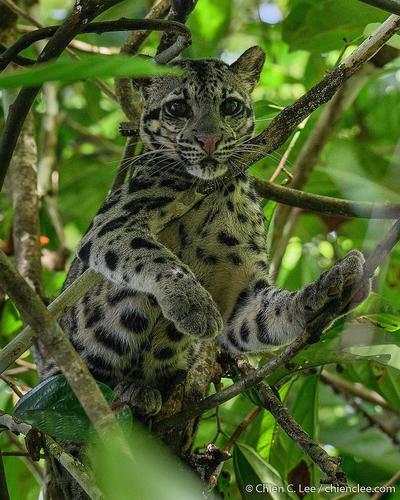
Thick, tawny to grayish-yellow fur covered with large, irregular dark-edged cloud-like blotches, giving rise to its common name; underside is paler with dark spots, and the tail is ringed with dark bands. Two dark stripes run along the back of the neck to the shoulders.
Size
Head-body length of 68-108 cm, with a tail length of 61-91 cm nearly equaling body length; shoulder height approximately 50-60 cm
Weight
Males typically weigh 18-25 kg, while females are smaller at 11-18 kg, showing notable sexual size dimorphism
Distinctive features
Distinguished from other big cats by its proportionally longest canine teeth relative to skull size among living felids, distinctive irregular blotch pattern (versus rosettes in leopards), and short, thick legs adapted for climbing. Its wide gape (nearly 100 degrees) is unique among cats.
Differences between males and females
Males are noticeably larger and heavier than females, weighing up to 40% more, though coat patterns and coloration are similar between sexes
Behaviour and diet of the Clouded Leopard
Primarily solitary, with individuals maintaining home ranges that may overlap between sexes but rarely between same-sex individuals; social interactions are largely limited to mating encounters and mother-offspring bonds.
When it is active
Primarily nocturnal and crepuscular, though some activity has been recorded during daytime hours; spends significant time resting in trees during the day.
Diet
Carnivorous, preying on a variety of species including deer, wild boar, primates (langurs, macaques), birds, porcupines, and smaller mammals; also known to take domestic livestock in areas near human settlements.
How it feeds and hunts
Uses both terrestrial stalking and ambush techniques as well as arboreal hunting, dropping onto prey from tree branches; exceptional climbing ability allows pursuit of prey like primates directly in the canopy.
Communication
Communicates through vocalizations including growls, hisses, and a distinctive 'sneeze' or short call similar to other Pantherinae; scent marking via urine spraying and cheek rubbing on trees is used for territorial signaling.
Interactions with other species
Faces potential competition from larger predators such as tigers and leopards where ranges overlap, and may avoid areas with high densities of these species; occasionally preyed upon by larger carnivores when young or vulnerable.
Role in its ecosystem
Functions as a mesopredator to apex predator in forest ecosystems, helping regulate populations of primates, ungulates, and smaller mammals, thereby contributing to forest ecosystem balance.
Reproduction and lifecycle
Breeding can occur year-round in some regions though may peak in certain seasons; gestation lasts approximately 85-95 days, resulting in litters of 1-5 cubs (typically 2-3); cubs are weaned around 3 months of age.
Raising the young
Females raise cubs alone without male involvement; cubs are born blind and helpless, opening their eyes around 10 days, and remain dependent on the mother for approximately 9-10 months before becoming independent.
Maturity and lifespan
Sexual maturity is reached at approximately 2 years of age; lifespan in the wild is estimated at 11 years, while captive individuals can live up to 17 years with proper care.
Taxonomy and naming of the Clouded Leopard
Classification
Mammalia > Carnivora > Felidae > Neofelis > Neofelis nebulosa
Subspecies
Two recognized subspecies: N. n. nebulosa (mainland Southeast Asia, southern China, Himalayas) and N. n. macrosceloides (sometimes debated, historically described from the Himalayan region); note that the Sunda clouded leopard (Neofelis diardi) from Borneo and Sumatra was reclassified as a separate species in 2006.
Scientific synonyms
Felis nebulosa (Griffith, 1821); Felis macrosceloides
What research says
Recent studies
Recent camera-trap studies across Southeast Asia have provided new insights into population densities and habitat use, revealing lower-than-expected densities in many protected areas and highlighting the impact of prey depletion on clouded leopard populations.
Genome and DNA
Diploid chromosome number of 38; genetic studies have confirmed clear divergence from the Sunda clouded leopard (Neofelis diardi), supporting their classification as distinct species based on both morphological and molecular data.
Compared with similar species
Distinguished from the closely related Sunda clouded leopard by smaller, more numerous cloud markings and slightly smaller body size; differs from true leopards (Panthera pardus) by its shorter legs, longer tail, and cloud-shaped rather than rosette markings, as well as its more primitive skull morphology.
The Clouded Leopard and people
The clouded leopard can rotate its ankles nearly 180 degrees, allowing it to climb down trees headfirst like a squirrel; it has the longest canine teeth relative to skull size of any living cat species; despite its name, it is not closely related to true leopards and belongs to its own distinct genus.
Where and how to see it
Best observed in protected reserves such as Khao Yai National Park in Thailand or in forested regions of Bhutan during dawn or dusk hours, though sightings are extremely rare due to the species' elusive and nocturnal nature; camera-trap footage offers a more reliable means of documentation than direct observation.
Risks to humans
No notable risk to humans under normal circumstances, as clouded leopards are shy and avoid human contact; extremely rare incidents may occur if the animal is cornered or threatened.
Human uses
Historically hunted for their pelts, teeth, and bones for use in traditional medicine and decorative purposes; currently protected by law in most range countries, though illegal trade persists in some regions.
Myths and legends
In various indigenous cultures across Southeast Asia and Borneo, clouded leopards are considered symbols of power, stealth, and spiritual significance, sometimes featured in local folklore as guardian spirits of the forest.
Countries where the Clouded Leopard is recorded
The 9 countries named in the range description of its IUCN Red List assessment.
Questions about the Clouded Leopard
Where does the Clouded Leopard live?
The Clouded Leopard is recorded in Bhutan, Cambodia, China, India and Laos, among 9 countries in total across Asia. These countries come from the range description of its IUCN Red List assessment, and they are what place the species on the interactive map.
Is the Clouded Leopard endangered?
Yes. The IUCN Red List assesses the Clouded Leopard as Vulnerable, one of the three threatened categories. The species faces a high risk of extinction in the wild. It is the first of the three threatened categories: numbers are falling, the range is shrinking, or the population is small enough that a single bad event could do lasting damage.
How many are left in the wild?
Estimated at fewer than 10,000 mature individuals globally, with a declining population trend across most of its range This figure comes from the species assessment on the IUCN Red List; population estimates for wild mammals are ranges, not counts, and are revised at each assessment.
What habitat does the Clouded Leopard live in?
Dense tropical and subtropical evergreen forests, moist deciduous forests, and secondary forests; also found in mangrove swamps and grassland-forest mosaics at lower densities.
What is the scientific name of the Clouded Leopard?
The Clouded Leopard is Neofelis nebulosa, in the family Felidae, order Carnivora.
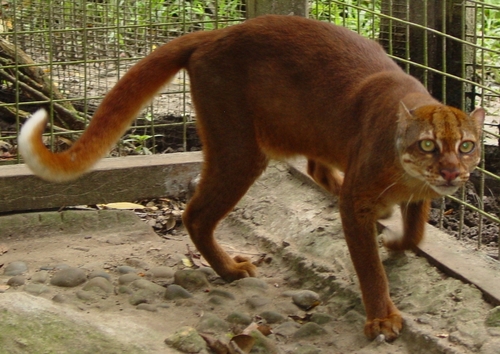
Other species in the genus Neofelis
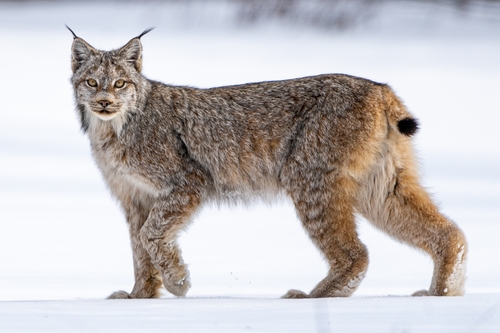
Other species in the family Felidae
Species that share its range
Sources
Conservation status, range description and population estimate come from the IUCN Red List assessment for Neofelis nebulosa. Countries are derived from that range description, not from a mapped country list. Last refreshed on .
The distribution map is drawn from the IUCN Red List spatial data compiled in 2021. IUCN (International Union for Conservation of Nature)