
Argali
Ovis ammon
Red List assessment
Near Threatenedon the IUCN Red List
- EXExtinct
- EWExtinct in the Wild
- CRCritically Endangered
- ENEndangered
- VUVulnerable
- NTNear Threatened
- LCLeast Concern
The Argali is recorded in 10 countries across Asia and Europe. The IUCN Red List assesses the Argali as Near Threatened. Estimated global population of 100,000-140,000 individuals, with an overall declining trend, though some populations under strict protection (e.g., Mongolia, Tajikistan) show stability or slight increases.
- Family
- Bovidae
- Order
- Artiodactyla
- Genus
- Ovis
- Countries recorded
- 10
- Continents
- Asia and Europe
- Red List category
- Near Threatened
- Data updated
- August 9, 2026
What is the Argali?
The Argali is the largest wild sheep species in the world, native to the high mountains and plateaus of Central Asia. Renowned for its massive spiraling horns, which can exceed 1.5 meters in males, it inhabits some of the most remote and rugged terrain on Earth. This species plays a key ecological role as a grazer in alpine ecosystems and is a flagship species for conservation in the region.
Where does the Argali live?
Central Asia, including Mongolia, China (Tibet, Xinjiang), Kyrgyzstan, Tajikistan, Kazakhstan, and parts of Russia, Afghanistan, Pakistan, and India (Ladakh)
Found across the mountain ranges of Central Asia including the Altai, Tian Shan, Pamir, and Himalayan foothills, spanning Mongolia, China, Kazakhstan, Kyrgyzstan, Tajikistan, Uzbekistan, Russia, Afghanistan, Pakistan, and India.
Altitude and depth
Typically found between 3000-5500 meters, though some populations occur as low as 300m in Mongolia's Gobi region.
Seasonal movements
Seasonal altitudinal migration occurs, with argali moving to lower elevations in winter to avoid deep snow and returning to higher pastures in summer for grazing.
Habitat of the Argali
Alpine meadows, rolling steppe, rocky outcrops, and high-altitude grasslands; prefers open terrain with good visibility to detect predators, avoiding dense forest.
Adaptations to its environment
Thick winter coat for insulation against extreme cold, large lung capacity for high-altitude oxygen efficiency, and strong legs adapted for traversing steep rocky terrain. Their coloration provides camouflage against rocky steppe backgrounds.
Conservation status and numbers
Near Threatened (NT) according to IUCN, with populations declining due to poaching, habitat loss, and competition with livestock; some subspecies like the Kara Tau argali are Critically Endangered.
Estimated population
Estimated global population of 100,000-140,000 individuals, with an overall declining trend, though some populations under strict protection (e.g., Mongolia, Tajikistan) show stability or slight increases.
What threatens the Argali?
Illegal hunting for meat and trophy horns, habitat degradation from overgrazing by domestic livestock, competition for forage, infrastructure development, and disease transmission from domestic sheep.
Diseases and parasites
Susceptible to diseases transmitted from domestic sheep and goats, including pasteurellosis and sarcoptic mange, as well as internal parasites such as gastrointestinal nematodes.
What is being done to protect it?
Protected under CITES Appendix II, with national protected areas established across its range (e.g., Altyn Emel National Park, Gobi Gurvansaikhan). Trophy hunting programs in some countries fund conservation through regulated quotas.
Recommended actions
Strengthen anti-poaching enforcement, reduce livestock competition through grazing management, expand transboundary protected area networks, and improve genetic monitoring of isolated subspecies populations.
What the Argali looks like
Coat color ranges from light grayish-brown to reddish-brown, with a whitish rump patch and underparts; coloration varies seasonally and darkens somewhat in winter.
Size
Shoulder height 90-125 cm; body length 120-190 cm depending on subspecies, with Marco Polo sheep being among the largest.
Weight
Males weigh 65-180 kg depending on subspecies, while females are notably smaller at 35-60 kg.
Distinctive features
Massive corkscrew-shaped horns in males, some of the largest of any sheep species, distinguish argali from other wild sheep; overall larger body size compared to related Ovis species.
Differences between males and females
Pronounced sexual dimorphism: males are significantly larger and possess large curling horns weighing up to 23 kg, while females have much smaller, slightly curved horns and lighter body mass.
Behaviour and diet of the Argali
Highly social, forming sex-segregated herds outside the rut; female-young groups can number 5-50 individuals, while male bachelor groups tend to be smaller and more loosely associated.
When it is active
Primarily diurnal, most active during early morning and late afternoon, resting during midday heat in higher elevations.
Diet
Herbivorous grazer feeding mainly on grasses, sedges, and forbs; diet shifts to shrubs and dried vegetation in winter when snow covers pasture.
Communication
Communication includes vocal bleats between ewes and lambs, visual displays of dominance through horn size and posturing among males, and scent marking during the rut.
Interactions with other species
Natural predators include snow leopards, wolves, and occasionally golden eagles preying on lambs; argali also compete with domestic livestock for grazing resources across much of their range.
Role in its ecosystem
As a keystone herbivore in alpine and steppe ecosystems, argali help shape vegetation structure through grazing and serve as an important prey base for large predators like snow leopards.
Reproduction and lifecycle
Rutting season occurs in late autumn to early winter (October-December), with males engaging in dramatic horn-clashing contests for mating rights; gestation lasts about 150-165 days, producing typically 1 lamb (occasionally twins).
Raising the young
Ewes give birth in isolated, sheltered areas and nurse lambs for several months; lambs can follow their mothers within days but remain dependent on milk for 4-6 months before fully weaning.
Maturity and lifespan
Sexual maturity is reached around 2-3 years for females and 5 years for males (though full breeding success often occurs later); lifespan in the wild is typically 10-13 years, up to 15 years in captivity.
Taxonomy and naming of the Argali
Classification
Class Mammalia > Order Artiodactyla > Family Bovidae > Genus Ovis > Species Ovis ammon
Subspecies
Several recognized subspecies including O. a. ammon (Altai argali, Mongolia/Russia), O. a. polii (Marco Polo sheep, Pamir region), O. a. karelini (Tian Shan argali), O. a. darwini (Gobi argali), O. a. hodgsoni (Tibetan argali), and O. a. nigrimontana (Kara Tau argali, critically endangered).
Scientific synonyms
Ovis argali; Caprovis ammon (historical usage)
What research says
Recent studies
Recent GPS-tracking studies in Mongolia and Tajikistan have revealed extensive transboundary movements, informing new conservation corridors between fragmented populations.
Genome and DNA
Argali possess 56 chromosomes (2n=56); genetic studies have highlighted hybridization potential with domestic sheep (Ovis aries) and have been used to trace subspecies divergence across their range.
Compared with similar species
Argali are notably larger than other wild sheep like the urial (Ovis vignei) or bighorn sheep (Ovis canadensis), with proportionally larger and more massive horns; they are considered the ancestral wild relative closely linked to domestic sheep lineage.
The Argali and people
The Marco Polo argali subspecies is named after the explorer who documented these sheep during his travels through the Pamir Mountains in the 13th century. Argali horns are the largest of any sheep species, with record specimens exceeding 190 cm in curl length. Their spiraled horns can weigh as much as the rest of their skeleton combined.
Where and how to see it
Best observed in early morning or late afternoon in protected reserves such as Mongolia's Gobi Gurvansaikhan National Park or Tajikistan's Pamir region during late summer to early autumn when herds gather at lower elevations.
Risks to humans
No notable risk to humans; argali are shy and avoid human contact, posing no direct threat.
Human uses
Historically hunted for meat and hides by local communities; today primarily valued for regulated trophy hunting programs that generate conservation funding, as well as being a significant cultural and ecotourism attraction.
Myths and legends
In Central Asian folklore, the argali (particularly the Marco Polo sheep) is a symbol of wilderness and mountain spirits, often depicted in ancient petroglyphs and associated with hunting traditions of nomadic peoples.
Countries where the Argali is recorded
The 10 countries named in the range description of its IUCN Red List assessment.
Questions about the Argali
Where does the Argali live?
The Argali is recorded in Afghanistan, China, India, Kazakhstan and Kyrgyzstan, among 10 countries in total across Asia and Europe. These countries come from the range description of its IUCN Red List assessment, and they are what place the species on the interactive map.
Is the Argali endangered?
The IUCN Red List assesses the Argali as Near Threatened. The species does not qualify as threatened today, but it is close to the thresholds and likely to cross them soon. It is the category that most often changes at the next assessment.
How many are left in the wild?
Estimated global population of 100,000-140,000 individuals, with an overall declining trend, though some populations under strict protection (e.g., Mongolia, Tajikistan) show stability or slight increases. This figure comes from the species assessment on the IUCN Red List; population estimates for wild mammals are ranges, not counts, and are revised at each assessment.
What habitat does the Argali live in?
Alpine meadows, rolling steppe, rocky outcrops, and high-altitude grasslands; prefers open terrain with good visibility to detect predators, avoiding dense forest.
What is the scientific name of the Argali?
The Argali is Ovis ammon, in the family Bovidae, order Artiodactyla.
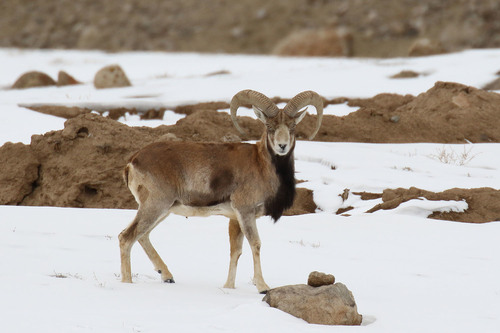
Other species in the genus Ovis
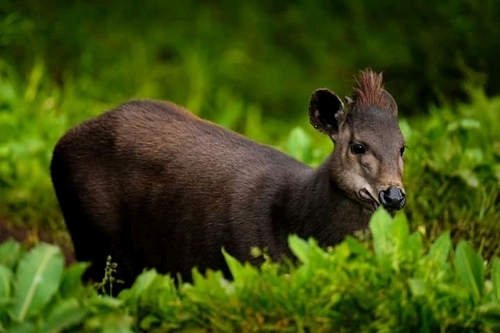
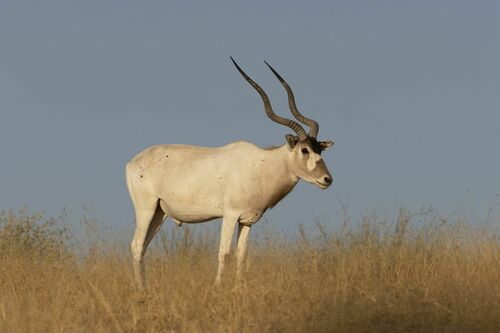
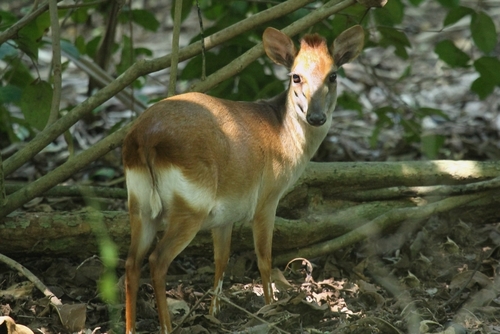
Other species in the family Bovidae
Species that share its range
Sources
Conservation status, range description and population estimate come from the IUCN Red List assessment for Ovis ammon. Countries are derived from that range description, not from a mapped country list. Last refreshed on .
The distribution map is drawn from the IUCN Red List spatial data compiled in 2020. IUCN (International Union for Conservation of Nature)