
Black-footed Cat
Felis nigripes
Red List assessment
Vulnerableon the IUCN Red List
- EXExtinct
- EWExtinct in the Wild
- CRCritically Endangered
- ENEndangered
- VUVulnerable
- NTNear Threatened
- LCLeast Concern
The Black-footed Cat is recorded in 3 countries across Africa. The IUCN Red List assesses the Black-footed Cat as Vulnerable. Estimated global population is fewer than 10,000 mature individuals, with a decreasing trend.
- Family
- Felidae
- Order
- Carnivora
- Genus
- Felis
- Countries recorded
- 3
- Continents
- Africa
- Red List category
- Vulnerable
- Data updated
- August 9, 2026
What is the Black-footed Cat?
The Black-footed Cat is the smallest wild cat species in Africa, native to the arid grasslands and savannas of southern Africa. Despite its diminutive size, it is a fierce and highly efficient nocturnal hunter, earning it the nickname 'the deadliest cat' due to its exceptionally high hunting success rate. It is elusive, rarely seen, and remains one of the least studied felids in the world.
Where does the Black-footed Cat live?
South Africa, Namibia, Botswana
Endemic to southern Africa, primarily found in South Africa (Northern Cape, Free State, Karoo regions), Namibia, and Botswana. Its range is patchy and fragmented, limited to specific arid biomes.
Altitude and depth
Typically found at elevations between 900 and 1,500 meters above sea level.
Habitat of the Black-footed Cat
Prefers arid and semi-arid savanna, grassland, and karoo scrubland with sparse vegetation. Often found in areas with sandy soils suitable for burrowing prey and termite mounds used as den sites. Avoids dense vegetation and rocky terrain.
Adaptations to its environment
Has thick fur on paw pads to protect against hot sand and cold nights typical of arid environments. Highly efficient kidneys allow it to survive with minimal water intake, deriving most moisture from prey. Nocturnal habits help avoid extreme daytime heat.
Conservation status and numbers
Classified as Vulnerable (VU) by the IUCN due to habitat loss, fragmentation, and population decline estimated at more than 10% over the last decade. Population trends are difficult to assess due to the species' elusive nature.
Estimated population
Estimated global population is fewer than 10,000 mature individuals, with a decreasing trend.
What threatens the Black-footed Cat?
Major threats include habitat degradation from overgrazing by livestock, indiscriminate poisoning and trapping intended for other predators, and collisions with vehicles. Disease transmission from domestic cats is also a growing concern.
Diseases and parasites
Susceptible to feline diseases such as feline immunodeficiency virus (FIV) and amyloidosis, the latter being a notable cause of mortality in captive populations.
What is being done to protect it?
Protected under national legislation in South Africa, Namibia, and Botswana; present in several protected areas including parts of the Kalahari. Research and monitoring programs, such as those by the Black-footed Cat Working Group, focus on ecology and captive breeding.
Recommended actions
Priority actions include expanding protected habitat corridors, reducing indiscriminate predator control methods, monitoring disease transmission from domestic cats, and increasing camera-trap based population studies.
What the Black-footed Cat looks like
Sandy to tawny fur covered with distinct black or dark brown spots that merge into rings on the tail and legs. Black soles on the feet give the species its name, and the face has fine black lines running from the eyes.
Size
Body length ranges from 35 to 52 cm, with a tail length of 10-20 cm; shoulder height is approximately 20-25 cm.
Weight
Males typically weigh 1.6-2.45 kg, while females are smaller, weighing 1.0-1.6 kg.
Distinctive features
Notably smaller and stockier than other small African cats such as the African wildcat, with a proportionally larger head and shorter legs. The bold black spotting pattern and black paw pads are key distinguishing features.
Differences between males and females
Males are noticeably larger and heavier than females, though coloration and patterning are similar between sexes.
Behaviour and diet of the Black-footed Cat
Strictly solitary except during mating encounters; individuals maintain and mark large home ranges that may overlap slightly between sexes.
When it is active
Almost exclusively nocturnal, spending daylight hours resting in burrows, hollow termite mounds, or dense grass tussocks.
Diet
Strict carnivore feeding primarily on small rodents, birds, and insects; known for extremely high caloric intake needs relative to body size, consuming up to 250 grams of prey per night.
How it feeds and hunts
Employs a stealthy stalk-and-pounce technique, and is noted for exceptional hunting success rates exceeding 60%, far higher than lions or leopards. Uses both ambush and active foraging, sometimes digging prey from burrows.
Communication
Communicates through scent marking via urine spraying and cheek rubbing, as well as vocalizations including a distinctive loud, deep call used during mating season despite the animal's tiny size.
Interactions with other species
Faces predation risk from larger carnivores such as caracals, jackals, and birds of prey; competes for prey with other small predators like African wildcats and mongooses.
Role in its ecosystem
Functions as a small but effective mesopredator, helping control rodent and insect populations within arid ecosystems.
Reproduction and lifecycle
Breeding can occur year-round but peaks in spring; gestation lasts about 63-68 days, producing litters of 1-4 kittens, most commonly two.
Raising the young
Females raise kittens alone in a den, moving them between multiple shelter sites for safety; weaning occurs around 8 weeks, with independence reached by 4-6 months.
Maturity and lifespan
Reaches sexual maturity around 8-12 months of age; lifespan in the wild is approximately 3-5 years, while captive individuals can live up to 10-13 years.
Taxonomy and naming of the Black-footed Cat
Classification
Mammalia > Carnivora > Felidae > Felis > Felis nigripes
Subspecies
Two subspecies recognized: Felis nigripes nigripes (South Africa, western regions) and Felis nigripes thomasi (Botswana, Zimbabwe border areas), though validity is debated.
Scientific synonyms
Felis nigripes Burchell, 1834 is the original and accepted name; no major synonyms in wide use.
What research says
Recent studies
Recent studies using GPS collaring and camera traps have provided new insights into its extremely high hunting success rate and nightly energy expenditure, highlighting its unique metabolic demands.
Genome and DNA
Diploid chromosome number is 2n=38, consistent with other Felidae species; genetic studies have contributed to broader felid phylogenetic research.
Compared with similar species
Smaller and more heavily spotted than the African wildcat, with a stockier build and shorter legs than the sand cat, another small arid-adapted felid.
The Black-footed Cat and people
Despite weighing less than a domestic cat, the Black-footed Cat has one of the highest hunting success rates of any wild cat, succeeding in an estimated 60% of hunts. It can kill more prey in a single night than a leopard does in six months relative to body size.
Where and how to see it
Best observed on guided night drives in reserves within the Kalahari region of South Africa or Namibia, using red-filtered spotlights during warmer months when activity increases.
Risks to humans
No notable risk to humans; the species is shy and avoids human contact, though it may bite defensively if captured or cornered.
Myths and legends
Referred to in some local Afrikaans folklore as the 'miershooptier' or 'ant-hill tiger,' reflecting its fierce reputation despite its small size.
Countries where the Black-footed Cat is recorded
The 3 countries named in the range description of its IUCN Red List assessment.
Questions about the Black-footed Cat
Where does the Black-footed Cat live?
The Black-footed Cat is recorded in Botswana, Namibia and South Africa across Africa. These countries come from the range description of its IUCN Red List assessment, and they are what place the species on the interactive map.
Is the Black-footed Cat endangered?
Yes. The IUCN Red List assesses the Black-footed Cat as Vulnerable, one of the three threatened categories. The species faces a high risk of extinction in the wild. It is the first of the three threatened categories: numbers are falling, the range is shrinking, or the population is small enough that a single bad event could do lasting damage.
How many are left in the wild?
Estimated global population is fewer than 10,000 mature individuals, with a decreasing trend. This figure comes from the species assessment on the IUCN Red List; population estimates for wild mammals are ranges, not counts, and are revised at each assessment.
What habitat does the Black-footed Cat live in?
Prefers arid and semi-arid savanna, grassland, and karoo scrubland with sparse vegetation.
What is the scientific name of the Black-footed Cat?
The Black-footed Cat is Felis nigripes, in the family Felidae, order Carnivora.
Other species in the genus Felis
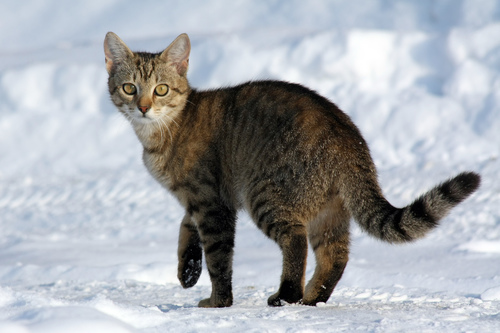
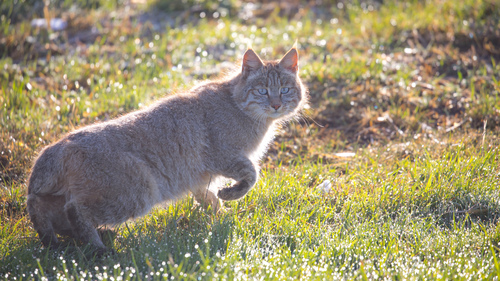
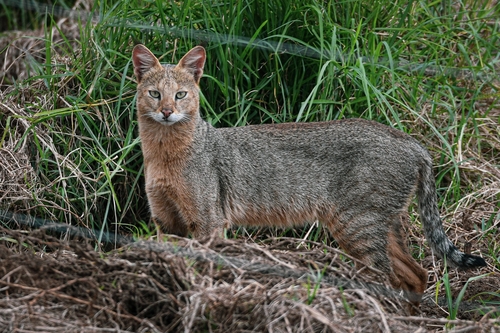
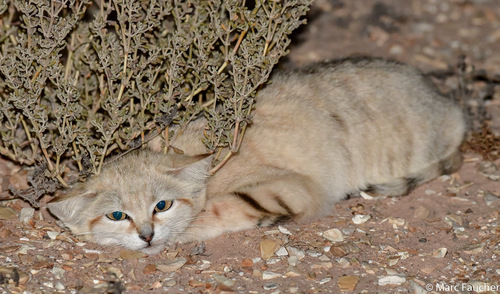
Other species in the family Felidae
Species that share its range
Sources
Conservation status, range description and population estimate come from the IUCN Red List assessment for Felis nigripes. Countries are derived from that range description, not from a mapped country list. Last refreshed on .
The distribution map is drawn from the IUCN Red List spatial data compiled in 2026. Black-footed Cat Working Group (BFCWG)