
Borneo Bay Cat
Catopuma badia
Red List assessment
Endangeredon the IUCN Red List
- EXExtinct
- EWExtinct in the Wild
- CRCritically Endangered
- ENEndangered
- VUVulnerable
- NTNear Threatened
- LCLeast Concern
The Borneo Bay Cat is recorded in 3 countries across Asia. The IUCN Red List assesses the Borneo Bay Cat as Endangered. No precise population estimate exists, but the total is thought to number fewer than 2,500 mature individuals and is declining.
- Family
- Felidae
- Order
- Carnivora
- Genus
- Catopuma
- Countries recorded
- 3
- Continents
- Asia
- Red List category
- Endangered
- Data updated
- August 9, 2026
What is the Borneo Bay Cat?
The Borneo Bay Cat is a small, elusive wild cat endemic to the island of Borneo, making it one of the least-known and rarest felids in the world. It is a forest specialist found exclusively in lowland tropical rainforest and is rarely observed by scientists or locals. Its striking uniform reddish-chestnut coat and long tail distinguish it from other Southeast Asian small cats. Due to extreme rarity and habitat specificity, it has become a flagship species for Bornean forest conservation.
Where does the Borneo Bay Cat live?
Borneo (Malaysia, Indonesia, Brunei)
Endemic to the island of Borneo, occurring in Malaysian states of Sabah and Sarawak, Indonesian Kalimantan, and Brunei. Records are scattered and sparse across the island, reflecting both its rarity and the difficulty of detection.
Altitude and depth
Mostly recorded at lowland elevations from near sea level up to about 500 m, with occasional records up to 900 m.
Habitat of the Borneo Bay Cat
Primarily found in dense lowland tropical rainforest, including primary and some secondary forest; also recorded near limestone outcrops and riverine forest. It appears to avoid heavily disturbed or open habitats, showing strong dependence on continuous forest cover.
Adaptations to its environment
Its slender build, long tail for balance, and retractable claws suggest adaptations for both terrestrial movement and climbing within dense forest understory. Reddish coat coloration may provide camouflage in the dim, reddish-brown leaf litter and shadows of the rainforest floor.
Conservation status and numbers
Classified as Endangered (EN) by the IUCN due to a small, fragmented population and ongoing severe habitat loss across its entire range on Borneo. Population is believed to be declining as lowland forests continue to be converted to agriculture and plantations.
Estimated population
No precise population estimate exists, but the total is thought to number fewer than 2,500 mature individuals and is declining. It is considered one of the rarest and most poorly studied cat species globally.
What threatens the Borneo Bay Cat?
The primary threat is large-scale deforestation and habitat conversion for oil palm plantations, logging, and agriculture. Additional threats include habitat fragmentation, incidental snaring/trapping intended for other species, and potential hunting.
What is being done to protect it?
The species occurs in several protected areas in Sabah and Kalimantan, including parts of the Heart of Borneo conservation initiative. It is listed on CITES Appendix II and protected under national wildlife laws in Malaysia, Indonesia, and Brunei.
Recommended actions
Priority actions include expanding camera-trap surveys to better understand distribution and abundance, strengthening protection of remaining lowland forest, and improving connectivity between forest fragments. Reducing snaring pressure and enforcing anti-poaching laws are also critical.
What the Borneo Bay Cat looks like
The coat is a rich, uniform chestnut to mahogany-red color, sometimes with faint spotting visible in certain light, and a paler underside. The tail is long, slender, and often has a slightly darker tip, while the ears are rounded with no prominent tufts.
Size
Head-body length approximately 40-62 cm, with a tail length of 30-40 cm, roughly half the body length.
Weight
Estimated body weight ranges from about 1.5 to 4 kg.
Distinctive features
Distinguished from the Marbled Cat and Leopard Cat by its plain, unspotted reddish coat and proportionally longer tail relative to body size. It lacks the marbled or heavily spotted patterning seen in related small Bornean felids.
Differences between males and females
Sexual dimorphism appears minimal, with males and females similar in size and coloration, though data is extremely limited due to rarity of specimens.
Behaviour and diet of the Borneo Bay Cat
Believed to be solitary, based on limited camera-trap and observational data, consistent with most small felid species. Social structure and territory sizes remain largely unknown.
When it is active
Thought to be primarily nocturnal and crepuscular, based on camera-trap capture times, though some daytime activity has also been recorded.
Diet
Presumed carnivorous, likely feeding on small mammals such as rodents and tree shrews, birds, and possibly reptiles. Direct dietary studies are lacking due to the species' extreme rarity.
How it feeds and hunts
Likely an ambush or stalk-and-pounce predator typical of small forest-dwelling felids, using dense understory cover to approach prey, though specific hunting behavior has not been directly documented.
Communication
Likely uses scent marking, vocalizations, and body postures similar to other small felids for territory marking and mate attraction, though no direct studies exist for this species.
Interactions with other species
Potential competitors include other small Bornean carnivores such as the Leopard Cat and Marbled Cat, while larger predators like the Clouded Leopard may pose a threat. Ecological interactions remain largely undocumented.
Role in its ecosystem
As a small carnivore, it likely plays a role in controlling populations of small mammals and birds within the forest ecosystem, contributing to trophic balance in lowland Bornean rainforest.
Reproduction and lifecycle
Almost nothing is documented about wild reproduction; captive and limited data suggest a gestation period similar to related small cats, roughly 60-70 days, with typically one to two kittens per litter.
Raising the young
Parental care is presumed to be provided solely by the mother, as is typical for solitary felids, though specific behaviors have never been documented in the wild.
Maturity and lifespan
Age of sexual maturity and lifespan are unknown in the wild; related small felids typically mature around 1-2 years and can live 10-15 years in captivity, but no Bay Cats have been successfully maintained long-term in captivity.
Taxonomy and naming of the Borneo Bay Cat
Classification
Class Mammalia > Order Carnivora > Family Felidae > Genus Catopuma > Species Catopuma badia
Scientific synonyms
Felis badia, Pardofelis badia, Profelis badia
What research says
Recent studies
Recent camera-trap surveys in Sabah and Kalimantan have provided new distribution records and confirmed the species' continued presence in select forest reserves, helping refine range maps. Genetic studies have also clarified its close evolutionary relationship to the Asian Golden Cat.
Genome and DNA
Genetic studies have confirmed its placement within the genus Catopuma, closely related to the Asian Golden Cat, based on molecular phylogenetic analyses, but detailed genomic data remain limited.
Compared with similar species
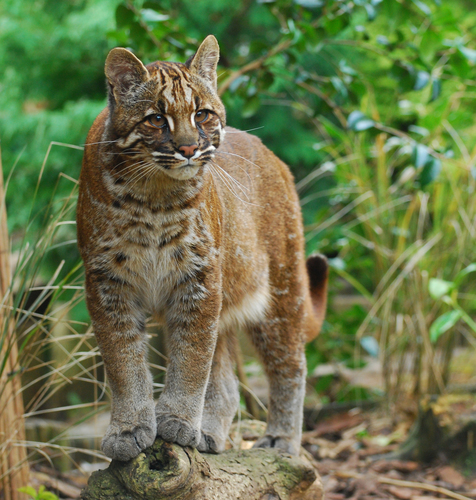
Compared to its close relative the Asian Golden Cat, the Bay Cat is smaller, has a plainer reddish coat without golden or grayish variants, and is restricted entirely to Borneo rather than mainland Asia. It is also rarer and far less studied than either the Leopard Cat or Marbled Cat found on the same island.
The Borneo Bay Cat and people
The Borneo Bay Cat was so rarely seen that for decades scientists knew it almost exclusively from a handful of museum skins; the first photograph of a live wild individual was not taken until the 1990s-2000s. It remains one of the least photographed and least studied cat species on Earth.
Where and how to see it
Sightings are exceptionally rare even for researchers; the best chance of any documentation is through camera-trap studies in protected lowland forests of Sabah, such as around the Danum Valley or Maliau Basin. Casual wildlife observation of this species is essentially impossible due to its rarity and elusiveness.
Risks to humans
No notable risk to humans.
Countries where the Borneo Bay Cat is recorded
The 3 countries named in the range description of its IUCN Red List assessment.
Questions about the Borneo Bay Cat
Where does the Borneo Bay Cat live?
The Borneo Bay Cat is recorded in Brunei, Indonesia and Malaysia across Asia. These countries come from the range description of its IUCN Red List assessment, and they are what place the species on the interactive map.
Is the Borneo Bay Cat endangered?
Yes. The IUCN Red List assesses the Borneo Bay Cat as Endangered, one of the three threatened categories. The species faces a very high risk of extinction in the wild — a step below Critically Endangered, but still on a trajectory that ends badly without intervention.
How many are left in the wild?
No precise population estimate exists, but the total is thought to number fewer than 2,500 mature individuals and is declining. This figure comes from the species assessment on the IUCN Red List; population estimates for wild mammals are ranges, not counts, and are revised at each assessment.
What habitat does the Borneo Bay Cat live in?
Primarily found in dense lowland tropical rainforest, including primary and some secondary forest; also recorded near limestone outcrops and riverine forest.
What is the scientific name of the Borneo Bay Cat?
The Borneo Bay Cat is Catopuma badia, in the family Felidae, order Carnivora.
Other species in the genus Catopuma
Other species in the family Felidae
Species that share its range
Sources
Conservation status, range description and population estimate come from the IUCN Red List assessment for Catopuma badia. Countries are derived from that range description, not from a mapped country list. Last refreshed on .
The distribution map is drawn from the IUCN Red List spatial data compiled in 2016. IUCN (International Union for Conservation of Nature)