
Anderson's Squirrel
Callosciurus quinquestriatus
Red List assessment
Least Concernon the IUCN Red List
- EXExtinct
- EWExtinct in the Wild
- CRCritically Endangered
- ENEndangered
- VUVulnerable
- NTNear Threatened
- LCLeast Concern
The Anderson's Squirrel is recorded in 3 countries across Asia. The IUCN Red List assesses the Anderson's Squirrel as Least Concern. No precise global population estimate exists, but the species is considered common within suitable habitat; overall population trend is presumed stable.
- Family
- Sciuridae
- Order
- Rodentia
- Genus
- Callosciurus
- Countries recorded
- 3
- Continents
- Asia
- Red List category
- Least Concern
- Data updated
- August 9, 2026
What is the Anderson's Squirrel?
Anderson's Squirrel is a medium-sized tree squirrel native to the montane forests of northern Myanmar, southwestern China, and northern Thailand. It is named after British zoologist John Anderson who conducted extensive natural history surveys in this region during the 19th century. The species is notable for its striking five-striped pattern on the back, which distinguishes it from many other Callosciurus species. It plays an important ecological role as a seed disperser in its forest habitat.
Where does the Anderson's Squirrel live?
Northern Myanmar, southwestern China (Yunnan), and northern Thailand
Found in northern Myanmar (Kachin and Shan states), southwestern Yunnan province in China, and northern Thailand, occupying a relatively restricted range within the eastern Himalayan foothills and adjacent Indochinese highlands.
Altitude and depth
Typically found at elevations between 600-2200 meters above sea level
Seasonal movements
No true hibernation or long-distance migration; activity levels may fluctuate seasonally in response to fruiting and flowering cycles of forest trees.
Habitat of the Anderson's Squirrel
Inhabits subtropical and tropical moist broadleaf forests, as well as mixed deciduous and evergreen montane forests. Prefers areas with dense canopy cover and mature trees that provide both food and nesting opportunities.
Adaptations to its environment
Possesses sharp curved claws and strong hind limbs adapted for arboreal locomotion and climbing large tree trunks. Its coloration provides camouflage against tree bark and dappled forest light, helping avoid predation while foraging.
Conservation status and numbers
Listed as Least Concern (LC) by IUCN due to a relatively wide distribution and presumed stable population, though localized habitat loss is a concern in parts of its range.
Estimated population
No precise global population estimate exists, but the species is considered common within suitable habitat; overall population trend is presumed stable.
What threatens the Anderson's Squirrel?
Primary threats include deforestation for agriculture and logging, habitat fragmentation, and potential hunting pressure in some areas, though these have not yet caused significant population decline.
Diseases and parasites
Specific studies on diseases and parasites in this species are limited, but like other tree squirrels it likely hosts common ectoparasites such as mites, ticks, and fleas.
What is being done to protect it?
Benefits indirectly from protected areas within its range such as national parks in Myanmar and nature reserves in Yunnan, though no species-specific conservation programs are known to exist.
Recommended actions
Continued habitat protection and forest connectivity in the tri-border region of Myanmar, China, and Thailand, along with population monitoring studies to better understand distribution and abundance trends.
What the Anderson's Squirrel looks like
Features a grayish to olive-brown dorsal coat marked with five distinctive pale stripes running along the back, giving rise to its species name 'quinquestriatus.' The underparts are typically paler, often cream or whitish, and the bushy tail is often grizzled gray.
Size
Head-body length typically ranges from 20-24 cm, with a bushy tail of similar or slightly greater length, roughly 20-25 cm.
Weight
Approximately 300-400 grams for adults, with minimal difference between sexes.
Distinctive features
The five parallel stripes along its back are the key diagnostic feature separating it from other Callosciurus species in the region, most of which lack this distinct striping pattern.
Behaviour and diet of the Anderson's Squirrel
Generally solitary or found in loose associations, occasionally seen in small family groups. Territorial behavior is common, particularly around prime feeding and nesting sites.
When it is active
Primarily diurnal, most active during early morning and late afternoon hours when foraging in the forest canopy.
Diet
Omnivorous diet consisting mainly of fruits, seeds, nuts, and flowers, supplemented occasionally with insects, bird eggs, and other small invertebrates.
How it feeds and hunts
Forages opportunistically in tree canopies, using keen eyesight and agility to locate and access fruiting and flowering trees; insect prey is caught opportunistically while foraging rather than through active hunting.
Communication
Communicates through a combination of vocal chirps and chattering calls, along with tail-flicking and body postures to signal alarm or territorial disputes.
Interactions with other species
Faces predation from raptors, small carnivores, and arboreal snakes; competes with other squirrel species and birds for fruiting resources within shared forest habitats.
Role in its ecosystem
Functions as an important seed disperser and occasional pollinator within its forest ecosystem, contributing to forest regeneration and plant diversity.
Reproduction and lifecycle
Breeding season is not sharply defined and may occur multiple times per year in favorable conditions; gestation lasts approximately 40 days, with litters typically consisting of 2-3 young.
Raising the young
Females provide sole parental care, nursing and protecting young in a nest built in tree hollows or dense branches until they are weaned and capable of independent foraging, typically within a few months.
Maturity and lifespan
Sexual maturity is typically reached around 1 year of age; lifespan in the wild is estimated at 5-6 years, potentially longer in captivity with reduced predation pressure.
Taxonomy and naming of the Anderson's Squirrel
Classification
Class Mammalia > Order Rodentia > Family Sciuridae > Genus Callosciurus > Species Callosciurus quinquestriatus
Subspecies
Several subspecies have been proposed including C. q. quinquestriatus and C. q. griselda, distinguished mainly by subtle coat coloration differences across their range in Myanmar, Yunnan, and Thailand, though taxonomic boundaries remain somewhat unsettled.
Scientific synonyms
Sciurus quinquestriatus (original combination)
What research says
Recent studies
Limited recent scientific literature exists specifically on this species, with most information derived from broader regional biodiversity surveys and taxonomic reviews of the Callosciurus genus.
Compared with similar species
Distinguished from the more widespread Pallas's squirrel (Callosciurus erythraeus) by its distinctive five-striped back pattern and generally more restricted montane range in the Myanmar-Yunnan-Thailand border region.
The Anderson's Squirrel and people
Named after 19th-century naturalist John Anderson, who documented much of the wildlife of Myanmar during British colonial expeditions. Its unique five-stripe pattern makes it one of the most visually distinctive squirrels in mainland Southeast Asia.
Where and how to see it
Best observed in early morning hours in montane forests of northern Myanmar's Kachin State or Yunnan's forest reserves, particularly during fruiting seasons when squirrels are most active in the canopy.
Risks to humans
No notable risk
Countries where the Anderson's Squirrel is recorded
The 3 countries named in the range description of its IUCN Red List assessment.
Questions about the Anderson's Squirrel
Where does the Anderson's Squirrel live?
The Anderson's Squirrel is recorded in China, Myanmar and Thailand across Asia. These countries come from the range description of its IUCN Red List assessment, and they are what place the species on the interactive map.
Is the Anderson's Squirrel endangered?
The IUCN Red List assesses the Anderson's Squirrel as Least Concern. The species is widespread and abundant enough not to qualify for any threatened category. It does not mean the species is safe forever, only that nothing in the current data raises an alarm.
How many are left in the wild?
No precise global population estimate exists, but the species is considered common within suitable habitat; overall population trend is presumed stable. This figure comes from the species assessment on the IUCN Red List; population estimates for wild mammals are ranges, not counts, and are revised at each assessment.
What habitat does the Anderson's Squirrel live in?
Inhabits subtropical and tropical moist broadleaf forests, as well as mixed deciduous and evergreen montane forests.
What is the scientific name of the Anderson's Squirrel?
The Anderson's Squirrel is Callosciurus quinquestriatus, in the family Sciuridae, order Rodentia.
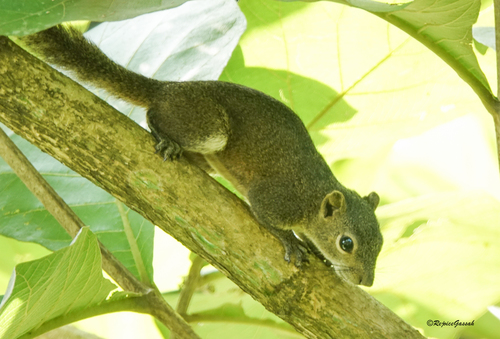
Other species in the genus Callosciurus
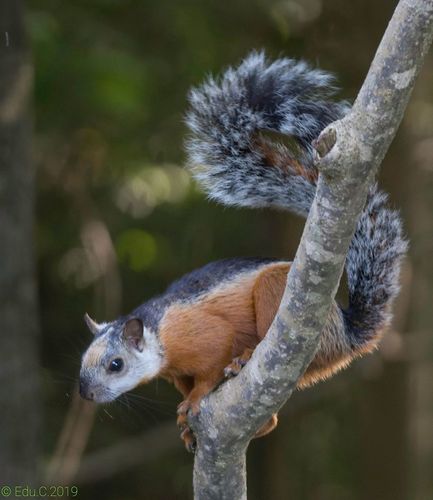
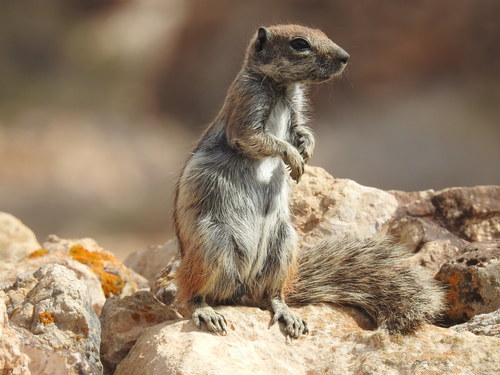
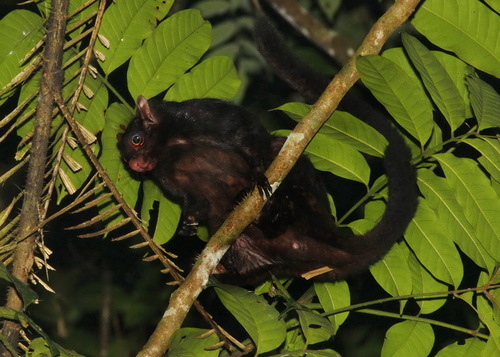
Other species in the family Sciuridae
Sources
Conservation status, range description and population estimate come from the IUCN Red List assessment for Callosciurus quinquestriatus. Countries are derived from that range description, not from a mapped country list. Last refreshed on .
The distribution map is drawn from the IUCN Red List spatial data compiled in 2008. IUCN (International Union for Conservation of Nature)