
Asian Golden Cat
Catopuma temminckii
Red List assessment
Vulnerableon the IUCN Red List
- EXExtinct
- EWExtinct in the Wild
- CRCritically Endangered
- ENEndangered
- VUVulnerable
- NTNear Threatened
- LCLeast Concern
The Asian Golden Cat is recorded in 10 countries across Asia. The IUCN Red List assesses the Asian Golden Cat as Vulnerable. The global population is estimated to be fewer than 10,000 mature individuals, with numbers continuing to decline across most of its range.
- Family
- Felidae
- Order
- Carnivora
- Genus
- Catopuma
- Countries recorded
- 10
- Continents
- Asia
- Red List category
- Vulnerable
- Data updated
- August 9, 2026
What is the Asian Golden Cat?
The Asian Golden Cat is a medium-sized wild cat native to the forests of South and Southeast Asia, notable for its striking coat color variation and elusive nature. It is closely related to the Bornean Bay Cat and African Golden Cat, though not genetically identical despite similar names. This solitary predator plays an important role as a mid-sized carnivore in its forest ecosystem. It remains one of the least studied wild cats due to its secretive, forest-dwelling habits.
Where does the Asian Golden Cat live?
Southeast Asia and parts of South Asia, including Nepal, India, China, Myanmar, Thailand, Malaysia, Sumatra, and Indochina
Ranges from Nepal and northeastern India through Myanmar, southern China, Thailand, Laos, Cambodia, Vietnam, Peninsular Malaysia, and the island of Sumatra in Indonesia.
Altitude and depth
Found from lowlands up to approximately 3,000 meters elevation, with most populations concentrated in lower to mid-elevation forests.
Habitat of the Asian Golden Cat
Primarily found in tropical and subtropical moist broadleaf forests, but also inhabits dry deciduous forests, subtropical evergreen forests, and occasionally rocky or scrubby areas near forest edges.
Adaptations to its environment
Its variable coat coloration (ranging from golden-brown to gray, melanistic, and spotted morphs) provides camouflage across diverse forest habitats. It has strong limbs and sharp retractable claws suited for climbing trees and stalking prey on the forest floor.
Conservation status and numbers
Classified as Vulnerable (VU) by the IUCN due to an estimated population decline of at least 30% over the past three generations, driven primarily by habitat loss and poaching pressure.
Estimated population
The global population is estimated to be fewer than 10,000 mature individuals, with numbers continuing to decline across most of its range.
What threatens the Asian Golden Cat?
Major threats include deforestation and habitat fragmentation from logging and agriculture, poaching for fur and body parts used in traditional medicine, and retaliatory killing due to livestock predation.
Diseases and parasites
Limited data exists, but like other wild felids it is susceptible to parasites such as ticks and intestinal worms, as well as feline diseases like feline leukemia virus.
What is being done to protect it?
The species is listed on CITES Appendix I, protected under national laws in most range countries, and found within numerous protected areas such as national parks and wildlife sanctuaries in Thailand, Malaysia, and Sumatra.
Recommended actions
Priority actions include strengthening anti-poaching enforcement, preserving and connecting forest habitats, conducting more field research to understand population status, and promoting community-based conservation to reduce human-wildlife conflict.
What the Asian Golden Cat looks like
Coat coloration varies widely from golden-brown, cinnamon, and gray to melanistic (black) or spotted forms, sometimes within the same population. The face often features distinctive white and black facial markings including stripes running from the eyes toward the ears.
Size
Body length ranges from about 66 to 105 cm, with a tail length of 40 to 57 cm; shoulder height is roughly 56 cm.
Weight
Weighs between 9 and 16 kg, with males generally larger and heavier than females.
Distinctive features
Distinguished from other small Asian cats by its larger size, uniform or variably patterned coat, and specific facial markings; it lacks the ocelli (eye-spots) on the ears seen in some other felids.
Differences between males and females
Males are typically larger and heavier than females, though coat coloration does not differ significantly between sexes.
Behaviour and diet of the Asian Golden Cat
Generally solitary and territorial, coming together only briefly for mating; home ranges of males often overlap with multiple females.
When it is active
Primarily nocturnal and crepuscular, though some daytime activity has been recorded, particularly in areas with low human disturbance.
Diet
Carnivorous, preying on small to medium-sized mammals such as rodents, hares, and small deer, as well as birds, lizards, and occasionally domestic poultry.
How it feeds and hunts
Hunts using stealth and ambush tactics, stalking prey on the ground and occasionally climbing trees to pursue birds or escape threats.
Communication
Communicates through vocalizations such as hisses, growls, and purring, as well as scent marking via urine spraying and scratching to establish territory.
Interactions with other species
Competes with other mid-sized carnivores like leopard cats and civets for prey and territory; larger predators such as tigers and leopards may pose occasional threats.
Role in its ecosystem
Functions as a mesopredator in its forest ecosystem, helping regulate populations of small to medium mammals and birds.
Reproduction and lifecycle
Breeding can occur year-round, with gestation lasting approximately 78-80 days; litters typically consist of 1-3 kittens.
Raising the young
Females raise the kittens alone, nursing and caring for them in a den until they are old enough to accompany her; independence is reached at around 18 months.
Maturity and lifespan
Reaches sexual maturity at around 18-24 months; lifespan in the wild is estimated at 12-15 years, while captive individuals have lived up to 20 years.
Taxonomy and naming of the Asian Golden Cat
Classification
Class Mammalia > Order Carnivora > Family Felidae > Genus Catopuma > Species Catopuma temminckii
Subspecies
Several subspecies proposed including C. t. temminckii (mainland Southeast Asia), C. t. moormensis (Himalayas, Nepal to Myanmar), and C. t. dominicanorum (Sumatra), though taxonomy remains debated.
Scientific synonyms
Felis temminckii, Profelis temminckii
What research says
Recent studies
Recent camera-trap studies have provided new insights into its distribution, activity patterns, and coat color variation across different habitats in Southeast Asia.
Genome and DNA
Has a diploid chromosome number of 2n=36, similar to other members of the Felidae family; genetic studies have helped clarify its relationship to other small cat species.
Compared with similar species
Similar in appearance to the African Golden Cat (Caracal aurata) but not closely related; more closely allied with the Bornean Bay Cat (Catopuma badia), sharing similar body structure and genus classification.
The Asian Golden Cat and people
The Asian Golden Cat displays one of the widest ranges of coat color variation among wild cats, from solid gold to spotted or nearly black. In parts of its range, it is called the 'fire cat' due to local legends about its protective powers against tigers.
Where and how to see it
Best observed in protected forest reserves such as Khao Yai National Park in Thailand or Kerinci Seblat National Park in Sumatra, ideally at dawn or dusk using camera traps due to its elusive nature.
Risks to humans
No notable risk to humans; it is a shy species that avoids human contact and rarely poses any threat.
Human uses
Historically hunted for its fur and for use in traditional medicine in parts of Asia; also occasionally kept illegally in the exotic pet trade.
Myths and legends
In some Southeast Asian cultures, particularly among the Karen and other indigenous groups, it is believed that carrying a whisker or fur of the Asian Golden Cat can ward off tigers and evil spirits.
Countries where the Asian Golden Cat is recorded
The 10 countries named in the range description of its IUCN Red List assessment.
Questions about the Asian Golden Cat
Where does the Asian Golden Cat live?
The Asian Golden Cat is recorded in Cambodia, China, India, Indonesia and Laos, among 10 countries in total across Asia. These countries come from the range description of its IUCN Red List assessment, and they are what place the species on the interactive map.
Is the Asian Golden Cat endangered?
Yes. The IUCN Red List assesses the Asian Golden Cat as Vulnerable, one of the three threatened categories. The species faces a high risk of extinction in the wild. It is the first of the three threatened categories: numbers are falling, the range is shrinking, or the population is small enough that a single bad event could do lasting damage.
How many are left in the wild?
The global population is estimated to be fewer than 10,000 mature individuals, with numbers continuing to decline across most of its range. This figure comes from the species assessment on the IUCN Red List; population estimates for wild mammals are ranges, not counts, and are revised at each assessment.
What habitat does the Asian Golden Cat live in?
Primarily found in tropical and subtropical moist broadleaf forests, but also inhabits dry deciduous forests, subtropical evergreen forests, and occasionally rocky or scrubby areas near forest edges.
What is the scientific name of the Asian Golden Cat?
The Asian Golden Cat is Catopuma temminckii, in the family Felidae, order Carnivora.
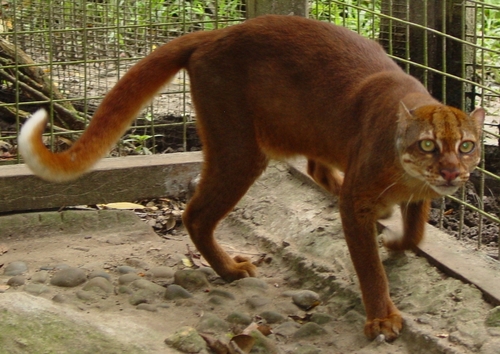
Other species in the genus Catopuma
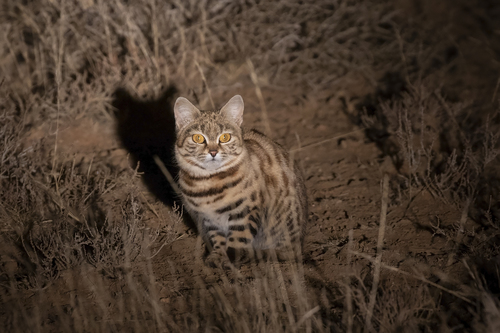
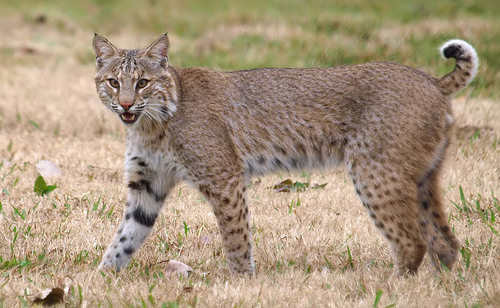
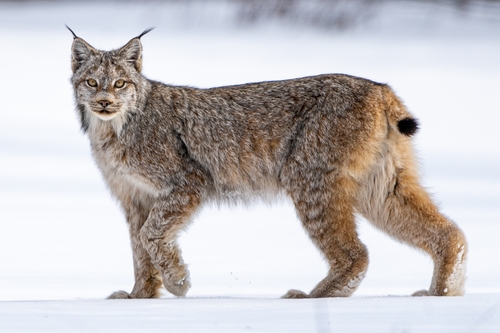
Other species in the family Felidae
Species that share its range
Sources
Conservation status, range description and population estimate come from the IUCN Red List assessment for Catopuma temminckii. Countries are derived from that range description, not from a mapped country list. Last refreshed on .
The distribution map is drawn from the IUCN Red List spatial data compiled in 2024. IUCN (International Union for Conservation of Nature)