
Chinese Pangolin
Manis pentadactyla
Red List assessment
Critically Endangeredon the IUCN Red List
- EXExtinct
- EWExtinct in the Wild
- CRCritically Endangered
- ENEndangered
- VUVulnerable
- NTNear Threatened
- LCLeast Concern
The Chinese Pangolin is recorded in 9 countries across Asia. The IUCN Red List assesses the Chinese Pangolin as Critically Endangered. Exact population numbers are unknown but are believed to number in the tens of thousands or fewer, with a continuing sharp declining trend across its range.
- Family
- Manidae
- Order
- Pholidota
- Genus
- Manis
- Countries recorded
- 9
- Continents
- Asia
- Red List category
- Critically Endangered
- Data updated
- August 9, 2026
What is the Chinese Pangolin?
The Chinese Pangolin is a small, scaly, nocturnal mammal covered in overlapping keratin scales, native to South and Southeast Asia. It is one of the most heavily trafficked mammals in the world due to demand for its scales and meat. This species plays an important ecological role as a natural pest controller, feeding almost exclusively on ants and termites. It is currently facing an extremely high risk of extinction in the wild.
Where does the Chinese Pangolin live?
Southern China, Taiwan, Northern India, Nepal, Bhutan, Bangladesh, Myanmar, and northern Vietnam/Laos
Found across southern China (including Yunnan, Guangxi, Guangdong), Taiwan, Hainan, northeastern India, Nepal, Bhutan, Bangladesh, northern Myanmar, and northern parts of Vietnam and Laos.
Altitude and depth
Occurs from lowlands up to approximately 2000-3000 meters elevation, with populations recorded at higher altitudes in Himalayan foothills.
Seasonal movements
No true migration or hibernation; however, activity patterns may shift seasonally with temperature, becoming more diurnal in cooler months in some regions.
Habitat of the Chinese Pangolin
Inhabits tropical and subtropical forests, grasslands, limestone karst areas, and agricultural land, often near forest edges. It prefers areas with loose soil suitable for burrowing and abundant ant/termite colonies.
Adaptations to its environment
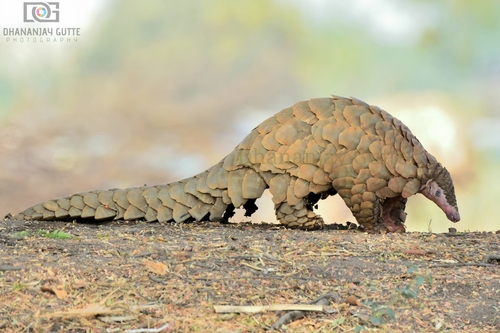
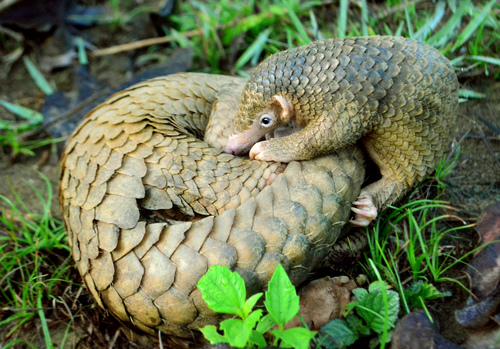
Possesses powerful claws for digging burrows and breaking into termite mounds, a long sticky tongue for capturing insects, and overlapping keratin scales for protection against predators. It can curl into a tight ball (conglobation) as a defense mechanism, and has poor eyesight compensated by an acute sense of smell.
Conservation status and numbers
Listed as Critically Endangered (CR) by the IUCN due to a population decline estimated at more than 90% over the past three generations, primarily driven by poaching and illegal trade for scales and meat.
Estimated population
Exact population numbers are unknown but are believed to number in the tens of thousands or fewer, with a continuing sharp declining trend across its range.
What threatens the Chinese Pangolin?
Primary threats include illegal wildlife trade for traditional medicine and meat consumption, habitat loss from deforestation and agricultural expansion, and low reproductive rates that hinder population recovery.
Diseases and parasites
Susceptible to various endoparasites and ectoparasites including ticks and mites; captive individuals often suffer from gastrointestinal issues and stress-related illnesses due to difficulty replicating natural diet and conditions.
What is being done to protect it?
Protected under CITES Appendix I (all international commercial trade banned), listed on national protected species lists in China, India, and other range countries, and subject to various rescue, rehabilitation, and captive breeding programs. Conservation NGOs conduct anti-poaching patrols and community education initiatives.
Recommended actions
Priority actions include strengthening law enforcement against poaching and trafficking, expanding protected habitat, conducting population surveys, raising public awareness to reduce demand for pangolin products, and improving captive breeding and rehabilitation success rates.
What the Chinese Pangolin looks like
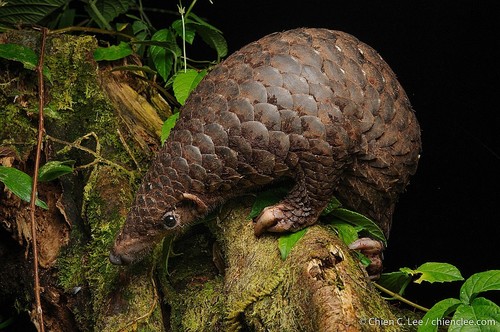
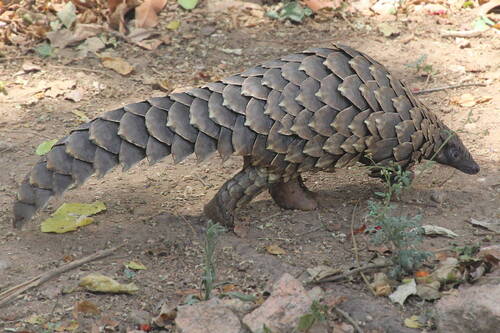
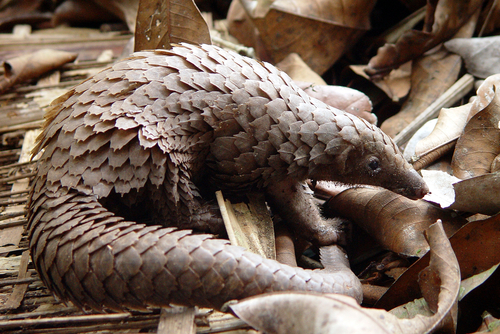
Covered in overlapping brownish-grey to yellowish-brown keratin scales that cover the entire dorsal side, head, tail, and outer limbs, while the underside is sparsely furred and pale. It has a small conical head with no teeth, a long sticky tongue, and short powerful limbs with strong claws.
Size
Body length (head and body) ranges from 40-58 cm, with tail length of 25-38 cm, giving a total length of approximately 65-96 cm.
Weight
Adults typically weigh between 2 and 7 kg, with males generally slightly larger than females.
Distinctive features
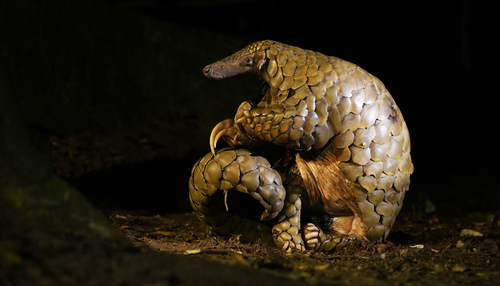
Distinguished from other pangolin species by its shorter tail (relative to Sunda or Indian pangolins), smaller ear pinnae, and specific scale patterns and coloration. It has five claws on each foot, giving rise to the species name pentadactyla.
Differences between males and females
Minimal sexual dimorphism; males are typically slightly larger and heavier than females, but external differences are otherwise subtle.
Behaviour and diet of the Chinese Pangolin
Solitary and largely asocial, individuals only come together briefly for mating. They maintain and defend individual burrow systems.
When it is active
Primarily nocturnal, though some individuals may show crepuscular or even diurnal activity in cooler climates or less disturbed areas.
Diet
Insectivorous, feeding almost exclusively on ants and termites, using its long sticky tongue to extract prey from nests, mounds, and tree bark.
How it feeds and hunts
Uses powerful foreclaws to break open ant and termite nests, then extends its long, mucus-coated tongue (which can be longer than its body) to lap up insects; it has no teeth and relies on a muscular, keratinized stomach lining to grind food.
Communication
Communicates primarily through scent marking using anal gland secretions and urine to mark territory and signal reproductive status; vocalizations are limited, mostly consisting of hisses or puffing sounds when threatened.
Interactions with other species
Natural predators include large carnivores such as tigers and leopards, though its primary defense (curling into an armored ball) deters most predators. It has few direct competitors due to its specialized myrmecophagous diet.
Role in its ecosystem
Plays a crucial ecological role as a natural regulator of ant and termite populations, helping maintain soil health and forest ecosystem balance through its burrowing and foraging activities.
Reproduction and lifecycle
Breeding can occur year-round in some regions but often peaks in autumn; gestation lasts approximately 130-140 days, typically resulting in a single offspring, rarely twins.
Raising the young
Females provide sole parental care, nursing the young in a burrow for several months. The juvenile often rides on the mother's tail during early development and remains dependent for 3-4 months before gradually becoming independent.
Maturity and lifespan
Reaches sexual maturity around 2 years of age; lifespan in the wild is estimated at 10-15 years, though captive individuals rarely survive long due to stress and dietary challenges.
Taxonomy and naming of the Chinese Pangolin
Classification
Class Mammalia > Order Pholidota > Family Manidae > Genus Manis > Species Manis pentadactyla
Subspecies
Three subspecies are sometimes recognized: M. p. pentadactyla (mainland China, northern Southeast Asia), M. p. aurita (northeastern India), and M. p. pusilla (Taiwan/Hainan), though taxonomic validity is debated.
Scientific synonyms
Manis dalmanni, Manis brachyura, Manis auritus
What research says
Recent studies
Recent research has focused on genomic sequencing for forensic wildlife trade identification, disease surveillance (including coronavirus research following pangolins' proposed role in SARS-CoV-2 origins), and improved captive breeding protocols.
Genome and DNA
The Chinese Pangolin has a diploid chromosome number of 2n=38; genomic studies have been conducted primarily to aid forensic identification in anti-trafficking efforts and to study its unique immune system adaptations.
Compared with similar species
Compared to the Sunda Pangolin (Manis javanica), the Chinese Pangolin has a shorter tail and smaller body size; it is closely related to the Indian Pangolin (Manis crassicaudata) but distinguished by scale morphology and geographic range.
The Chinese Pangolin and people
Pangolins are the only mammals entirely covered in scales made of keratin, the same protein found in human hair and nails. When threatened, they can curl into an almost impenetrable ball, and their name derives from the Malay word 'pengguling,' meaning 'one who rolls up.'
Where and how to see it
Extremely difficult to observe due to its nocturnal, solitary, and secretive nature combined with critically low population numbers; best chances are through guided night surveys in protected forest reserves in Nepal or northeastern India with experienced local trackers.
Risks to humans
No notable risk to humans; pangolins are non-aggressive and pose no direct threat, though handling wild individuals is discouraged due to potential zoonotic disease transmission.
Human uses
Heavily exploited for traditional medicine (scales believed to treat various ailments despite no scientific basis), consumed as a luxury meat in parts of Asia, and illegally traded internationally, making it one of the most trafficked mammals globally.
Myths and legends
In traditional Chinese medicine, pangolin scales are believed (without scientific evidence) to have healing properties for various ailments, contributing significantly to poaching pressure; in some cultures, pangolins are considered mystical creatures bridging the animal and reptile worlds due to their unique scaled appearance.
Countries where the Chinese Pangolin is recorded
The 9 countries named in the range description of its IUCN Red List assessment.
Questions about the Chinese Pangolin
Where does the Chinese Pangolin live?
The Chinese Pangolin is recorded in Bangladesh, Bhutan, China, India and Laos, among 9 countries in total across Asia. These countries come from the range description of its IUCN Red List assessment, and they are what place the species on the interactive map.
Is the Chinese Pangolin endangered?
Yes. The IUCN Red List assesses the Chinese Pangolin as Critically Endangered, one of the three threatened categories. The species faces an extremely high risk of extinction in the wild. This is the last category before extinction, and it is reached through a very small or steeply declining population, a tiny range, or both.
How many are left in the wild?
Exact population numbers are unknown but are believed to number in the tens of thousands or fewer, with a continuing sharp declining trend across its range. This figure comes from the species assessment on the IUCN Red List; population estimates for wild mammals are ranges, not counts, and are revised at each assessment.
What habitat does the Chinese Pangolin live in?
Inhabits tropical and subtropical forests, grasslands, limestone karst areas, and agricultural land, often near forest edges.
What is the scientific name of the Chinese Pangolin?
The Chinese Pangolin is Manis pentadactyla, in the family Manidae, order Pholidota.
Other species in the genus Manis
Other species in the family Manidae
Species that share its range
Sources
Conservation status, range description and population estimate come from the IUCN Red List assessment for Manis pentadactyla. Countries are derived from that range description, not from a mapped country list. Last refreshed on .
The distribution map is drawn from the IUCN Red List spatial data compiled in 2019. IUCN SSC Pangolin Specialist Group