
Indian Pangolin
Manis crassicaudata
Red List assessment
Endangeredon the IUCN Red List
- EXExtinct
- EWExtinct in the Wild
- CRCritically Endangered
- ENEndangered
- VUVulnerable
- NTNear Threatened
- LCLeast Concern
The Indian Pangolin is recorded in 5 countries across Asia. The IUCN Red List assesses the Indian Pangolin as Endangered. Exact population numbers are unknown due to the species' elusive and nocturnal nature, but populations are considered to be declining rapidly across its range, with local extinctions reported in several areas of India and Sri Lanka.
- Family
- Manidae
- Order
- Pholidota
- Genus
- Manis
- Countries recorded
- 5
- Continents
- Asia
- Red List category
- Endangered
- Data updated
- August 9, 2026
What is the Indian Pangolin?
The Indian Pangolin is a large, solitary, nocturnal mammal covered in overlapping keratin scales, native to the Indian subcontinent. It is remarkable for being one of the few mammals with a full armor of scales, which it uses defensively by curling into a tight ball. This species is a specialized insectivore feeding primarily on ants and termites, playing a crucial role in controlling insect populations. It is critically threatened by poaching for its scales and meat, making it one of the most trafficked mammals in the world.
Where does the Indian Pangolin live?
Indian subcontinent, including India, Sri Lanka, Bangladesh, Pakistan, and parts of Nepal
Widely distributed across the Indian subcontinent, including most of India (except the northeast), Sri Lanka, Bangladesh, and parts of Pakistan. Historically also reported in Nepal, though its presence there is now uncertain. Absent from the Himalayan region and northeastern India where it is replaced by the Chinese pangolin.
Altitude and depth
Typically found from sea level up to about 2,500 meters elevation, though most populations occur in lowland and hilly regions below 1,500 meters
Seasonal movements
No significant seasonal migration; however, breeding activity may show slight seasonal peaks, and burrow use may increase during extreme temperatures or monsoon season
Habitat of the Indian Pangolin
Inhabits a wide range of habitats including tropical and subtropical forests, grasslands, scrublands, and agricultural areas. It prefers areas with soft soil suitable for burrowing and abundant termite or ant colonies. Found in both plains and hilly terrain up to moderate elevations.
Adaptations to its environment
Possesses powerful claws for digging burrows and breaking into termite mounds, a long sticky tongue for extracting insects, and specialized scales made of keratin for protection against predators. Its ability to curl into a ball and its strong sense of smell (compensating for poor eyesight) are key adaptations for survival in diverse habitats.
Conservation status and numbers
Endangered (EN) according to IUCN Red List, with population declines estimated at over 50% over the past three generations primarily due to intense poaching pressure for illegal wildlife trade. Listed on CITES Appendix I, banning all international commercial trade.
Estimated population
Exact population numbers are unknown due to the species' elusive and nocturnal nature, but populations are considered to be declining rapidly across its range, with local extinctions reported in several areas of India and Sri Lanka.
What threatens the Indian Pangolin?
Primary threats include poaching for scales (used in traditional medicine, especially in China and Vietnam) and meat (considered a delicacy), habitat loss due to agricultural expansion and deforestation, and illegal international wildlife trafficking networks.
Diseases and parasites
Known to host various ectoparasites such as ticks and mites, as well as endoparasites including nematodes; captive individuals often suffer from stress-related illnesses and digestive issues due to improper diet in captivity.
What is being done to protect it?
Protected under CITES Appendix I and national wildlife protection laws in India (Wildlife Protection Act, Schedule I), Sri Lanka, and Bangladesh. Conservation programs include anti-poaching patrols, community awareness campaigns, rescue and rehabilitation centers, and international collaboration to combat trafficking networks.
Recommended actions
Priority actions include strengthening anti-poaching law enforcement, increasing public awareness to reduce demand for pangolin products, expanding protected habitat areas, supporting rescue and release programs, and conducting more research to better understand population status and ecology.
What the Indian Pangolin looks like
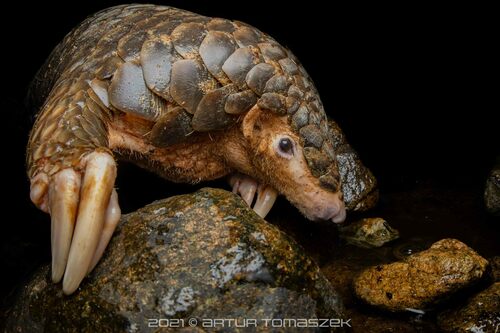
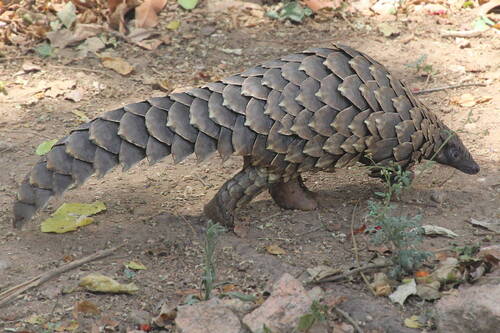
The body is covered in large, overlapping brownish scales made of keratin, covering the back, tail, and outer limbs, while the underside is covered in sparse fur. The head is small and conical with no teeth, and the animal has a long, sticky tongue used for feeding. Strong, curved claws on the forelimbs are adapted for digging.
Size
Body length ranges from 60 to 100 cm including the tail, with the tail alone measuring 33 to 47 cm; total length can reach up to 1.5 meters in large individuals
Weight
Adults typically weigh between 10 and 16 kg, with some large males reaching up to 21 kg; females are generally slightly smaller than males
Distinctive features
Distinguished from other pangolin species by its larger size, thicker tail, and the number and arrangement of scales; it has fewer but larger scales compared to the Chinese pangolin. The Indian Pangolin also has a distinctly rounded, less pointed head shape.
Differences between males and females
Minimal sexual dimorphism; males are generally slightly larger and heavier than females, but there are no notable differences in coloration or scale patterns
Behaviour and diet of the Indian Pangolin
Solitary and largely asocial, coming together only briefly during the breeding season. Individuals maintain and defend territories using scent marking from specialized glands.
When it is active
Primarily nocturnal, spending daylight hours resting in burrows and emerging at night to forage for food. Highly secretive and rarely observed in the wild.
Diet
Strict insectivore, feeding almost exclusively on ants and termites, which it locates using its keen sense of smell and extracts using its long, sticky tongue that can extend up to 40 cm.
How it feeds and hunts
Uses powerful foreclaws to break open termite mounds and ant nests, then employs its long, sticky tongue to lap up insects. It may consume thousands of ants or termites in a single feeding session and can close its ears and nostrils to protect against insect bites during foraging.
Communication
Communicates primarily through scent marking using secretions from anal glands, along with limited vocalizations such as hisses or grunts when threatened. Body language, including curling into a ball, serves as a primary defense communication signal.
Interactions with other species
Natural predators include tigers, leopards, and pythons, though its scaled armor provides significant protection against most threats. It has limited direct competition with other species due to its specialized diet of ants and termites.
Role in its ecosystem
Plays an important ecological role as a natural pest controller, regulating populations of ants and termites, which helps maintain soil health and prevent damage to vegetation and structures. Its digging activity also aerates soil, promoting nutrient cycling.
Reproduction and lifecycle
Breeding can occur year-round with a possible peak between winter months; gestation lasts approximately 65-70 days, resulting in a single offspring per litter, occasionally twins.
Raising the young
The mother provides sole parental care, nursing the young in the burrow for the first few weeks. The young pangolin may ride on the mother's tail base during early foraging trips, learning survival skills before becoming independent at around 3-4 months of age.
Maturity and lifespan
Reaches sexual maturity at around 2 years of age; lifespan in the wild is estimated at 8-10 years, while captive individuals have been recorded to live up to 19 years, though captivity often proves stressful for this species.
Taxonomy and naming of the Indian Pangolin
Classification
Class Mammalia > Order Pholidota > Family Manidae > Genus Manis > Species Manis crassicaudata
Scientific synonyms
Manis crassicaudata has been historically referred to under Manis pentadactyla crassicaudata in older taxonomic treatments before being recognized as a distinct species
What research says
Recent studies
Recent studies have focused on using genetic forensics to trace trafficked pangolin scales back to their geographic origin, helping law enforcement combat illegal trade networks. Other research has examined captive breeding challenges and disease susceptibility in rescued individuals.
Genome and DNA
The Indian Pangolin has a diploid chromosome number of 2n=36; genetic studies have been used primarily to distinguish it from other pangolin species and to trace illegal trade routes through DNA forensics.
Compared with similar species
Similar to the Chinese Pangolin (Manis pentadactyla) but larger in size with a thicker tail and fewer, larger scales. It differs from African pangolin species by its more terrestrial and burrowing lifestyle rather than arboreal tendencies.
The Indian Pangolin and people
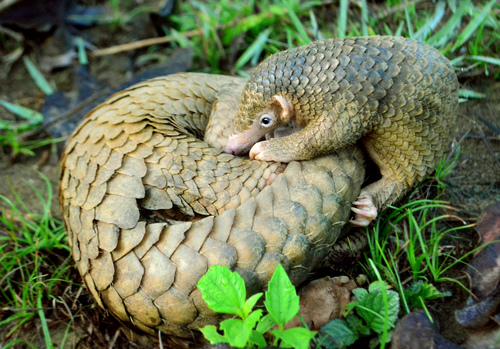
Pangolins are the only mammals entirely covered in scales, and when threatened, they can curl into a near-impenetrable ball. Despite their tough appearance, they are gentle, toothless animals that rely entirely on their tongue to eat, which can be longer than their own body when fully extended internally.
Where and how to see it
Due to its nocturnal and elusive nature, sightings in the wild are extremely rare; best chances of observation are in protected reserves in India and Sri Lanka during nighttime safaris with experienced guides. Camera traps are often the most reliable method used by researchers to document its presence.
Risks to humans
No notable risk to humans; the species is non-aggressive and poses no threat unless directly handled, in which case it may curl defensively rather than attack.
Human uses
Heavily exploited for its scales, which are used in traditional medicine (particularly in China and Vietnam) despite lacking proven medicinal value, and for its meat, considered a delicacy in some regions. This exploitation has made it one of the most illegally trafficked mammals in the world.
Myths and legends
In some traditional cultures, pangolin scales are believed to have medicinal properties, including the ability to cure ailments ranging from asthma to cancer, despite no scientific evidence supporting these claims. This belief has significantly fueled illegal poaching and trade.
Countries where the Indian Pangolin is recorded
The 5 countries named in the range description of its IUCN Red List assessment.
Questions about the Indian Pangolin
Where does the Indian Pangolin live?
The Indian Pangolin is recorded in Bangladesh, India, Nepal, Pakistan and Sri Lanka across Asia. These countries come from the range description of its IUCN Red List assessment, and they are what place the species on the interactive map.
Is the Indian Pangolin endangered?
Yes. The IUCN Red List assesses the Indian Pangolin as Endangered, one of the three threatened categories. The species faces a very high risk of extinction in the wild — a step below Critically Endangered, but still on a trajectory that ends badly without intervention.
How many are left in the wild?
Exact population numbers are unknown due to the species' elusive and nocturnal nature, but populations are considered to be declining rapidly across its range, with local extinctions reported in several areas of India and Sri Lanka. This figure comes from the species assessment on the IUCN Red List; population estimates for wild mammals are ranges, not counts, and are revised at each assessment.
What habitat does the Indian Pangolin live in?
Inhabits a wide range of habitats including tropical and subtropical forests, grasslands, scrublands, and agricultural areas.
What is the scientific name of the Indian Pangolin?
The Indian Pangolin is Manis crassicaudata, in the family Manidae, order Pholidota.
Other species in the genus Manis
Other species in the family Manidae
Species that share its range
Sources
Conservation status, range description and population estimate come from the IUCN Red List assessment for Manis crassicaudata. Countries are derived from that range description, not from a mapped country list. Last refreshed on .
The distribution map is drawn from the IUCN Red List spatial data compiled in 2019. IUCN SSC Pangolin Specialist Group