
Giant Ground Pangolin
Smutsia gigantea
Red List assessment
Endangeredon the IUCN Red List
- EXExtinct
- EWExtinct in the Wild
- CRCritically Endangered
- ENEndangered
- VUVulnerable
- NTNear Threatened
- LCLeast Concern
The Giant Ground Pangolin is recorded in 8 countries across Africa. The IUCN Red List assesses the Giant Ground Pangolin as Endangered. Exact population figures are unknown due to its elusive nature, but populations are declining rapidly across its range.
- Family
- Manidae
- Order
- Pholidota
- Genus
- Smutsia
- Countries recorded
- 8
- Continents
- Africa
- Red List category
- Endangered
- Data updated
- August 9, 2026
What is the Giant Ground Pangolin?
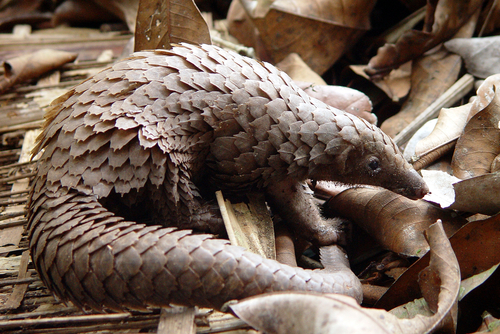
The Giant Ground Pangolin is the largest of all pangolin species, a solitary and elusive mammal covered in overlapping keratin scales. It inhabits the dense tropical forests of Central and West Africa, where it forages for ants and termites using its long sticky tongue. This remarkable creature is one of the most heavily trafficked mammals in the world due to demand for its scales and meat.
Where does the Giant Ground Pangolin live?
Central and West Africa, primarily in the Congo Basin countries
Found across the Congo Basin including Democratic Republic of Congo, Republic of Congo, Cameroon, Central African Republic, Gabon, and parts of West Africa including Nigeria, Ghana, Liberia, and Sierra Leone. Range is fragmented due to habitat loss and hunting pressure.
Altitude and depth
0-1500m above sea level, primarily found in lowland areas
Habitat of the Giant Ground Pangolin
Primarily found in lowland tropical rainforests, gallery forests, and forest-savanna mosaics. Prefers areas near water sources with abundant termite and ant populations. Also found in secondary forests and forest edges adjacent to agricultural land.
Adaptations to its environment
Possesses large, overlapping keratin scales for protection against predators, capable of rolling into a tight ball when threatened. Strong forelimbs and claws are adapted for digging into termite mounds and ant nests. A long, sticky, muscular tongue (longer than its body when fully extended) allows efficient extraction of insects from deep tunnels.
Conservation status and numbers
Endangered (EN) according to IUCN Red List, with population declines exceeding 50% over the past three generations (approximately 21 years) due to intense poaching pressure for illegal wildlife trade. Listed on CITES Appendix I, banning all international commercial trade.
Estimated population
Exact population figures are unknown due to its elusive nature, but populations are declining rapidly across its range. Estimated to have experienced significant declines in areas with high hunting pressure and habitat fragmentation.
What threatens the Giant Ground Pangolin?
Primary threats include illegal hunting and poaching for the international scale trade (used in traditional medicine) and bushmeat consumption. Habitat destruction from logging, agricultural expansion, and mining also significantly impacts populations across its range.
Diseases and parasites
Susceptible to various parasites including ticks and internal parasites; specific disease research is limited due to the species' elusive nature and conservation status.
What is being done to protect it?
Protected under CITES Appendix I since 2016, banning international commercial trade. Various national parks and protected areas within its range provide some habitat protection, and conservation organizations are conducting research and anti-poaching efforts in key range countries.
Recommended actions
Strengthening anti-poaching enforcement and reducing illegal wildlife trade networks, particularly targeting international trafficking routes. Habitat protection and connectivity restoration are critical, along with community education programs and alternative livelihood support to reduce hunting pressure.
What the Giant Ground Pangolin looks like
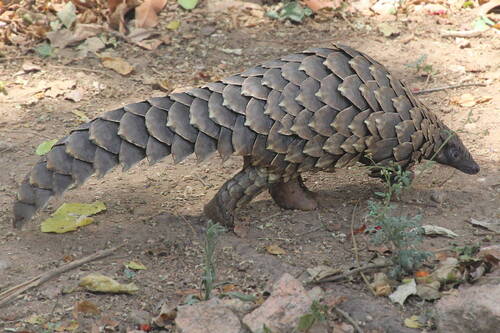
Covered in large, overlapping brownish-grey to olive-brown keratin scales covering the entire body except for the underside, face, and inner limbs. The underside is covered in coarse hair, and the animal has small eyes, a elongated snout, and no teeth.
Size
Body length ranges from 125-140 cm including tail, with the tail alone measuring approximately 50-65 cm
Weight
Adults typically weigh between 30-40 kg, making it the largest pangolin species; males may be slightly larger than females
Distinctive features
Distinguished from other pangolin species by its significantly larger size and more robust build. Its scales are notably larger and thicker than those of other African pangolin species, and it has a more elongated snout adapted for its specialized diet.
Differences between males and females
Minimal sexual dimorphism, though males may be marginally larger and heavier than females on average
Behaviour and diet of the Giant Ground Pangolin
Solitary animal that only comes together with conspecifics for mating purposes. Maintains and defends individual territories through scent marking, avoiding direct contact with other pangolins outside of breeding season.
When it is active
Primarily nocturnal, spending daylight hours resting in burrows or hollow logs. Emerges at night to forage for food, using keen sense of smell to locate ant and termite colonies.
Diet
Strict myrmecophage (ant and termite specialist), consuming large quantities of these insects daily. May consume up to 200,000 insects per year, showing preference for certain termite and ant species found in forest habitats.
How it feeds and hunts
Uses powerful claws to break open termite mounds and ant nests, then extends its extremely long, sticky tongue deep into tunnels to extract insects. Lacks teeth, so relies on a muscular stomach with ingested stones to grind food.
Communication
Communicates primarily through scent marking using secretions from specialized glands to mark territory and signal reproductive status. Limited vocalizations are used, with body language and scent playing the dominant role in communication.
Interactions with other species
Natural predators include large carnivores such as leopards and large snakes, though the pangolin's scaled armor and ability to curl into a ball provide significant defense. Humans represent the greatest threat through hunting and habitat destruction rather than natural predation.
Role in its ecosystem
Plays an important ecological role as a natural pest control agent, regulating ant and termite populations within forest ecosystems. Its digging activities also contribute to soil aeration and nutrient cycling in its habitat.
Reproduction and lifecycle
Breeding can occur year-round with no strict seasonal pattern observed. Gestation period is estimated at approximately 140-150 days, with females typically giving birth to a single offspring.
Raising the young
Mother provides sole parental care, nursing and protecting the young in a burrow for the first few months of life. The offspring may ride on the mother's tail during early development and remains dependent for several months before becoming independent.
Maturity and lifespan
Sexual maturity is reached at approximately 2 years of age. Lifespan in the wild is estimated at 15-20 years, though data is limited; captive individuals have survived longer with proper care.
Taxonomy and naming of the Giant Ground Pangolin
Classification
Mammalia > Pholidota > Manidae > Smutsia > Smutsia gigantea
Scientific synonyms
Manis gigantea (former genus classification)
What research says
Recent studies
Recent genetic studies have helped clarify taxonomic relationships within the Manidae family and improved understanding of population structure across fragmented ranges. Camera trap studies have provided new insights into behavior and habitat use in previously understudied areas.
Compared with similar species
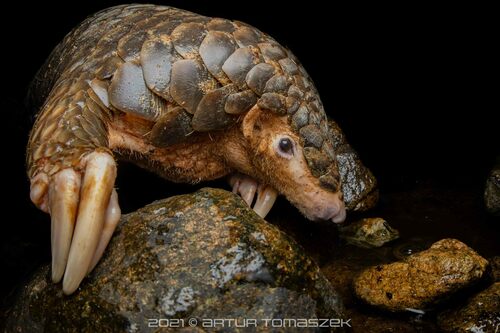
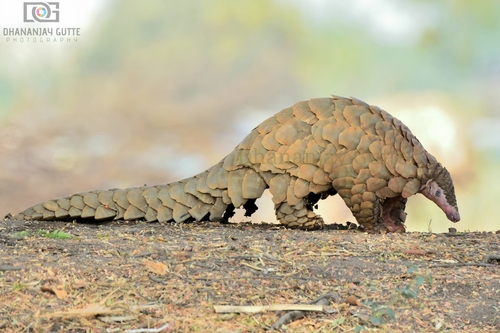
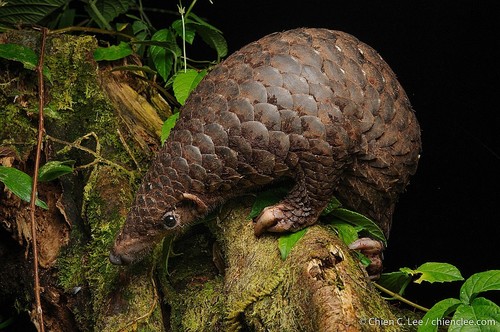
Compared to the smaller white-bellied pangolin (Phataginus tricuspis) and black-bellied pangolin, the Giant Ground Pangolin is significantly larger, terrestrial rather than arboreal, and has a more robust build suited for ground-dwelling life. It is more closely related to other Smutsia species like the Temminck's pangolin found in East and Southern Africa.
The Giant Ground Pangolin and people
The Giant Ground Pangolin's tongue can extend up to 40 cm and is anchored near its pelvis rather than in the throat. Despite its formidable armor, it is one of the most trafficked mammals on Earth, with scales weighing up to 20% of its total body weight.
Where and how to see it
Due to its nocturnal and highly elusive nature, sightings in the wild are extremely rare and difficult to arrange. Protected areas within the Congo Basin, such as certain national parks in Gabon or DRC, offer the best albeit still unlikely chances with experienced local guides and camera trap monitoring.
Risks to humans
No notable risk to humans; the species is entirely non-aggressive and poses no physical threat, relying on its scaled armor for defense rather than attack.
Human uses
Heavily hunted for its scales, which are used in traditional medicine practices particularly in parts of Asia and Africa, despite lack of scientific evidence for medicinal efficacy. Also hunted for bushmeat in local communities, contributing significantly to population declines.
Myths and legends
In various Central African cultures, pangolins are associated with traditional beliefs and are sometimes considered to have mystical or medicinal properties, contributing to demand for their scales in traditional practices. Some local folklore views the animal's unique appearance as having spiritual significance.
Countries where the Giant Ground Pangolin is recorded
The 8 countries named in the range description of its IUCN Red List assessment.
Questions about the Giant Ground Pangolin
Where does the Giant Ground Pangolin live?
The Giant Ground Pangolin is recorded in Cameroon, Central African Republic, Democratic Republic of the Congo, Gabon and Ghana, among 8 countries in total across Africa. These countries come from the range description of its IUCN Red List assessment, and they are what place the species on the interactive map.
Is the Giant Ground Pangolin endangered?
Yes. The IUCN Red List assesses the Giant Ground Pangolin as Endangered, one of the three threatened categories. The species faces a very high risk of extinction in the wild — a step below Critically Endangered, but still on a trajectory that ends badly without intervention.
How many are left in the wild?
Exact population figures are unknown due to its elusive nature, but populations are declining rapidly across its range. This figure comes from the species assessment on the IUCN Red List; population estimates for wild mammals are ranges, not counts, and are revised at each assessment.
What habitat does the Giant Ground Pangolin live in?
Primarily found in lowland tropical rainforests, gallery forests, and forest-savanna mosaics.
What is the scientific name of the Giant Ground Pangolin?
The Giant Ground Pangolin is Smutsia gigantea, in the family Manidae, order Pholidota.
Other species in the genus Smutsia
Other species in the family Manidae
Species that share its range

Sources
Conservation status, range description and population estimate come from the IUCN Red List assessment for Smutsia gigantea. Countries are derived from that range description, not from a mapped country list. Last refreshed on .
The distribution map is drawn from the IUCN Red List spatial data compiled in 2019. IUCN SSC Pangolin Specialist Group