
Temminck's Ground Pangolin
Smutsia temminckii
Red List assessment
Vulnerableon the IUCN Red List
- EXExtinct
- EWExtinct in the Wild
- CRCritically Endangered
- ENEndangered
- VUVulnerable
- NTNear Threatened
- LCLeast Concern
The Temminck's Ground Pangolin is recorded in 11 countries across Africa. The IUCN Red List assesses the Temminck's Ground Pangolin as Vulnerable. Precise figures are unknown due to its elusive nature, but population is considered to be declining significantly across its range, with local extirpations reported in parts of South Africa and Mozambique
- Family
- Manidae
- Order
- Pholidota
- Genus
- Smutsia
- Countries recorded
- 11
- Continents
- Africa
- Red List category
- Vulnerable
- Data updated
- August 9, 2026
What is the Temminck's Ground Pangolin?
Temminck's Ground Pangolin is a solitary, nocturnal, scale-covered mammal found across the savannas and woodlands of southern and eastern Africa. It is the only pangolin species adapted to arid and semi-arid terrestrial habitats rather than forests, using powerful claws to dig for ants and termites. Remarkable for its keratin armor, this species curls into a tight ball when threatened, making it one of the most trafficked mammals in the world.
Where does the Temminck's Ground Pangolin live?
Southern and East Africa, including South Africa, Zimbabwe, Mozambique, Botswana, Namibia, Zambia, Tanzania, and Kenya
Ranges across southern and eastern Africa including South Africa, Zimbabwe, Mozambique, Botswana, Namibia, Zambia, Malawi, Tanzania, Kenya, and parts of Uganda and South Sudan.
Altitude and depth
Sea level up to approximately 1600 meters
Seasonal movements
No true migration or hibernation, but activity and foraging effort shift seasonally with ant/termite availability and temperature, often more nocturnal in hot summer months and more crepuscular in cooler seasons
Habitat of the Temminck's Ground Pangolin
Found in savanna, woodland, grassland, and semi-arid scrub habitats; avoids dense forest and prefers areas with sandy or loamy soils suitable for burrowing and termite/ant abundance.
Adaptations to its environment
Overlapping keratin scales provide armor-like protection, strong forelimb claws enable digging into termite mounds and soil, and a long sticky tongue (extending further than body length via internal attachment near the pelvis) allows efficient insect extraction; low metabolic rate and burrowing behavior help conserve water and regulate temperature in arid habitats.
Conservation status and numbers
Classified as Vulnerable by IUCN due to significant population declines driven primarily by illegal poaching for scales and bushmeat, compounded by habitat loss; population trend is decreasing across its range.
Estimated population
Precise figures are unknown due to its elusive nature, but population is considered to be declining significantly across its range, with local extirpations reported in parts of South Africa and Mozambique
What threatens the Temminck's Ground Pangolin?
Illegal wildlife trade for scales (used in traditional medicine, largely exported to Asia) and bushmeat, electrocution on electrified fences, habitat degradation, and incidental snaring.
Diseases and parasites
Known to host various ectoparasites such as ticks, and can suffer from stress-related illnesses in captivity; specific disease studies remain limited
What is being done to protect it?
Protected under CITES Appendix I (all international commercial trade banned), listed on national protected species lists in most range states, rehabilitation and reintroduction programs exist in South Africa (e.g., African Pangolin Working Group), and some reserves actively monitor and protect populations.
Recommended actions
Strengthen anti-poaching and anti-trafficking enforcement, mitigate electrified fence mortality, expand community-based conservation and education, support rehabilitation/release programs, and increase research on population status and ecology.
What the Temminck's Ground Pangolin looks like
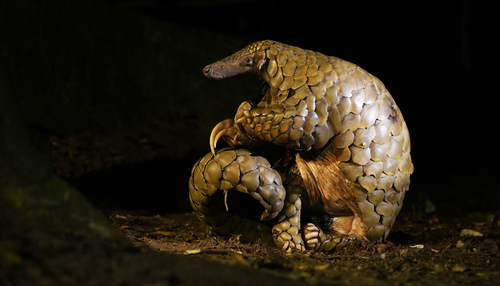
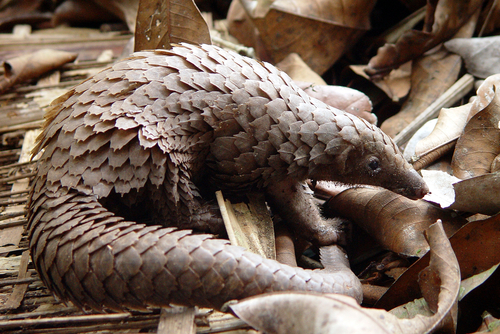
Covered in overlapping brownish to olive-colored keratin scales over the body, with pale, sparsely-haired underside; the head is small and conical, with no teeth, and it has a long, muscular, prehensile tail.
Size
Body length (head-to-tail) typically 70-100 cm, including a tail of about 35-50 cm
Weight
Adults typically weigh between 5 and 18 kg, with males generally slightly larger than females
Distinctive features
Distinguished from other pangolin species by its strictly terrestrial and savanna-adapted lifestyle, larger and thicker claws for digging in harder soils, and geographic range restricted to southern/eastern Africa unlike the more forest-associated African tree pangolins.
Differences between males and females
Minimal sexual dimorphism; males are generally slightly larger and heavier than females, with proportionally larger tails
Behaviour and diet of the Temminck's Ground Pangolin
Solitary and largely asocial except during mating encounters or when a mother is raising offspring; individuals maintain home ranges that may overlap slightly, particularly between sexes
When it is active
Primarily nocturnal, though can be crepuscular or occasionally active during cooler daylight hours, especially in winter
Diet
Specialized myrmecophage feeding almost exclusively on ants and termites, selecting specific species based on availability and nutritional content
How it feeds and hunts
Uses strong foreclaws to break open termite mounds and ant nests, then extracts prey using an extremely long, sticky tongue; relies on keen sense of smell rather than eyesight to locate prey.
Communication
Primarily communicates via scent marking with urine, feces, and glandular secretions to signal territory and reproductive status; limited vocalizations include hissing or puffing sounds when threatened.
Interactions with other species
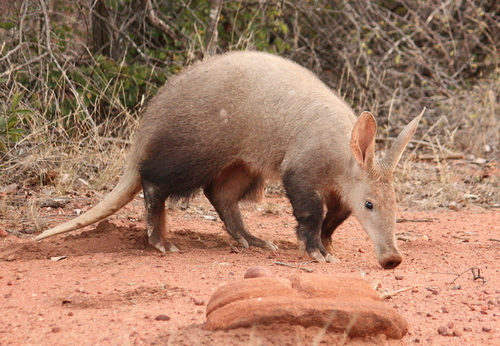
Preyed upon by large carnivores such as lions, leopards, and hyenas, as well as pythons; shares habitat with other insectivorous species like aardvarks with which it may compete for termite resources but generally avoids direct competition due to differing prey specialization.
Role in its ecosystem
Plays an important ecological role in regulating ant and termite populations, which in turn influences soil aeration and nutrient cycling in savanna ecosystems.
Reproduction and lifecycle
Breeding can occur year-round with possible peaks in certain seasons; gestation lasts about 105-140 days, and females typically give birth to a single offspring (rarely twins).
Raising the young
Mothers provide sole parental care, carrying the young on the base of their tail for the first few months and nursing it while gradually introducing it to foraging; the juvenile becomes independent after approximately 3-4 months but may stay near the mother longer.
Maturity and lifespan
Sexual maturity is generally reached around 1-2 years of age; lifespan in the wild is estimated at up to 15 years, with some individuals in captivity reportedly living slightly longer under proper care
Taxonomy and naming of the Temminck's Ground Pangolin
Classification
Mammalia > Pholidota > Manidae > Smutsia > Smutsia temminckii
Scientific synonyms
Manis temminckii (original combination); formerly classified under genus Manis before Smutsia was resurrected as a distinct genus
What research says
Recent studies
Recent studies focus on population genetics for forensic tracing of trafficked scales, GPS/radio-tracking studies of home range and movement ecology, and assessments of electrified fence mortality impacts in South Africa
Genome and DNA
Genomic studies place pangolins within their own order Pholidota closely related to Carnivora; chromosome number and detailed genome assembly for this species remain incompletely characterized
Compared with similar species
Compared to the Chinese and Sunda pangolins, Temminck's Ground Pangolin is larger and adapted to open savanna rather than forest; compared to other African pangolins like the White-bellied and Black-bellied Pangolins, it is strictly terrestrial rather than arboreal.
The Temminck's Ground Pangolin and people
Its tongue can be longer than its own body and is anchored near the pelvis rather than the mouth; when threatened, it curls into an almost impenetrable ball that even lions struggle to open; it can consume up to 200,000 ants or termites in a single night.
Where and how to see it
Best observed on guided night drives in protected reserves in South Africa (such as private reserves in Limpopo or the Greater Kruger area) during cooler months when they may be more active at dusk; sightings are rare and require patience due to their elusive, solitary nature.
Risks to humans
No notable risk to humans; pangolins are non-aggressive and defend themselves only by curling into a ball rather than biting or attacking.
Human uses
Heavily targeted for illegal trade in scales used in traditional medicine and for bushmeat consumption in parts of its range, despite international trade bans; not used in legal commercial farming due to its protected status.
Myths and legends
In several African cultures, pangolins are considered symbols of good luck or are used in traditional rainmaking and healing rituals; their scales are highly valued (though scientifically unproven) in traditional medicine across Africa and Asia for supposed medicinal properties.
Countries where the Temminck's Ground Pangolin is recorded
The 11 countries named in the range description of its IUCN Red List assessment.
Questions about the Temminck's Ground Pangolin
Where does the Temminck's Ground Pangolin live?
The Temminck's Ground Pangolin is recorded in Botswana, Kenya, Malawi, Mozambique and Namibia, among 11 countries in total across Africa. These countries come from the range description of its IUCN Red List assessment, and they are what place the species on the interactive map.
Is the Temminck's Ground Pangolin endangered?
Yes. The IUCN Red List assesses the Temminck's Ground Pangolin as Vulnerable, one of the three threatened categories. The species faces a high risk of extinction in the wild. It is the first of the three threatened categories: numbers are falling, the range is shrinking, or the population is small enough that a single bad event could do lasting damage.
How many are left in the wild?
Precise figures are unknown due to its elusive nature, but population is considered to be declining significantly across its range, with local extirpations reported in parts of South Africa and Mozambique This figure comes from the species assessment on the IUCN Red List; population estimates for wild mammals are ranges, not counts, and are revised at each assessment.
What habitat does the Temminck's Ground Pangolin live in?
Found in savanna, woodland, grassland, and semi-arid scrub habitats; avoids dense forest and prefers areas with sandy or loamy soils suitable for burrowing and termite/ant abundance.
What is the scientific name of the Temminck's Ground Pangolin?
The Temminck's Ground Pangolin is Smutsia temminckii, in the family Manidae, order Pholidota.
Other species in the genus Smutsia
Other species in the family Manidae
Species that share its range

Sources
Conservation status, range description and population estimate come from the IUCN Red List assessment for Smutsia temminckii. Countries are derived from that range description, not from a mapped country list. Last refreshed on .
The distribution map is drawn from the IUCN Red List spatial data compiled in 2019. IUCN SSC Pangolin Specialist Group