
White-tailed Mountain Vole
Alticola albicaudus
Red List assessment
Data Deficienton the IUCN Red List
- EXExtinct
- EWExtinct in the Wild
- CRCritically Endangered
- ENEndangered
- VUVulnerable
- NTNear Threatened
- LCLeast Concern
Data Deficient has no position on the scale above — it records the absence of an assessment, not a degree of risk.
The White-tailed Mountain Vole is recorded in 3 countries across Asia. The IUCN Red List records the White-tailed Mountain Vole as Data Deficient. Unknown; no reliable population estimate exists.
- Family
- Cricetidae
- Order
- Rodentia
- Genus
- Alticola
- Countries recorded
- 3
- Continents
- Asia
- Red List category
- Data Deficient
- Data updated
- August 9, 2026
What is the White-tailed Mountain Vole?
The White-tailed Mountain Vole is a small, stocky rodent of the tribe Arvicolini adapted to extreme high-altitude environments in the western Himalayan region. It is most readily identified by its conspicuously white tail, which is uncommon among closely related mountain voles. It inhabits rocky alpine terrain above the treeline and is poorly known due to the remoteness and inaccessibility of its range. Its Data Deficient IUCN status reflects very limited survey data rather than an established population trend.
Where does the White-tailed Mountain Vole live?
Western Himalayas; primarily Pakistan (Gilgit-Baltistan, Chitral, Karakoram), northwestern India (Ladakh, Jammu & Kashmir), and possibly northeastern Afghanistan
Confirmed from the western Himalayas and Karakoram ranges: northern Pakistan (Gilgit-Baltistan, Chitral District), northwestern India (Ladakh, the former Jammu & Kashmir state), and possibly the Wakhan Corridor of northeastern Afghanistan. The exact range limits remain poorly defined.
Altitude and depth
Typically found between approximately 3,000 and 5,000 m above sea level; most records come from high alpine and subalpine zones well above the treeline.
Seasonal movements
Likely remains active year-round under the snow in subnivean galleries, as is characteristic of many Alticola species. Breeding activity is restricted to the warmer months (May–September). No confirmed long-distance migrations are known.
Habitat of the White-tailed Mountain Vole
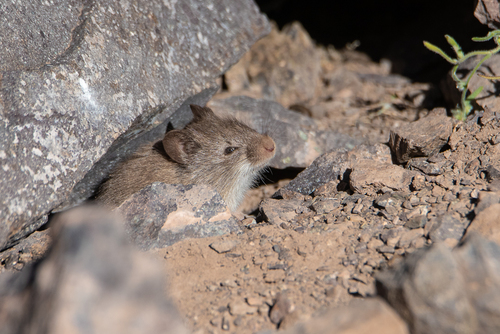
Rocky alpine slopes, talus fields, boulder screes, and subalpine meadows typical of the high Himalayas and Karakoram. It favors areas with crevices and rock piles that provide shelter from predators and harsh weather. Sparse grasses, sedges, and cushion plants are characteristic vegetation of its habitat.
Adaptations to its environment
Dense, soft fur provides insulation against extreme cold and UV radiation at high altitude. Compact body form with short limbs and ears minimizes heat loss. Like other mountain voles, it likely caches plant material and exploits subnivean space during winter. Strong claws and agile movement assist navigation of rocky terrain.
Conservation status and numbers
Data Deficient (DD) on the IUCN Red List, assessed most recently in 2016. This status reflects insufficient information on population size, distribution, and ecology to make a reliable assessment rather than implying the species is necessarily at low risk.
Estimated population
Unknown; no reliable population estimate exists. Population trend is undetermined due to the lack of systematic surveys.
What threatens the White-tailed Mountain Vole?
Potential threats include habitat degradation from livestock overgrazing in high-altitude pastures, climate change causing upward shift and reduction of suitable alpine habitat, and possible competition with domestic animals or other rodents. Mining and road construction in the Karakoram and Himalayas may also fragment populations.
Diseases and parasites
No specific disease studies exist for this species. Related Alticola and Microtus species are known hosts of various helminths, fleas, and ticks, and may harbor hantaviruses or other zoonotic pathogens; similar exposure is plausible but unconfirmed.
What is being done to protect it?
Parts of its presumed range fall within protected areas such as Khunjerab National Park (Pakistan) and Hemis National Park (India), which may afford some incidental protection. No species-specific conservation programs are currently known.
Recommended actions
Priority actions include dedicated field surveys to map the true distribution and assess population status, ecological studies on habitat use and diet, genomic analysis to clarify population structure, and upgrading the IUCN assessment with new data. Inclusion in high-altitude biodiversity monitoring programs would be beneficial.
What the White-tailed Mountain Vole looks like
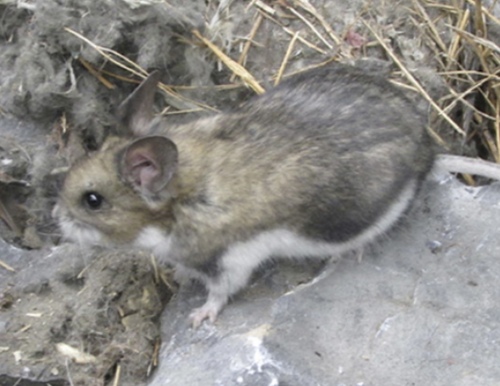
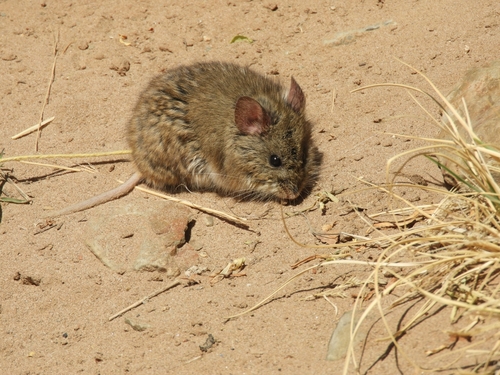
Dorsal fur is soft and dense, typically pale gray to grayish-brown with a slightly paler mid-dorsal region; underparts are whitish to pale buff. The tail is distinctly bicolored or entirely white, giving the species its common name. Eyes are relatively small and ears are short and rounded, partly concealed by fur.
Size
Body length approximately 100–130 mm; tail length approximately 30–50 mm (notably shorter than body and conspicuously white); hindfoot approximately 17–20 mm.
Weight
Estimated 25–55 g based on closely related Alticola species; no reliable sex-specific weight data are available.
Distinctive features
The predominantly white tail is the most diagnostic character separating it from sympatric congeners such as Alticola roylei and Alticola stoliczkanus, which have dusky or grayish tails. The overall paler dorsal coloration also helps distinguish it from darker high-altitude vole species in the region.
Differences between males and females
Minimal or absent; no marked differences in size or coloration between the sexes are reported, as is typical for the genus Alticola.
Behaviour and diet of the White-tailed Mountain Vole
Presumed semi-colonial or loosely social, living in small family groups sharing rock crevice systems, as observed in related Alticola species. Territories may be maintained around burrow systems. Exact social structure is undocumented.
When it is active
Likely primarily diurnal and crepuscular, foraging during daylight hours in its alpine habitat. Activity may shift to periods of lower predator activity. Winter activity is presumably reduced to subnivean galleries.
Diet
Strictly herbivorous; diet consists of grasses, sedges, forbs, mosses, lichens, and seeds available in alpine meadows and rocky outcrops. Like other Alticola, it likely stores plant material in caches for winter use.
Communication
Likely communicates via high-pitched ultrasonic and audible vocalizations, scent marking with urine and glandular secretions, and tactile signals, consistent with other small arvicolines. Alarm calls may warn conspecifics of approaching predators.
Interactions with other species
Likely predated upon by raptors (e.g., Golden Eagle, Upland Buzzard), mustelids (e.g., stoats, weasels), and foxes in its high-altitude range. May compete for resources with Alticola roylei and Alticola stoliczkanus where ranges overlap. Ectoparasites such as fleas, mites, and ticks are expected, as in related species.
Role in its ecosystem
Functions as a primary consumer in high-altitude alpine ecosystems, converting plant biomass into animal protein available to predators. Burrowing and caching behavior may contribute to soil aeration and seed dispersal. It is an important prey item for alpine predators.
Reproduction and lifecycle
Breeding season likely restricted to the short alpine summer, approximately May to August or September. Gestation period is estimated at 19–21 days (typical for arvicolines). Litter size probably ranges from 2 to 6 pups; multiple litters per season are possible under favorable conditions.
Raising the young
Young are altricial at birth and are nursed in a well-insulated nest within a rock crevice or burrow. The female provides primary parental care; pups are weaned at approximately 3 weeks of age, as is typical for the subfamily Arvicolinae.
Maturity and lifespan
Sexual maturity likely reached at 4–8 weeks of age, consistent with other small arvicolines. Wild lifespan estimated at 1–2 years; captive longevity is unknown as the species has not been maintained in captivity.
Taxonomy and naming of the White-tailed Mountain Vole
Classification
Mammalia > Rodentia > Cricetidae (Arvicolinae) > Alticola > Alticola albicaudus
Scientific synonyms
Originally described as Arvicola albicauda Blanford, 1875; subsequently transferred to genus Alticola.
What research says
Recent studies
Published research specifically targeting Alticola albicaudus is extremely sparse. The species has been included in broader phylogenetic studies of the tribe Arvicolini, where molecular data confirm its placement within the Alticola clade, but detailed ecological or behavioral studies remain absent.
Genome and DNA
Chromosome number is not formally published for this species; related Alticola species typically have 2n = 54–60. No specific genomic studies on A. albicaudus are known.
Compared with similar species
Most closely related to other western Himalayan Alticola species including A. roylei (Royle's Mountain Vole) and A. stoliczkanus (Stoliczka's Mountain Vole). It differs primarily in its white tail, paler dorsal coloration, and specific range. Compared to the more widespread Microtus species that share lower-altitude habitats, Alticola species are generally more specialized for rocky, high-altitude environments.
The White-tailed Mountain Vole and people
Its bright white tail is so distinctive that it serves as the species' English name — a rarity in a genus where tails are usually dull gray or brown. Despite living at altitudes where temperatures can drop below -30°C in winter, it does not hibernate and remains active beneath the snow. It shares its extreme alpine environment with snow leopards and Himalayan wolves, making it both predator food and an overlooked piece of one of the world's most iconic high-altitude ecosystems.
Where and how to see it
Best observed in the warmer months (June–August) in the Karakoram and western Himalayan ranges, particularly in boulder-strewn alpine meadows above 3,500 m. Khunjerab National Park in Pakistan and the high passes of Ladakh, India, are candidate locations. Patient waiting near talus slopes at dawn or dusk offers the best chance of a sighting.
Risks to humans
No notable risk to humans. Like all wild small mammals it may carry ectoparasites, so direct handling should be avoided.
Countries where the White-tailed Mountain Vole is recorded
The 3 countries named in the range description of its IUCN Red List assessment.
Questions about the White-tailed Mountain Vole
Where does the White-tailed Mountain Vole live?
The White-tailed Mountain Vole is recorded in Afghanistan, India and Pakistan across Asia. These countries come from the range description of its IUCN Red List assessment, and they are what place the species on the interactive map.
Is the White-tailed Mountain Vole endangered?
The IUCN Red List assesses the White-tailed Mountain Vole as Data Deficient. There is not enough information to judge the risk of extinction, usually because the species is rarely seen or has never been surveyed. It is not a reassuring category: several species were Data Deficient right up to the point they were found to be Critically Endangered.
How many are left in the wild?
Unknown; no reliable population estimate exists. This figure comes from the species assessment on the IUCN Red List; population estimates for wild mammals are ranges, not counts, and are revised at each assessment.
What habitat does the White-tailed Mountain Vole live in?
Rocky alpine slopes, talus fields, boulder screes, and subalpine meadows typical of the high Himalayas and Karakoram.
What is the scientific name of the White-tailed Mountain Vole?
The White-tailed Mountain Vole is Alticola albicaudus, in the family Cricetidae, order Rodentia.
Other species in the genus Alticola

Other species in the family Cricetidae
Sources
Conservation status, range description and population estimate come from the IUCN Red List assessment for Alticola albicaudus. Countries are derived from that range description, not from a mapped country list. Last refreshed on .
The distribution map is drawn from the IUCN Red List spatial data compiled in 2008. IUCN (International Union for Conservation of Nature)