
Southern Pygmy Mouse
Baiomys musculus
Red List assessment
Least Concernon the IUCN Red List
- EXExtinct
- EWExtinct in the Wild
- CRCritically Endangered
- ENEndangered
- VUVulnerable
- NTNear Threatened
- LCLeast Concern
The Southern Pygmy Mouse is recorded in 5 countries across North America. The IUCN Red List assesses the Southern Pygmy Mouse as Least Concern. No precise global population estimate is available.
- Family
- Cricetidae
- Order
- Rodentia
- Genus
- Baiomys
- Countries recorded
- 5
- Continents
- North America
- Red List category
- Least Concern
- Data updated
- August 9, 2026
What is the Southern Pygmy Mouse?
Baiomys musculus, the Southern Pygmy Mouse, is one of the smallest rodents in North America, weighing as little as 7 grams. It inhabits tropical dry forests, grasslands, and scrubby areas from western Mexico through Central America. It is closely related to the Northern Pygmy Mouse (Baiomys taylori) but occupies a more southern and geographically distinct range. Despite its diminutive size, it is ecologically significant as a seed consumer and prey item for numerous predators.
Where does the Southern Pygmy Mouse live?
Mexico (western and southern regions), Guatemala, El Salvador, Honduras, Nicaragua
Ranges from the Pacific slope of western and southwestern Mexico (Jalisco, Colima, Michoacán, Guerrero, Oaxaca, Chiapas) southward through Guatemala, El Salvador, Honduras, and Nicaragua. Its range is largely allopatric from B. taylori, which occupies more northern and arid zones.
Altitude and depth
Typically found from sea level up to approximately 1,800 m elevation, most commonly in lowland and mid-elevation zones below 1,200 m.
Seasonal movements
No true hibernation or long-distance migration is known. Reproductive activity may peak during the wet season when food resources are most abundant, but breeding can occur year-round in warmer lowland areas.
Habitat of the Southern Pygmy Mouse
Primarily found in tropical dry forests, tall grass savannas, brushy scrublands, and agricultural margins with dense herbaceous cover. It thrives in areas with a mix of grassy patches and low shrubs that offer nesting material and cover. It also colonizes weedy fields, forest edges, and disturbed habitats near human settlements.
Adaptations to its environment
Its tiny body size reduces caloric requirements, allowing survival in resource-limited environments. It constructs well-concealed grass nests in dense vegetation for insulation and predator avoidance. Its cryptic dark dorsal coloration provides camouflage in leaf litter and shadowed ground cover.
Conservation status and numbers
Least Concern (IUCN). The species has a wide distribution, tolerates moderate habitat disturbance, and maintains stable populations across its range. No major population-level declines have been documented sufficient to warrant a higher threat category.
Estimated population
No precise global population estimate is available. The species is considered relatively common and locally abundant throughout much of its range; population trend is presumed stable.
What threatens the Southern Pygmy Mouse?
Habitat loss due to agricultural expansion, cattle grazing, and deforestation of tropical dry forests represents the primary long-term threat. Intensive pesticide use in agricultural zones can reduce insect prey availability. Local predation pressure from domestic cats and rodenticide use in human-modified landscapes may affect populations near settlements.
Diseases and parasites
Susceptible to ectoparasites including fleas, mites, and lice common to small neotropical rodents. May serve as a reservoir or incidental host for hantaviruses and other zoonotic pathogens, as is typical for cricetid rodents, though specific epidemiological studies on this species are limited.
What is being done to protect it?
The species occurs within several protected areas throughout Mexico and Central America, including national parks and biosphere reserves. It benefits from general wildlife protection laws in Mexico (NOM-059) and international conventions (CITES), though it is not specifically listed as a protected species.
Recommended actions
Continued monitoring of populations in areas subject to intense agricultural pressure and deforestation is advisable. Protection and restoration of tropical dry forest corridors would benefit this and many co-occurring small mammal species. Reduction of rodenticide use in agricultural buffer zones near natural habitats is recommended.
What the Southern Pygmy Mouse looks like
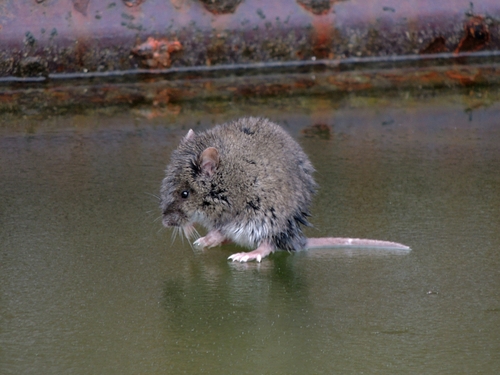
Dorsal fur is dark grayish-brown to blackish-brown, often with a slightly rusty or buff wash along the sides. The ventral surface is pale gray to whitish. The tail is bicolored (darker above, lighter below), relatively short, and lightly haired. Eyes and ears are small relative to the head.
Size
Head-body length: 50–75 mm; tail length: 35–55 mm (tail is shorter than or approximately equal to body length). Among the smallest rodents in the Western Hemisphere.
Weight
Typically 6–12 g. Sexual differences in weight are minimal, with males and females of similar size.
Distinctive features
Distinguished from the closely related Northern Pygmy Mouse (B. taylori) by its generally darker and more saturated dorsal pelage and its more southerly distribution. Compared to sympatric Peromyscus species, it is dramatically smaller with a proportionally shorter tail and lacks the sharply contrasting white underparts typical of that genus.
Differences between males and females
Sexual dimorphism is minimal in this species. Males and females are nearly identical in external appearance and body measurements, with no notable differences in pelage or body proportions.
Behaviour and diet of the Southern Pygmy Mouse
Baiomys musculus is notable among small rodents for exhibiting a tendency toward pair bonding; mated pairs may share a nest and home range. It is not strongly gregarious but may tolerate conspecifics within overlapping territories. Social interactions include allogrooming between paired individuals.
When it is active
Primarily nocturnal and crepuscular, with peak activity occurring at dusk and during the night. It may also show brief diurnal activity, particularly in dense vegetative cover. Activity patterns may shift seasonally with temperature and food availability.
Diet
Omnivorous, feeding primarily on grass seeds, forb seeds, green plant material (stems, leaves), and invertebrates including insects and larvae. Seeds form the dietary staple, but arthropod protein is important especially during breeding periods.
How it feeds and hunts
Forages on the ground and among low vegetation using olfaction and vibrissae to locate seeds and invertebrates. It gleans insects directly from vegetation and soil surface. Seeds may be husked in situ or cached in small quantities near the nest.
Communication
Communicates through ultrasonic vocalizations (beyond human hearing range) used in courtship and mother-pup interactions. Scent marking via urine and glandular secretions is used to demarcate territories and convey reproductive status. Physical contact and allogrooming reinforce pair bonds.
Interactions with other species
Preyed upon by owls (especially Barn Owls, Tyto alba), small raptors, snakes, mustelids, and domestic cats. Competes for food resources with other granivorous rodents such as Peromyscus and Reithrodontomys species. May play a minor role in seed dispersal of grasses and forbs.
Role in its ecosystem
Functions as a primary consumer of grass and forb seeds, contributing to seed predation dynamics and potentially some seed dispersal. As a small abundant prey species, it is an important energy conduit from plant production to secondary consumers such as raptors and carnivorous mammals.
Reproduction and lifecycle
Gestation lasts approximately 20–23 days. Litter sizes range from 1 to 5, with 2–3 young being typical. Females can produce multiple litters per year (potentially 4–6 in favorable conditions). Breeding may occur year-round in tropical lowlands, with peaks tied to wet-season resource abundance.
Raising the young
The female is the primary caregiver, nursing and thermoregulating altricial pups in a grass-lined nest. Pups are born hairless and blind, opening their eyes around 10–12 days. The male in pair-bonded situations may remain in proximity and guard the nest. Weaning occurs at approximately 16–21 days.
Maturity and lifespan
Sexual maturity is reached remarkably quickly, at approximately 30–40 days of age, which is among the fastest in rodents. Wild lifespan is estimated at 6–12 months due to high predation pressure; captive individuals may live 2–3 years.
Taxonomy and naming of the Southern Pygmy Mouse
Classification
Mammalia > Rodentia > Cricetidae > Baiomys > Baiomys musculus
Subspecies
Multiple subspecies recognized: B. m. musculus (southwestern Mexico), B. m. brunneus (Oaxaca), B. m. nigrescens (Chiapas, Guatemala), B. m. pallidus (Guerrero), B. m. pullus (El Salvador, Honduras), B. m. saturatus (Honduras), B. m. temporalis (Puebla), B. m. handleyi (Nicaragua). Boundaries between some subspecies remain debated.
Scientific synonyms
Hesperomys musculus Saussure, 1860 (original description). Also historically placed in the genera Peromyscus and Mus. Baiomys brunneus and B. nigrescens were formerly treated as separate species.
What research says
Recent studies
Recent phylogeographic analyses have confirmed the distinction between B. musculus and B. taylori and have examined population structure across the Mexican highlands. Some studies have reassessed subspecific boundaries using mitochondrial DNA, suggesting cryptic diversity within the species complex.
Genome and DNA
The diploid chromosome number is 2n = 48. Phylogenomic studies place Baiomys within the tribe Reithrodontomyini (Cricetidae). Detailed genomic studies specific to B. musculus remain limited compared to model rodents.
Compared with similar species
Baiomys musculus is closely related to B. taylori (Northern Pygmy Mouse), which ranges from Texas and Arizona into northern Mexico. B. taylori tends to be slightly paler and occupies more arid and semi-arid habitats. Both species share the characteristic extremely small body size, pair-bonding tendency, and early sexual maturity that distinguish the genus Baiomys from other New World mice.
The Southern Pygmy Mouse and people
The Southern Pygmy Mouse is among the smallest rodents in the Americas, with some individuals weighing less than a United States dime coin. Unlike most rodents, which are promiscuous, Baiomys musculus is one of the few small rodents known to form relatively stable pair bonds. Its accelerated sexual maturity at roughly one month of age means that a female born in spring could theoretically become a grandmother by mid-summer.
Where and how to see it
Best observed in western and southern Mexico along the Pacific coast (Jalisco, Colima, Michoacán) in grassy clearings, forest edges, and shrubby roadsides at night using a headlamp. Sherman live traps set along fence lines and vegetation borders are the most reliable detection method. The dry-to-wet season transition (May–June) can be a productive observation period as animals increase foraging activity.
Risks to humans
No notable risk to humans under normal circumstances. As with all wild rodents, handling without protection carries a theoretical risk of zoonotic disease transmission; direct contact should be avoided. It poses no bite threat beyond a minor defensive nip if restrained.
Human uses
Occasionally used as a subject in laboratory research on mammalian reproductive biology and rodent sociality due to its pair-bonding behavior and rapid reproductive cycle. It has no significant history of use in traditional medicine, food, or the pet trade.
Countries where the Southern Pygmy Mouse is recorded
The 5 countries named in the range description of its IUCN Red List assessment.
Questions about the Southern Pygmy Mouse
Where does the Southern Pygmy Mouse live?
The Southern Pygmy Mouse is recorded in El Salvador, Guatemala, Honduras, Mexico and Nicaragua across North America. These countries come from the range description of its IUCN Red List assessment, and they are what place the species on the interactive map.
Is the Southern Pygmy Mouse endangered?
The IUCN Red List assesses the Southern Pygmy Mouse as Least Concern. The species is widespread and abundant enough not to qualify for any threatened category. It does not mean the species is safe forever, only that nothing in the current data raises an alarm.
How many are left in the wild?
No precise global population estimate is available. This figure comes from the species assessment on the IUCN Red List; population estimates for wild mammals are ranges, not counts, and are revised at each assessment.
What habitat does the Southern Pygmy Mouse live in?
Primarily found in tropical dry forests, tall grass savannas, brushy scrublands, and agricultural margins with dense herbaceous cover.
What is the scientific name of the Southern Pygmy Mouse?
The Southern Pygmy Mouse is Baiomys musculus, in the family Cricetidae, order Rodentia.
Other species in the genus Baiomys
Other species in the family Cricetidae
Species that share its range
Sources
Conservation status, range description and population estimate come from the IUCN Red List assessment for Baiomys musculus. Countries are derived from that range description, not from a mapped country list. Last refreshed on .
The distribution map is drawn from the IUCN Red List spatial data compiled in 2008. IUCN (International Union for Conservation of Nature)