
Northern Pygmy Mouse
Baiomys taylori
Red List assessment
Least Concernon the IUCN Red List
- EXExtinct
- EWExtinct in the Wild
- CRCritically Endangered
- ENEndangered
- VUVulnerable
- NTNear Threatened
- LCLeast Concern
The Northern Pygmy Mouse is recorded in 2 countries across North America. The IUCN Red List assesses the Northern Pygmy Mouse as Least Concern. No precise global population estimate is available.
- Family
- Cricetidae
- Order
- Rodentia
- Genus
- Baiomys
- Countries recorded
- 2
- Continents
- North America
- Red List category
- Least Concern
- Data updated
- August 9, 2026
What is the Northern Pygmy Mouse?
The Northern Pygmy Mouse is one of the smallest rodents in North America, weighing as little as 7 grams. It inhabits semi-arid grasslands, brushy scrublands, and weedy agricultural margins from southern Texas south through much of Mexico. Despite its diminutive size, it is a remarkably resilient and prolific breeder. It is the sole member of its genus found predominantly in the United States.
Where does the Northern Pygmy Mouse live?
Southern United States (Texas, southern Oklahoma, southeastern Arizona) and Mexico (Tamaulipas, Nuevo León, Coahuila, San Luis Potosí, Jalisco, Veracruz, and adjacent states)
Occurs from south-central and southern Texas (Hidalgo, Cameron, Webb counties and north to Travis County), marginally into southwestern Oklahoma, southeastern Arizona, and through eastern and central Mexico including Tamaulipas, Nuevo León, Coahuila, San Luis Potosí, Jalisco, and Veracruz.
Altitude and depth
Generally found from sea level to approximately 2,000 m elevation, most abundant in lowland and mid-elevation semi-arid grasslands and brush.
Seasonal movements
Does not hibernate. Activity and reproductive rates may be somewhat reduced during cold winter months in the northern part of its range, but breeding can occur year-round in warmer southern regions.
Habitat of the Northern Pygmy Mouse
Prefers dense herbaceous ground cover including grassy fields, brushy pastures, weedy roadsides, thorn scrub (chaparral), and disturbed agricultural borders. It typically requires thick low vegetation for shelter and nesting, often associated with cactus or mesquite habitat in semi-arid zones.
Adaptations to its environment
Its extremely small body size reduces caloric requirements in resource-limited semi-arid environments. It constructs well-hidden grass nests within dense vegetation for thermoregulation and predator avoidance. High reproductive rate compensates for high predation pressure.
Conservation status and numbers
Least Concern (IUCN). The species has a broad range, tolerates habitat disturbance to some degree, and maintains relatively stable populations across most of its range. No major population-level decline has been documented.
Estimated population
No precise global population estimate is available. The species is considered locally common to abundant in suitable habitats; population trend is presumed stable overall.
What threatens the Northern Pygmy Mouse?
Agricultural intensification and the conversion of native brushy grasslands to row crops reduces available habitat. Pesticide use may reduce invertebrate prey. Overgrazing removes essential ground cover. Predation by domestic cats poses a localized threat.
Diseases and parasites
Known to host fleas (Siphonaptera), mites, and bot fly larvae (Cuterebra spp.). Has been studied as a potential reservoir host for various arboviruses in Texas. Ectoparasite loads are typical for small cricetid rodents.
What is being done to protect it?
No species-specific conservation program exists. The species benefits incidentally from protected areas across its range, including state and national wildlife refuges in Texas (e.g., Lower Rio Grande Valley NWR) and protected natural areas in Mexico.
Recommended actions
Monitoring population trends in response to agricultural expansion; preservation of native grassland and brushland habitats along the Rio Grande corridor; reduction of pesticide use in key areas; further taxonomic and genetic studies to clarify subspecific diversity.
What the Northern Pygmy Mouse looks like
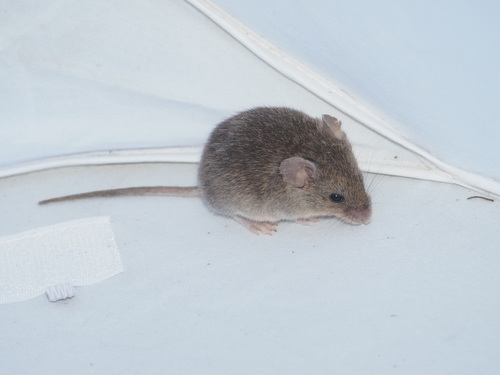
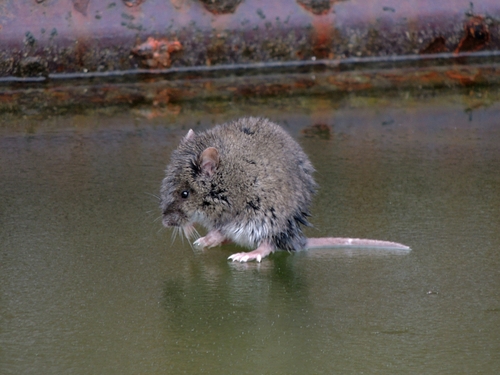
Dorsal pelage is grayish-brown to dark brownish-gray, often with a slightly darker mid-dorsal streak. Ventral surface is paler grayish-white. The tail is slender and relatively short, approximately equal to or shorter than the head-body length. Eyes and ears are small relative to related cricetid rodents.
Size
Total body length 90–115 mm; head-body length approximately 50–70 mm; tail 38–55 mm; hind foot 14–16 mm; ear 10–13 mm.
Weight
Typically 7–12 grams; adults average around 8–10 g with little sexual size dimorphism reported.
Distinctive features
Distinguished from the closely related Southern Pygmy Mouse (Baiomys musculus) by its more northerly range, generally paler and grayer dorsal coloration, and subtly smaller size. Separated from juvenile Peromyscus by its shorter tail, overall grayer tones, and proportionally smaller ears.
Differences between males and females
Sexual dimorphism is minimal. Males and females are similar in size and coloration. Breeding females develop prominent mammary tissue, which is the most reliable external sex indicator.
Behaviour and diet of the Northern Pygmy Mouse
Somewhat social; individuals may share nests or live in loose colonies within favorable patches of habitat. Home ranges are small (typically under 0.1 ha) and may broadly overlap. Not strongly territorial but some intraspecific competition occurs.
When it is active
Primarily nocturnal and crepuscular. Activity peaks shortly after dusk and before dawn. Individuals remain in nests during the hottest part of the day and during cold nights.
Diet
Omnivorous. Diet consists primarily of seeds (grasses and forbs), supplemented with green plant material, fungi, and invertebrates (insects, small arthropods). Seed consumption dominates, making it an important secondary seed predator in its ecosystem.
How it feeds and hunts
Forages on the ground and among low vegetation using olfactory cues to locate seeds and invertebrates. It gleans insects from vegetation surfaces and leaf litter. No complex pursuit or ambush strategy; opportunistic and generalist forager.
Communication
Uses high-frequency ultrasonic vocalizations for mother-pup communication and potentially for intraspecific signaling. Scent marking via urination and possibly glandular secretions demarcates home ranges. Tactile communication occurs during social grooming and mating.
Interactions with other species
Prey for numerous predators including owls (Barn Owl, Great Horned Owl), snakes (rat snakes, coachwhips), raptors, and small carnivores (weasels, domestic cats). Competes for seeds with other granivorous rodents such as Peromyscus spp. and Reithrodontomys spp.
Role in its ecosystem
Functions as a secondary seed predator and minor seed disperser in semi-arid grasslands. As a prey species for many predators, it is an important link in food webs. It also contributes to soil disturbance through burrowing and nest construction.
Reproduction and lifecycle
Breeds year-round in warm regions; peak breeding in spring and fall in Texas. Gestation period is approximately 20 days. Litter size ranges from 1 to 5 young, averaging 2–3. Multiple litters are produced per year (potentially 5–6 annually).
Raising the young
Altricial young are born blind, hairless, and helpless. The female provides primary parental care, nursing young in a grass-lined nest for approximately 15–20 days. Males may remain near the nest but direct paternal care is limited. Young are weaned at about 3 weeks.
Maturity and lifespan
Sexual maturity can be reached in as few as 30–40 days, making it one of the fastest-maturing North American rodents. Lifespan in the wild is typically less than one year due to heavy predation; captive individuals may live 2–3 years.
Taxonomy and naming of the Northern Pygmy Mouse
Classification
Mammalia > Rodentia > Cricetidae > Baiomys > Baiomys taylori
Subspecies
B. t. taylori (central Texas, northeastern Mexico), B. t. paulus (southern Texas), B. t. subater (western Mexico, Jalisco region), B. t. analogus (central Mexico), B. t. quaestus (Tamaulipas/Nuevo León). Subspecific boundaries are debated.
Scientific synonyms
Mus taylori Thomas, 1887 (original description); Baiomys taylori has also appeared under Peromyscus taylori in older literature.
What research says
Recent studies
Recent phylogeographic studies have examined gene flow across the US-Mexico border populations. Research has also investigated its role as an ectoparasite host and potential arbovirus reservoir in the lower Rio Grande Valley. Subspecific boundaries continue to be reassessed with molecular tools.
Genome and DNA
Diploid chromosome number is 2n = 52. Karyotypic studies have helped distinguish it from B. musculus. Molecular phylogenetic analyses place Baiomys as basal within the tribe Reithrodontomyini.
Compared with similar species
Very similar to the Southern Pygmy Mouse (Baiomys musculus), which replaces it in southern and central Mexico; B. musculus tends to be slightly darker and occurs at higher elevations in some areas. Both are far smaller than any Peromyscus species, with which they may co-occur.
The Northern Pygmy Mouse and people
The Northern Pygmy Mouse is among the smallest rodents in North America, roughly the weight of two U.S. pennies. It can reach sexual maturity in about one month — one of the fastest development timelines among all North American mammals. Despite its tiny stature, it can be surprisingly bold, and captive individuals have been observed actively confronting larger cage-mates.
Where and how to see it
Best observed in southern Texas (e.g., Hidalgo County, Starr County) and along the lower Rio Grande Valley during warm nights using a headlamp in grassy brushy edges or along field margins. Sherman live-trapping surveys yield the most reliable detections; peak activity occurs 1–3 hours after sunset.
Risks to humans
No notable risk. May carry ectoparasites (fleas, mites) and potentially harbor arboviruses, so standard precautions should be used when handling wild-caught individuals. Bite risk is minimal and of no medical significance.
Human uses
Used as a laboratory model organism in reproductive biology and developmental studies due to its rapid maturation and prolific breeding. It has also been used in ecotoxicology studies assessing pesticide impacts on small mammal communities. No significant commercial or traditional use.
Countries where the Northern Pygmy Mouse is recorded
The 2 countries named in the range description of its IUCN Red List assessment.
Questions about the Northern Pygmy Mouse
Where does the Northern Pygmy Mouse live?
The Northern Pygmy Mouse is recorded in Mexico and United States across North America. These countries come from the range description of its IUCN Red List assessment, and they are what place the species on the interactive map.
Is the Northern Pygmy Mouse endangered?
The IUCN Red List assesses the Northern Pygmy Mouse as Least Concern. The species is widespread and abundant enough not to qualify for any threatened category. It does not mean the species is safe forever, only that nothing in the current data raises an alarm.
How many are left in the wild?
No precise global population estimate is available. This figure comes from the species assessment on the IUCN Red List; population estimates for wild mammals are ranges, not counts, and are revised at each assessment.
What habitat does the Northern Pygmy Mouse live in?
Prefers dense herbaceous ground cover including grassy fields, brushy pastures, weedy roadsides, thorn scrub (chaparral), and disturbed agricultural borders.
What is the scientific name of the Northern Pygmy Mouse?
The Northern Pygmy Mouse is Baiomys taylori, in the family Cricetidae, order Rodentia.
Other species in the genus Baiomys
Other species in the family Cricetidae
Species that share its range
Sources
Conservation status, range description and population estimate come from the IUCN Red List assessment for Baiomys taylori. Countries are derived from that range description, not from a mapped country list. Last refreshed on .
The distribution map is drawn from the IUCN Red List spatial data compiled in 2008. IUCN (International Union for Conservation of Nature)