
Salvin's Big-eyed Bat
Chiroderma salvini
Red List assessment
Least Concernon the IUCN Red List
- EXExtinct
- EWExtinct in the Wild
- CRCritically Endangered
- ENEndangered
- VUVulnerable
- NTNear Threatened
- LCLeast Concern
The Salvin's Big-eyed Bat is recorded in 10 countries across North America and South America. The IUCN Red List assesses the Salvin's Big-eyed Bat as Least Concern. No precise global population estimate exists, but the species is considered common within suitable habitat; overall population trend is believed to be stable to slightly declining due to habitat loss.
- Family
- Phyllostomidae
- Order
- Chiroptera
- Genus
- Chiroderma
- Countries recorded
- 10
- Continents
- North America and South America
- Red List category
- Least Concern
- Data updated
- August 9, 2026
What is the Salvin's Big-eyed Bat?
Salvin's Big-eyed Bat is a medium-sized frugivorous bat belonging to the leaf-nosed bat family Phyllostomidae, native to the Neotropical forests of Central America and parts of northern South America. It is named after Osbert Salvin, a British naturalist, and is distinguished by its prominent facial stripes and large eyes adapted for nocturnal fruit foraging. The species plays an important ecological role as a seed disperser in tropical forest ecosystems.
Where does the Salvin's Big-eyed Bat live?
Central America, from southern Mexico through Guatemala, Belize, Honduras, Nicaragua, Costa Rica, Panama, and into northern Colombia and Ecuador
Ranges from southern Mexico through Central America (Guatemala, Belize, Honduras, El Salvador, Nicaragua, Costa Rica, Panama) and extends into northwestern South America including Colombia and Ecuador.
Altitude and depth
Typically found from sea level up to approximately 1800 meters elevation, though most records occur below 1500 meters.
Seasonal movements
No long-distance migration is documented; however, reproductive activity may show slight seasonal peaks correlating with fruit availability during wetter periods.
Habitat of the Salvin's Big-eyed Bat
Primarily inhabits lowland and montane tropical evergreen forests, including primary and secondary growth forest, as well as forest edges and sometimes disturbed agricultural landscapes near forest remnants.
Adaptations to its environment
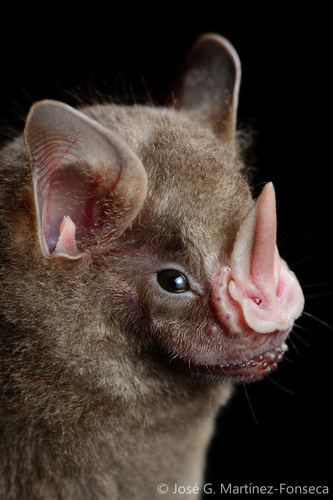
Possesses large eyes for enhanced night vision to locate fruit, and a nose-leaf structure aiding echolocation for navigation in dense forest. Its dentition is adapted for processing soft fruit pulp, and strong wings allow agile flight through cluttered forest understory.
Conservation status and numbers
Listed as Least Concern (LC) by the IUCN due to its relatively wide distribution and presumed large population, though localized deforestation may cause regional declines.
Estimated population
No precise global population estimate exists, but the species is considered common within suitable habitat; overall population trend is believed to be stable to slightly declining due to habitat loss.
What threatens the Salvin's Big-eyed Bat?
Habitat loss due to deforestation for agriculture and logging, forest fragmentation, and potential pesticide use in agricultural landscapes near forest edges.
Diseases and parasites
Like many bats, may host ectoparasites such as mites and bat flies (Streblidae), as well as being a potential reservoir for various viruses, though specific studies on this species are limited.
What is being done to protect it?
Benefits indirectly from protected areas and forest reserves across its range in Central America, including national parks in Costa Rica and Panama that preserve tropical forest habitat.
Recommended actions
Continued monitoring of population trends, protection of remaining forest habitat, promotion of sustainable land-use practices, and further ecological research on its role in seed dispersal.
What the Salvin's Big-eyed Bat looks like
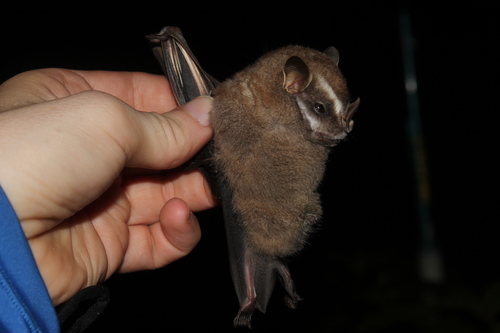
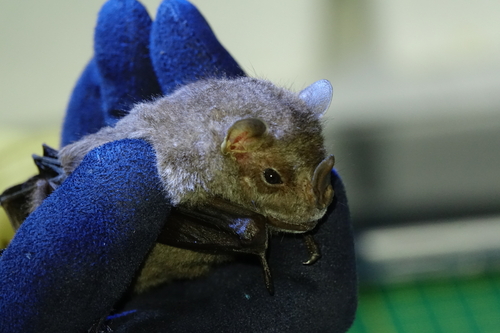
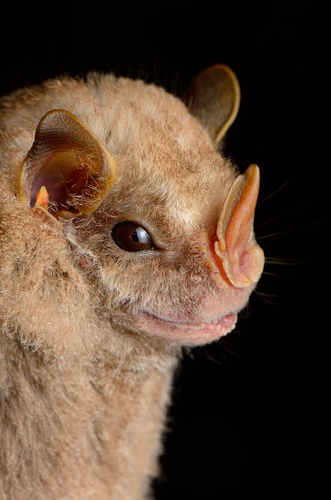
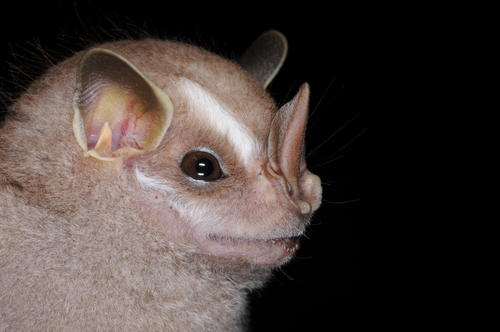
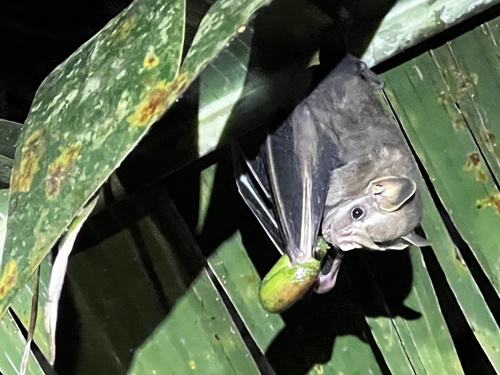
The fur is generally brownish to grayish-brown, with a pale dorsal stripe running down the back and distinctive white facial stripes bordering the eyes and nose-leaf. The large eyes are a notable feature distinguishing it within its genus.
Size
Forearm length typically ranges from 40 to 45 mm; total body length is approximately 55-65 mm.
Weight
Adults typically weigh between 18 and 24 grams.
Distinctive features
Distinguished from related Chiroderma species by dental characteristics, the pattern and intensity of facial stripes, and specific cranial measurements used in taxonomic identification.
Differences between males and females
Sexual dimorphism is minimal, with males and females being similar in size and coloration.
Behaviour and diet of the Salvin's Big-eyed Bat
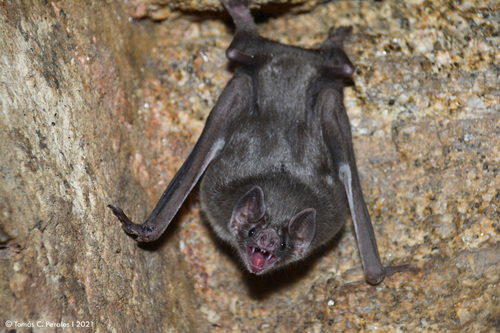
Generally roosts in small groups, sometimes solitary or in pairs, within foliage, tree cavities, or under leaves; social structure is not highly complex compared to some other bat species.
When it is active
Strictly nocturnal, emerging after dusk to forage for fruit and returning to roost sites before dawn.
Diet
Primarily frugivorous, feeding on a variety of fruits from trees and shrubs such as figs (Ficus) and other soft-fleshed fruits; may occasionally consume nectar or pollen opportunistically.
How it feeds and hunts
Forages by flying through forest understory and canopy to locate ripe fruit using vision and echolocation, often plucking fruit in flight or landing briefly to feed.
Communication
Communicates through echolocation calls for navigation, as well as social vocalizations and possibly olfactory cues for roost mate recognition and mating behavior.
Interactions with other species
Preyed upon by owls, snakes, and other nocturnal predators; competes with other frugivorous bats for fruit resources but also coexists with them by partitioning food resources across different plant species.
Role in its ecosystem
Functions as an important seed disperser within tropical forest ecosystems, contributing to forest regeneration and plant diversity by spreading seeds from consumed fruits across the landscape.
Reproduction and lifecycle
Breeding appears to occur seasonally, potentially linked to fruit abundance, with females giving birth to a single pup after a gestation period typical of phyllostomid bats (around 4 months).
Raising the young
Females carry and nurse a single offspring, providing sole parental care; young bats are weaned within a few weeks to a couple of months and become independent shortly thereafter.
Maturity and lifespan
Sexual maturity is typically reached within the first year of life; lifespan in the wild is estimated at several years, though exact data for this species is limited, with related phyllostomid bats living up to 10 years or more.
Taxonomy and naming of the Salvin's Big-eyed Bat
Classification
Class Mammalia > Order Chiroptera > Family Phyllostomidae > Genus Chiroderma > Species Chiroderma salvini
Scientific synonyms
Chiroderma salvini has occasionally been considered synonymous with or closely allied to Chiroderma villosum in older taxonomic treatments, though it is now recognized as a distinct species
What research says
Recent studies
Recent phylogenetic studies using molecular data have helped clarify the taxonomic relationships within the genus Chiroderma, refining understanding of species boundaries including Chiroderma salvini.
Compared with similar species
Similar to Chiroderma villosum and Chiroderma trinitatum, but can be distinguished by subtle differences in facial stripe patterns, dental morphology, and cranial dimensions.
The Salvin's Big-eyed Bat and people
Despite being called a 'big-eyed bat,' its eyes are relatively large for a bat, aiding in nocturnal fruit-finding rather than relying solely on echolocation. This species contributes to the natural regeneration of tropical forests by dispersing seeds far from parent plants.
Where and how to see it
Best observed at dusk near fruiting trees in tropical forest habitats within its range, such as in Costa Rica or Panama; using a bat detector can help identify its presence through echolocation calls.
Risks to humans
No notable risk to humans; like all bats, direct contact should be avoided due to general potential for disease transmission, but this species poses no specific aggressive threat.
Countries where the Salvin's Big-eyed Bat is recorded
The 10 countries named in the range description of its IUCN Red List assessment.
Questions about the Salvin's Big-eyed Bat
Where does the Salvin's Big-eyed Bat live?
The Salvin's Big-eyed Bat is recorded in Belize, Colombia, Costa Rica, Ecuador and El Salvador, among 10 countries in total across North America and South America. These countries come from the range description of its IUCN Red List assessment, and they are what place the species on the interactive map.
Is the Salvin's Big-eyed Bat endangered?
The IUCN Red List assesses the Salvin's Big-eyed Bat as Least Concern. The species is widespread and abundant enough not to qualify for any threatened category. It does not mean the species is safe forever, only that nothing in the current data raises an alarm.
How many are left in the wild?
No precise global population estimate exists, but the species is considered common within suitable habitat; overall population trend is believed to be stable to slightly declining due to habitat loss. This figure comes from the species assessment on the IUCN Red List; population estimates for wild mammals are ranges, not counts, and are revised at each assessment.
What habitat does the Salvin's Big-eyed Bat live in?
Primarily inhabits lowland and montane tropical evergreen forests, including primary and secondary growth forest, as well as forest edges and sometimes disturbed agricultural landscapes near forest remnants.
What is the scientific name of the Salvin's Big-eyed Bat?
The Salvin's Big-eyed Bat is Chiroderma salvini, in the family Phyllostomidae, order Chiroptera.
Other species in the genus Chiroderma
Other species in the family Phyllostomidae
Species that share its range

Sources
Conservation status, range description and population estimate come from the IUCN Red List assessment for Chiroderma salvini. Countries are derived from that range description, not from a mapped country list. Last refreshed on .
The distribution map is drawn from the IUCN Red List spatial data compiled in 2008. IUCN (International Union for Conservation of Nature)