
Hairy Big-eyed Bat
Chiroderma villosum
Red List assessment
Least Concernon the IUCN Red List
- EXExtinct
- EWExtinct in the Wild
- CRCritically Endangered
- ENEndangered
- VUVulnerable
- NTNear Threatened
- LCLeast Concern
The Hairy Big-eyed Bat is recorded in 13 countries across North America and South America. The IUCN Red List assesses the Hairy Big-eyed Bat as Least Concern. Population size is not precisely quantified but is believed to be large and stable given its wide range and adaptability.
- Family
- Phyllostomidae
- Order
- Chiroptera
- Genus
- Chiroderma
- Countries recorded
- 13
- Continents
- North America and South America
- Red List category
- Least Concern
- Data updated
- August 9, 2026
What is the Hairy Big-eyed Bat?
The Hairy Big-eyed Bat is a medium-sized frugivorous bat found throughout the Neotropics, notable for its distinctive facial stripes and large eyes adapted for low-light foraging. It plays an important ecological role as a seed disperser in tropical forests. This species is widespread and adaptable, occupying a variety of forested habitats from lowlands to mid-elevation forests.
Where does the Hairy Big-eyed Bat live?
Central and South America, including Mexico, Central American countries, and the Amazon Basin
Ranges from southern Mexico through Central America (Belize, Guatemala, Honduras, Nicaragua, Costa Rica, Panama) into South America, including Colombia, Venezuela, Ecuador, Peru, Bolivia, Brazil, and the Guianas.
Altitude and depth
Typically found from sea level up to about 1,500 meters elevation.
Seasonal movements
No long-distance migration is known; some local movements may occur in response to fruit availability, but the species does not hibernate.
Habitat of the Hairy Big-eyed Bat
Primarily found in tropical and subtropical moist lowland forests, but also occurs in secondary forests, forest edges, and sometimes agricultural areas with fruiting trees. It roosts in tree foliage, hollow trees, and sometimes caves or human structures.
Adaptations to its environment
Possesses large eyes for enhanced night vision to locate fruit, and specialized teeth for processing fruit pulp. Its broad wings allow for efficient flight through dense forest understory.
Conservation status and numbers
Listed as Least Concern (LC) by the IUCN due to its wide distribution, presumed large population, and tolerance of some habitat disturbance.
Estimated population
Population size is not precisely quantified but is believed to be large and stable given its wide range and adaptability.
What threatens the Hairy Big-eyed Bat?
Habitat loss from deforestation and agricultural expansion is the primary threat, though the species shows some resilience to disturbed habitats.
Diseases and parasites
Like other bats, may host ectoparasites such as bat flies (Streblidae) and internal parasites, though specific studies on this species are limited.
What is being done to protect it?
No species-specific conservation programs exist; the bat benefits indirectly from protected areas and forest reserves throughout its range in Central and South America.
Recommended actions
Continued monitoring of population trends, protection of remaining tropical forest habitat, and further taxonomic studies to clarify subspecies status.
What the Hairy Big-eyed Bat looks like
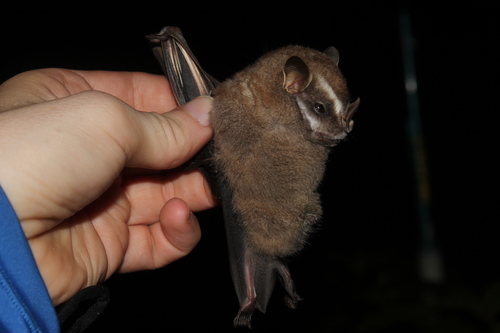
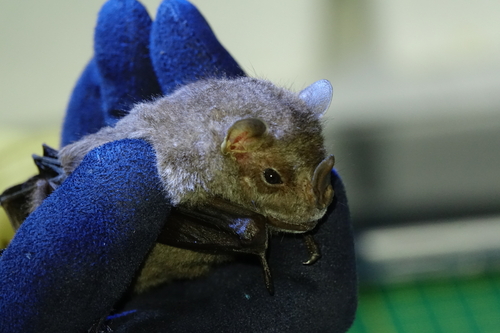
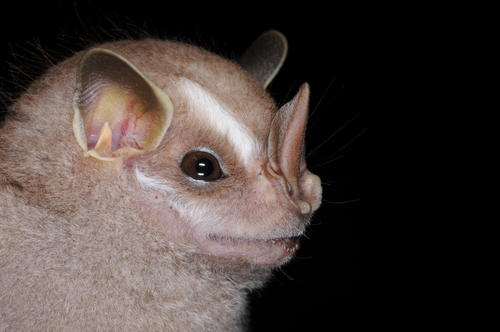
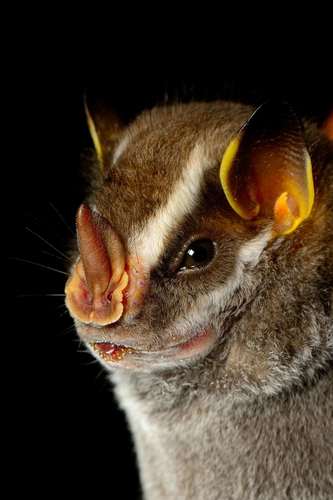
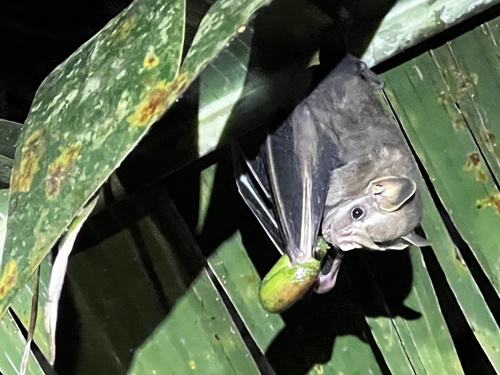
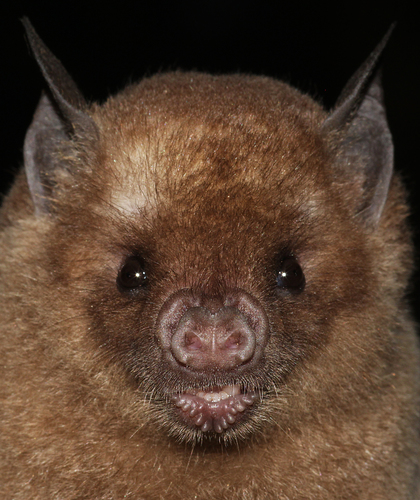
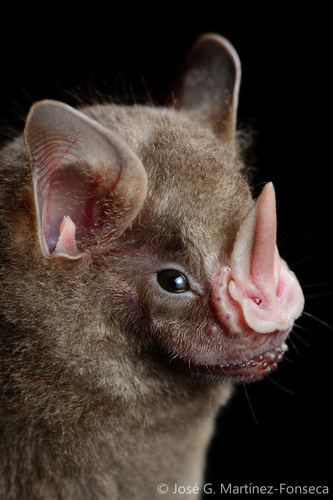
Fur is generally brownish to grayish-brown, with distinctive white or pale facial stripes running from the nose to behind the eyes. The species has a short, broad muzzle and a small nose leaf typical of phyllostomid bats.
Size
Forearm length ranges from approximately 42-48 mm; total body length is around 55-65 mm.
Weight
Typically weighs between 20-30 grams.
Distinctive features
Distinguished from other Chiroderma species by dental characteristics, size, and the pattern of facial stripes; the hairy appearance of the forearms and body gives rise to its common name.
Differences between males and females
Minimal sexual dimorphism; males and females are similar in size and appearance.
Behaviour and diet of the Hairy Big-eyed Bat
Generally roosts in small groups, though group sizes can vary; social structure within roosts is not well documented but may include mixed-sex clusters.
When it is active
Nocturnal, becoming active after dusk to forage for fruit and returning to roosts before dawn.
Diet
Primarily frugivorous, feeding on a variety of fruits from forest trees; may occasionally supplement diet with nectar or pollen.
How it feeds and hunts
Forages by flying through forest canopy and understory, using vision and possibly echolocation to locate ripe fruit; typically plucks fruit and carries it to a perch to feed.
Communication
Likely uses echolocation calls for navigation, along with social vocalizations within roosts; specific call structures are not well studied for this species.
Interactions with other species
Predators may include owls, other birds of prey, and some carnivorous mammals; the bat may compete with other frugivorous bat species for fruit resources.
Role in its ecosystem
Serves as an important seed disperser for various tropical fruiting plants, contributing to forest regeneration and plant diversity.
Reproduction and lifecycle
Breeding may occur seasonally or with some flexibility depending on fruit availability; gestation is estimated around 4-5 months, typical of phyllostomid bats, with usually a single offspring per birth.
Raising the young
Females carry and nurse a single pup, which clings to the mother initially; weaning occurs after several weeks, typical of similar-sized phyllostomid bats.
Maturity and lifespan
Sexual maturity is likely reached within the first year, similar to related species; lifespan in the wild is estimated at several years, though specific data are scarce.
Taxonomy and naming of the Hairy Big-eyed Bat
Classification
Class Mammalia > Order Chiroptera > Family Phyllostomidae > Genus Chiroderma > Species Chiroderma villosum
Subspecies
Several subspecies have been proposed (e.g., C. v. villosum, C. v. jesupi, C. v. gorgasi) though taxonomy remains debated; ranges roughly correspond to different portions of Central and South America.
Scientific synonyms
None widely recognized; the species has been consistently classified under Chiroderma villosum since its description by Peters in 1860.
What research says
Recent studies
Recent phylogenetic studies have helped clarify relationships within the genus Chiroderma, though species-specific behavioral studies remain limited.
Genome and DNA
Specific chromosome count and detailed genomic studies for this species are not well documented in accessible literature.
Compared with similar species
Similar to other Chiroderma species like C. salvini and C. doriae, but can be distinguished by size, dental characteristics, and facial stripe patterns.
The Hairy Big-eyed Bat and people
Despite its name, the bat's 'hairy' appearance refers to fine hairs on its forearms and body rather than being unusually furry overall. Its large eyes are unusual among bats, many of which rely more heavily on echolocation than vision.
Where and how to see it
Best observed at dusk in tropical forest habitats using fruiting trees as attractants; mist-netting studies by researchers often reveal this species in lowland forest sites in Central and South America.
Risks to humans
No notable risk; like other bats, it may carry pathogens but poses minimal direct threat to humans if not handled.
Countries where the Hairy Big-eyed Bat is recorded
The 13 countries named in the range description of its IUCN Red List assessment.
Questions about the Hairy Big-eyed Bat
Where does the Hairy Big-eyed Bat live?
The Hairy Big-eyed Bat is recorded in Belize, Bolivia, Brazil, Colombia and Costa Rica, among 13 countries in total across North America and South America. These countries come from the range description of its IUCN Red List assessment, and they are what place the species on the interactive map.
Is the Hairy Big-eyed Bat endangered?
The IUCN Red List assesses the Hairy Big-eyed Bat as Least Concern. The species is widespread and abundant enough not to qualify for any threatened category. It does not mean the species is safe forever, only that nothing in the current data raises an alarm.
How many are left in the wild?
Population size is not precisely quantified but is believed to be large and stable given its wide range and adaptability. This figure comes from the species assessment on the IUCN Red List; population estimates for wild mammals are ranges, not counts, and are revised at each assessment.
What habitat does the Hairy Big-eyed Bat live in?
Primarily found in tropical and subtropical moist lowland forests, but also occurs in secondary forests, forest edges, and sometimes agricultural areas with fruiting trees.
What is the scientific name of the Hairy Big-eyed Bat?
The Hairy Big-eyed Bat is Chiroderma villosum, in the family Phyllostomidae, order Chiroptera.
Other species in the genus Chiroderma
Other species in the family Phyllostomidae
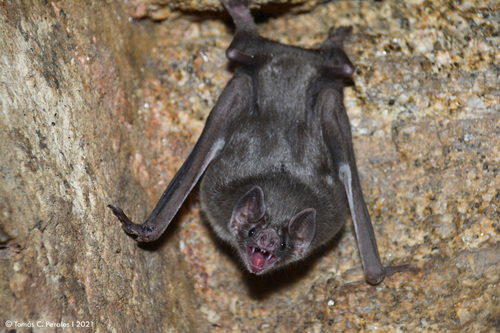
Species that share its range
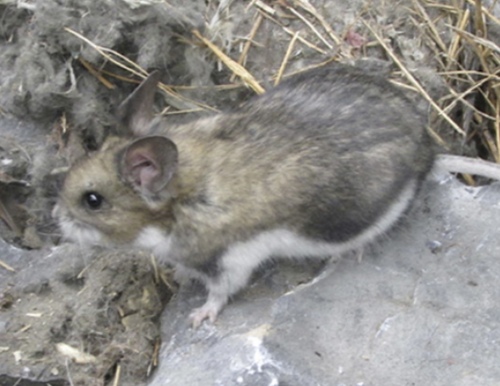
Sources
Conservation status, range description and population estimate come from the IUCN Red List assessment for Chiroderma villosum. Countries are derived from that range description, not from a mapped country list. Last refreshed on .
The distribution map is drawn from the IUCN Red List spatial data compiled in 2008. IUCN (International Union for Conservation of Nature)