
Guadeloupean Big-eyed Bat
Chiroderma improvisum
Red List assessment
Endangeredon the IUCN Red List
- EXExtinct
- EWExtinct in the Wild
- CRCritically Endangered
- ENEndangered
- VUVulnerable
- NTNear Threatened
- LCLeast Concern
The IUCN Red List assesses the Guadeloupean Big-eyed Bat as Endangered. Population size is unknown but presumed to be very small given the rarity of records; the overall trend is believed to be declining due to ongoing habitat degradation and natural disturbances.
- Family
- Phyllostomidae
- Order
- Chiroptera
- Genus
- Chiroderma
- Red List category
- Endangered
- Data updated
- August 9, 2026
What is the Guadeloupean Big-eyed Bat?
Chiroderma improvisum is a rare species of leaf-nosed bat endemic to a tiny range in the Lesser Antilles, known only from Guadeloupe and Montserrat. It is one of the least-studied bats in the Caribbean, with very few specimens ever recorded since its description in 1983. Its extremely restricted distribution and vulnerability to natural disasters make it a species of high conservation concern. It belongs to the frugivorous 'big-eyed bat' genus, characterized by relatively large eyes adapted for nocturnal fruit foraging.
Where does the Guadeloupean Big-eyed Bat live?
Lesser Antilles, specifically Guadeloupe and Montserrat
Restricted to two islands in the Lesser Antilles: Guadeloupe (including Basse-Terre) and Montserrat. This makes it one of the most geographically restricted bat species in the Caribbean region.
Altitude and depth
Approximately 0-600 meters above sea level, mainly in lowland to lower montane forest zones.
Seasonal movements
No known migratory behavior; likely exhibits some reproductive seasonality tied to fruiting seasons of local plants, though data are limited.
Habitat of the Guadeloupean Big-eyed Bat
Found in tropical moist forest and secondary forest habitats, often near fruiting trees at low to mid elevations. It appears to favor humid forest patches with dense canopy cover that provide roosting sites and food resources.
Adaptations to its environment
Possesses large eyes suited to low-light foraging in dense forest understory and canopy. Wing morphology is adapted for maneuverable flight in cluttered forest environments, aiding in navigation among vegetation while foraging for fruit.
Conservation status and numbers
Classified as Endangered (EN) by the IUCN due to its extremely small range, fragmented populations on only two islands, and susceptibility to catastrophic events such as hurricanes that can devastate its limited habitat and roosting sites.
Estimated population
Population size is unknown but presumed to be very small given the rarity of records; the overall trend is believed to be declining due to ongoing habitat degradation and natural disturbances.
What threatens the Guadeloupean Big-eyed Bat?
Primary threats include habitat loss from deforestation and agricultural expansion, hurricane damage (increasingly severe due to climate change), volcanic activity on Montserrat, and the inherently small population size which increases extinction risk from stochastic events.
What is being done to protect it?
Limited targeted conservation programs exist specifically for this species; general forest protection measures in Guadeloupe's national park system may provide incidental habitat protection. Montserrat's Centre Hills forest reserve offers some habitat safeguarding following volcanic disturbances.
Recommended actions
Priority actions include conducting comprehensive population surveys, protecting remaining forest habitat on both islands, monitoring roost sites, and developing island-specific conservation and disaster-response plans to buffer against hurricane and volcanic impacts.
What the Guadeloupean Big-eyed Bat looks like
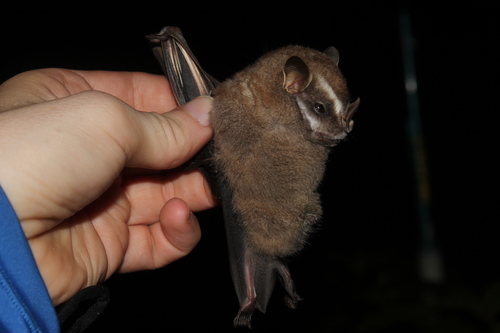
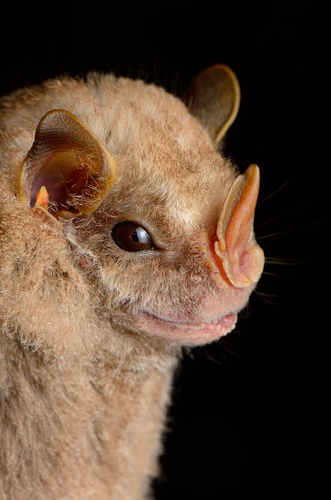
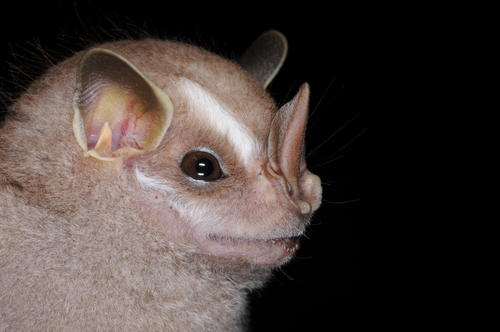
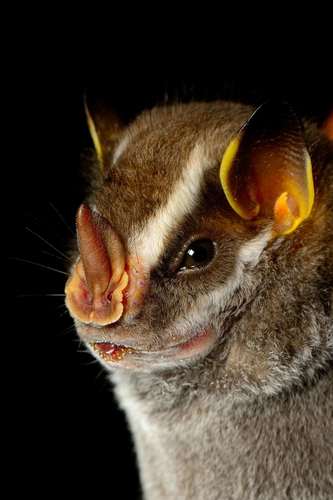
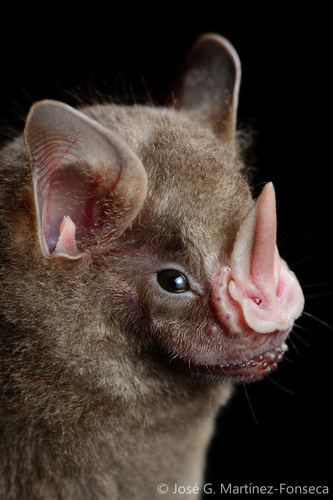
Fur is typically brownish-gray, with the genus characteristically showing faint pale dorsal stripes and large, prominent eyes. The nose leaf is well-developed, typical of phyllostomid bats, aiding in echolocation and possibly olfaction.
Size
Forearm length approximately 42-46 mm; body length is small, typical of the genus Chiroderma, roughly 6-7 cm excluding wings.
Weight
Estimated body weight around 15-20 grams, consistent with similarly sized Chiroderma species.
Distinctive features
Distinguished from congeners primarily through subtle skull and dental morphology differences, along with its unique restricted island distribution; field identification relies heavily on genetic or specialist morphological analysis.
Behaviour and diet of the Guadeloupean Big-eyed Bat
Likely roosts in small groups, as is typical for many Chiroderma species, though specific social structure data for this species are lacking due to its rarity.
When it is active
Nocturnal, active primarily at night when foraging for fruit and possibly nectar in forest habitats.
Diet
Primarily frugivorous, feeding on native forest fruits; may supplement diet with nectar or pollen from flowering trees, consistent with related Chiroderma species.
How it feeds and hunts
Forages by flying through forest canopy and understory, using echolocation combined with vision (aided by large eyes) to locate ripe fruit; likely uses a 'trap-line' foraging strategy visiting known fruiting trees repeatedly.
Communication
Likely communicates via echolocation calls for navigation and foraging, along with social vocalizations for roost-mate interactions, though specific studies on this species' calls are lacking.
Interactions with other species
May compete with other frugivorous bats on the islands for fruit resources; predators likely include birds of prey and possibly introduced mammalian predators such as rats or mongooses at roost sites.
Role in its ecosystem
Plays an important ecological role as a seed disperser and potentially a pollinator within its native forest ecosystem, contributing to forest regeneration and plant diversity.
Reproduction and lifecycle
Reproductive biology is poorly documented; presumably follows a pattern similar to related phyllostomids with possible seasonal birth peaks linked to fruit abundance, single offspring per breeding event.
Raising the young
Maternal care is expected to be the primary form of parental investment, with females carrying and nursing a single pup, typical of most bat species.
Maturity and lifespan
Specific data unavailable; related phyllostomid bats typically reach sexual maturity within one year and can live up to 10-15 years in the wild.
Taxonomy and naming of the Guadeloupean Big-eyed Bat
Classification
Class Mammalia > Order Chiroptera > Family Phyllostomidae > Genus Chiroderma > Species Chiroderma improvisum
What research says
Recent studies
Recent genetic and morphological studies have helped clarify taxonomic relationships within the genus Chiroderma, though species-specific research on C. improvisum remains scarce due to limited specimen availability.
Compared with similar species
Closely related to other Chiroderma species such as Chiroderma villosum and Chiroderma trinitatum, but distinguished by its unique island endemism and subtle cranial differences; overall similar in size and ecology to other small frugivorous phyllostomids.
The Guadeloupean Big-eyed Bat and people
This bat is known from only a handful of museum specimens, making it one of the rarest bats in the Caribbean; it was only formally described as a distinct species in 1983, highlighting how much remains unknown about Caribbean bat diversity.
Where and how to see it
Best observation opportunities, if any, would be in undisturbed forest patches of Basse-Terre, Guadeloupe, at night near fruiting trees; however, due to its rarity, sightings are exceptionally uncommon and specialized bat survey equipment would be required.
Risks to humans
No notable risk to humans; this species poses no threat as it is a small, harmless fruit-eating bat.
Questions about the Guadeloupean Big-eyed Bat
Is the Guadeloupean Big-eyed Bat endangered?
Yes. The IUCN Red List assesses the Guadeloupean Big-eyed Bat as Endangered, one of the three threatened categories. The species faces a very high risk of extinction in the wild — a step below Critically Endangered, but still on a trajectory that ends badly without intervention.
How many are left in the wild?
Population size is unknown but presumed to be very small given the rarity of records; the overall trend is believed to be declining due to ongoing habitat degradation and natural disturbances. This figure comes from the species assessment on the IUCN Red List; population estimates for wild mammals are ranges, not counts, and are revised at each assessment.
What habitat does the Guadeloupean Big-eyed Bat live in?
Found in tropical moist forest and secondary forest habitats, often near fruiting trees at low to mid elevations.
What is the scientific name of the Guadeloupean Big-eyed Bat?
The Guadeloupean Big-eyed Bat is Chiroderma improvisum, in the family Phyllostomidae, order Chiroptera.
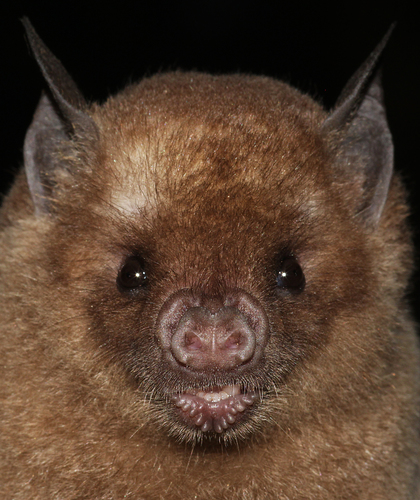
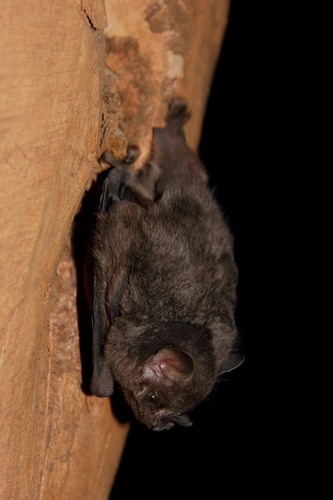
Other species in the genus Chiroderma
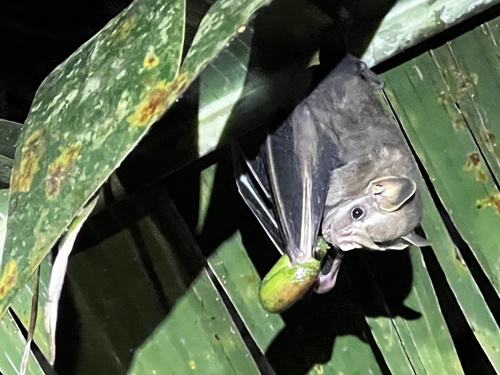
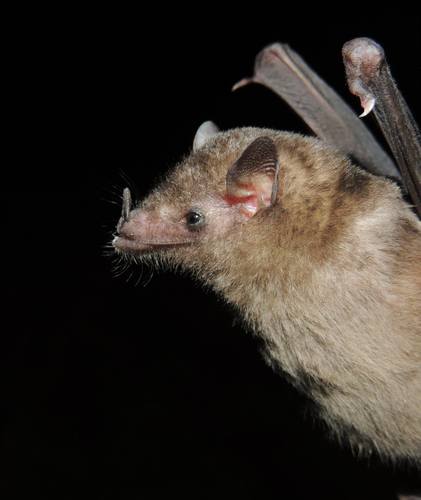
Other species in the family Phyllostomidae
Sources
Conservation status, range description and population estimate come from the IUCN Red List assessment for Chiroderma improvisum. Countries are derived from that range description, not from a mapped country list. Last refreshed on .
The distribution map is drawn from the IUCN Red List spatial data compiled in 2008. IUCN (International Union for Conservation of Nature)