
Northern Naked-tailed Armadillo
Cabassous centralis
Red List assessment
Least Concernon the IUCN Red List
- EXExtinct
- EWExtinct in the Wild
- CRCritically Endangered
- ENEndangered
- VUVulnerable
- NTNear Threatened
- LCLeast Concern
The Northern Naked-tailed Armadillo is recorded in 10 countries across North America and South America. The IUCN Red List assesses the Northern Naked-tailed Armadillo as Least Concern. No precise global population estimate exists, but the population trend is believed to be decreasing due to ongoing habitat degradation across its range
- Family
- Chlamyphoridae
- Order
- Cingulata
- Genus
- Cabassous
- Countries recorded
- 10
- Continents
- North America and South America
- Red List category
- Least Concern
- Data updated
- August 9, 2026
What is the Northern Naked-tailed Armadillo?
The Northern Naked-tailed Armadillo is a small, fossorial armadillo species found in the humid lowland forests of Central America. It is characterized by its distinctive nearly hairless tail lacking bony scutes, unlike most other armadillo species. This elusive, burrowing mammal spends much of its time underground and is rarely observed due to its nocturnal and secretive habits. It plays an important ecological role as an insectivore, particularly targeting ant and termite colonies.
Where does the Northern Naked-tailed Armadillo live?
Central America and northern South America, including Costa Rica, Honduras, Nicaragua, Panama, Colombia, and Venezuela
Ranges from southern Mexico through Central America (Guatemala, Belize, Honduras, El Salvador, Nicaragua, Costa Rica, Panama) into northern South America, including parts of Colombia and Venezuela. Distribution is patchy and closely tied to forest cover.
Altitude and depth
Sea level to approximately 1500 meters elevation, though most commonly found in lowland areas below 1000 meters
Habitat of the Northern Naked-tailed Armadillo
Primarily inhabits tropical and subtropical moist lowland forests, but can also be found in secondary forests, savannas, and agricultural areas with sufficient soil cover for burrowing. Prefers areas with loose, well-drained soil suitable for digging extensive burrow systems.
Adaptations to its environment
Possesses powerful front claws adapted for digging burrows and excavating ant/termite nests. The reduced tail armor and overall streamlined body shape facilitate movement through tunnels. Strong sense of smell compensates for poor eyesight in its underground and nocturnal lifestyle.
Conservation status and numbers
Listed as Least Concern (LC) by IUCN due to its relatively wide distribution across Central America, though populations are likely declining due to habitat loss. The species benefits from tolerance of some habitat disturbance and secondary forest use.
Estimated population
No precise global population estimate exists, but the population trend is believed to be decreasing due to ongoing habitat degradation across its range
What threatens the Northern Naked-tailed Armadillo?
Habitat loss and fragmentation due to deforestation for agriculture and cattle ranching represent the primary threat. Road mortality and occasional hunting for local consumption also impact populations in some regions.
Diseases and parasites
Limited specific data exists, though armadillos in general can carry various ectoparasites like ticks and mites, and some species are known reservoirs for Mycobacterium leprae (leprosy), though this is primarily documented in nine-banded armadillos.
What is being done to protect it?
Protected within several national parks and reserves throughout its range, including areas in Costa Rica and Panama. Benefits indirectly from broader tropical forest conservation initiatives in Central America.
Recommended actions
Increased research on population densities and habitat requirements, protection of remaining forest corridors, and monitoring of road mortality impacts. Public education to reduce incidental hunting would also benefit conservation.
What the Northern Naked-tailed Armadillo looks like
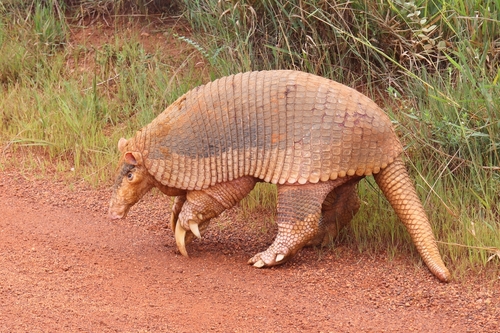
Covered in a bony carapace divided into movable bands, typically brownish to grayish in color, with sparse hair visible between the scutes. The tail is notably naked, lacking the bony rings found in most other armadillo species, giving the species its common name.
Size
Body length typically ranges from 30 to 45 cm, with an additional tail length of 15-20 cm
Weight
Adults typically weigh between 2.5 to 3.5 kg, with minimal difference between sexes
Distinctive features
Distinguished from other Cabassous species by subtle differences in scute count and skull morphology, and from other armadillo genera by its distinctly naked, scale-free tail. Has fewer than 13 movable bands on its carapace compared to related species.
Behaviour and diet of the Northern Naked-tailed Armadillo
Solitary animals that only associate briefly during breeding season. Individuals maintain separate burrow systems and show minimal social interaction outside of mating.
When it is active
Primarily nocturnal, emerging from burrows at night to forage, though can occasionally be active during crepuscular hours. Spends significant daytime hours resting in underground burrows.
Diet
Insectivorous diet consisting mainly of ants and termites, supplemented occasionally with other invertebrates like beetle larvae and worms. Uses powerful claws to break into insect colonies and a long sticky tongue to extract prey.
How it feeds and hunts
Locates insect colonies primarily through smell, then uses strong forelimb claws to dig into ant and termite nests. Extracts prey using a long, sticky tongue adapted for capturing small insects within tunnels.
Communication
Communication methods are poorly studied but likely include scent marking of burrows and territories, as is common among fossorial mammals. Limited vocalization has been documented.
Interactions with other species
Natural predators likely include large cats such as jaguars and pumas, as well as large raptors and snakes capable of catching them near burrow entrances. Burrows may be used secondarily by other small animals after abandonment.
Role in its ecosystem
Functions as an important insectivore controlling ant and termite populations within its forest ecosystem. Burrowing activity also contributes to soil aeration and nutrient cycling in tropical forest floors.
Reproduction and lifecycle
Breeding season and specific reproductive timing are not well documented, though gestation is estimated at around 4 months. Females typically give birth to a single offspring per litter.
Raising the young
Limited data exists on parental care, but as with related armadillo species, the mother likely provides sole care for the single offspring, nursing it within the burrow until weaning.
Maturity and lifespan
Age of sexual maturity is not well documented but is estimated at around 1-2 years based on related species. Lifespan in the wild is unknown, though captive individuals of related armadillo species can live 10-15 years.
Taxonomy and naming of the Northern Naked-tailed Armadillo
Classification
Mammalia > Cingulata > Chlamyphoridae > Cabassous > Cabassous centralis
Scientific synonyms
Cabassous hoplophorus, Tatusia centralis
What research says
Recent studies
Recent camera trap studies in Costa Rica and Panama have provided new insights into activity patterns and habitat use of this elusive species. Genetic studies continue to clarify taxonomic relationships within the Cabassous genus.
Compared with similar species
Similar to other Cabassous species like the Greater Naked-tailed Armadillo (C. tatouay) but generally smaller in size with a more restricted Central American range. Distinguished from nine-banded armadillos (Dasypus novemcinctus) by its naked tail and fewer movable bands.
The Northern Naked-tailed Armadillo and people
Despite being called 'naked-tailed,' the tail actually retains a thin layer of skin without bony plates, unlike the rest of its armored body. This species is so secretive that it was rarely photographed in the wild until camera trap technology became widespread in recent decades.
Where and how to see it
Best observed through camera trap footage or guided night tours in protected forests of Costa Rica or Panama, as direct sightings are extremely rare due to its nocturnal and fossorial habits. Look for fresh burrow entrances and diggings near ant or termite mounds as indirect signs of presence.
Risks to humans
No notable risk to humans as this species is shy, non-aggressive, and avoids human contact
Human uses
Occasionally hunted for bushmeat by local communities in parts of its range, though this is not widespread. No significant commercial trade or traditional medicine use has been documented.
Countries where the Northern Naked-tailed Armadillo is recorded
The 10 countries named in the range description of its IUCN Red List assessment.
Questions about the Northern Naked-tailed Armadillo
Where does the Northern Naked-tailed Armadillo live?
The Northern Naked-tailed Armadillo is recorded in Belize, Colombia, Costa Rica, El Salvador and Guatemala, among 10 countries in total across North America and South America. These countries come from the range description of its IUCN Red List assessment, and they are what place the species on the interactive map.
Is the Northern Naked-tailed Armadillo endangered?
The IUCN Red List assesses the Northern Naked-tailed Armadillo as Least Concern. The species is widespread and abundant enough not to qualify for any threatened category. It does not mean the species is safe forever, only that nothing in the current data raises an alarm.
How many are left in the wild?
No precise global population estimate exists, but the population trend is believed to be decreasing due to ongoing habitat degradation across its range This figure comes from the species assessment on the IUCN Red List; population estimates for wild mammals are ranges, not counts, and are revised at each assessment.
What habitat does the Northern Naked-tailed Armadillo live in?
Primarily inhabits tropical and subtropical moist lowland forests, but can also be found in secondary forests, savannas, and agricultural areas with sufficient soil cover for burrowing.
What is the scientific name of the Northern Naked-tailed Armadillo?
The Northern Naked-tailed Armadillo is Cabassous centralis, in the family Chlamyphoridae, order Cingulata.
Other species in the genus Cabassous
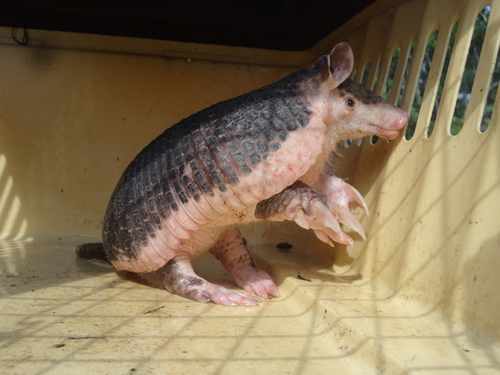
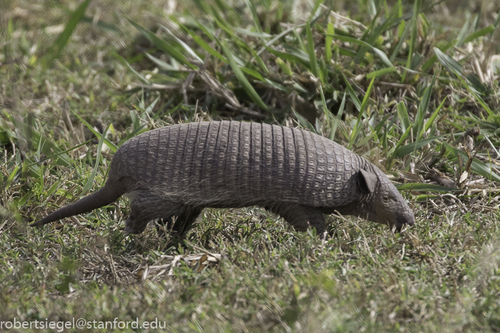
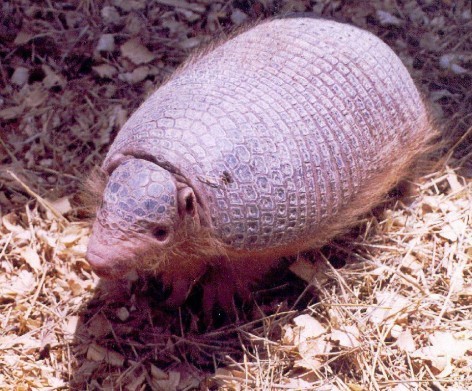
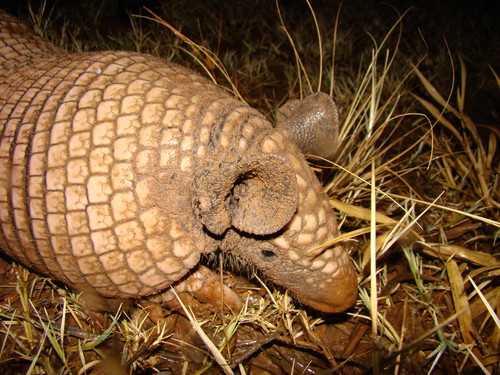
Other species in the family Chlamyphoridae
Species that share its range
Sources
Conservation status, range description and population estimate come from the IUCN Red List assessment for Cabassous centralis. Countries are derived from that range description, not from a mapped country list. Last refreshed on .
The distribution map is drawn from the IUCN Red List spatial data compiled in 2024. IUCN (International Union for Conservation of Nature)